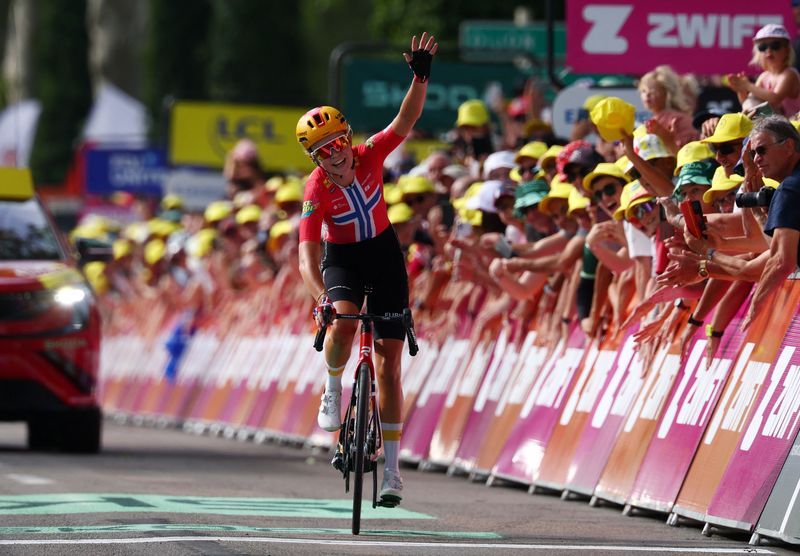
In a landmark moment for Nordic cycling, Norwegian rider Sigrid Haugset powered to a commanding solo victory on Monday's mountain stage of the Tour de France Femmes, making history as the first competitor from her country to win on this prestigious platform. The 27-year-old Uno-X Mobility rider's triumph came with particular significance as she simultaneously claimed the coveted yellow jersey, edging out defending leader Lorena Wiebes of the Netherlands and becoming the first Norwegian ever to hold the overall classification in the women's version of cycling's most celebrated race.
Haugset's dominance on the 156.5-kilometre route proved decisive in the undulating terrain as she pulled clear during the climb to Col de la Savine and maintained her advantage through relentless pursuit from Belgian challenger Lotte Kopecky, who finished a distant one minute and 24 seconds adrift. Marianne Vos of the Netherlands completed the podium positions in third place at the Poligny finish. The Norwegian's remarkable performance has established a commanding two-minute-and-22-second buffer over Kimberly Le Court of Mauritius heading into the subsequent stages, suggesting a potential coronation looms should she maintain form and avoid the inevitable tactical attacks from her rivals.
The emotional weight of her achievement appeared to overwhelm Haugset as she reflected on the outcome in the immediate aftermath. Struggling to articulate the magnitude of her success, she acknowledged the surreal nature of breaking through such a significant barrier in professional cycling. Her candid admission that she never anticipated reaching such heights underscores the genuine astonishment many observers felt witnessing a Norwegian female cyclist claim this particular stage, a development that will reverberate throughout Scandinavian cycling communities and inspire future generations of competitors from the region.
Throughout the demanding ascent, Haugset demonstrated the psychological resilience required at the sport's highest level. As the Belgian challenger methodically closed the gap in the final kilometres, the Norwegian confronted an internal battle between accepting a strong second-place finish and pushing through mounting physical fatigue to claim outright victory. Her recollection of supporters back home proved decisive in her mental calculus, providing the emotional fuel necessary to repel Kopecky's fierce challenge and secure the stage win that had previously eluded all Norwegian women cyclists on this stage.
The stage itself delivered considerable drama even before Haugset's decisive breakaway altered the race complexion. As the peloton navigated its first encounter with serious climbing through the Col de la Faucille categorized as a first-category ascent, multiple riders found themselves scattered across the tarmac following a significant crash that claimed both reigning world champion Magdeleine Vallieres and former Tour de France winner Demi Vollering. The incident created momentary confusion across the field, yet immediate remounting by all involved riders prevented any lasting fracturing of the main bunch, with the peloton maintaining cohesion through the remainder of the 11.4-kilometre climb.
Haugset's aggressive manoeuvre commenced during the subsequent Col de la Savine climb, where she unleashed her superior climbing ability and established the separation that would define the remainder of the afternoon's racing. Kopecky's response came within reasonable time and the Belgian mounted a determined pursuit, closing to within striking distance as the race transitioned into France proper. Yet despite her best efforts, Kopecky could not bridge the expanding gap as Haugset demonstrated superior endurance through the middle kilometres when fatigue typically sets in.
The classification picture shifted dramatically as a consequence of Haugset's dominance. Outgoing yellow jersey holder Wiebes trailed the eventual winner by 13 minutes entering the final 20 kilometres, having proved incapable of matching the pace established higher up the general classification hierarchy. Le Court and Vollering, who had occupied the second and third overall positions before this stage, circulated within the main peloton more than two minutes adrift of the primary breakaway protagonists, their challenge to the race leadership effectively neutralized through a combination of tactical positioning and the demands of hilly terrain.
Haugset's resolve intensified precisely when accumulated effort might typically precipitate a decline in performance. As Kopecky relentlessly pursued, reducing her deficit to just ten seconds with ten kilometres remaining, the Norwegian discovered additional reserves of strength and motivation that catapulted her toward victory. The decisive moment arrived with three kilometres to traverse, when Haugset orchestrated an acceleration that definitively distanced Kopecky and rendered further Belgian resistance futile. The manner of victory underscored her complete superiority on this particular day, with the Norwegian demonstrating the combination of tactical acumen, physical capability, and mental fortitude that characterizes the finest professional cyclists.
The unusual sight of Haugset crossing the finish line without the typical celebratory flourishes provided a revealing glimpse into the genuine physical exertion this victory demanded. Her sheepish acknowledgement that her biceps remained incapable of supporting even the basic arm movements required for celebration served as an unfiltered testament to the intensity of her effort. The comment delivered with characteristic Nordic humour suggested an awareness that observers back in Norway, particularly her boyfriend, might scrutinize the seeming restraint—even as her exhaustion rendered anything beyond basic forward propulsion physiologically impossible during those final metres.
For Malaysian and Southeast Asian cycling enthusiasts observing the Tour de France Femmes, this stage provides instructive lessons regarding sustained performance on mountainous terrain and the decisive role that mental resilience plays in professional cycling. Haugset's refusal to accept a secondary outcome despite the mounting physical toll illustrates the distinction between competent cyclists and champions. Her breakthrough carries broader implications for smaller cycling nations seeking to establish presence at sport's highest levels, suggesting that strategic investment in elite talent development can yield results regardless of a nation's historical cycling prominence.

