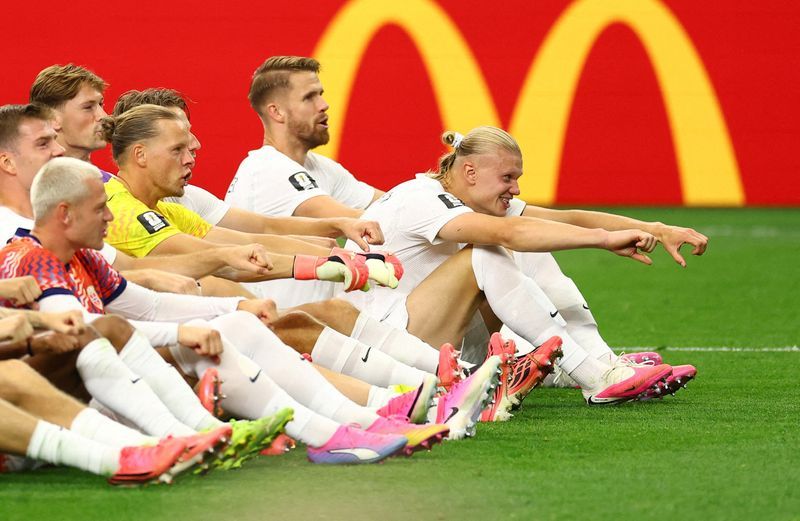
Norway's storybook return to the World Cup stage concluded in Miami on Saturday, when England's Jude Bellingham struck twice in extra time to eliminate the Nordic side 2-1 in their quarter-final encounter. The result ended what has been a transformative tournament for the Norwegians, who came into the competition having spent nearly three decades in the international wilderness, absent from any World Cup since 1998. Yet despite the pain of this exit, the Scandinavian nation departs with its reputation substantially enhanced and a newfound confidence that its football culture has genuinely evolved.
Manager Stale Solbakken's squad captured global imagination through a combination of sporting excellence and theatrical flair that transcended the pitch itself. Before the tournament commenced, the Norwegian contingent participated in a photoshoot deliberately styled around their Viking ancestors, a nod to their seafaring heritage that would eventually become central to the side's romantic narrative throughout the competition. This self-aware celebration of national identity resonated powerfully with supporters and neutrals alike, transforming what might have been merely another returning underdog story into something altogether more culturally significant and engaging for international audiences.
The campaign's trajectory was one of progressive ambition realised. Norway navigated their group stage with the efficiency expected of a team boasting Erling Haaland's goal-scoring prowess, before dispatching Ivory Coast 2-1 in the last 32 round, with Haaland himself providing a decisive brace. This victory opened the possibility of something greater, an opportunity to test themselves against elite competition. What followed exceeded even the most optimistic projections when Norway achieved a 2-1 triumph over Brazil, the tournament's defending champions and one of world football's perennial superpowers. That victory sent supporters and media observers into rapturous celebration, daring to imagine an improbable journey to the semi-finals or beyond.
The Norwegian supporters created one of the tournament's most recognisable and enduring images through their "Viking row" celebration, a coordinated spectacle that became synonymous with the nation's run and earned admiration from rival fans across the competition. Even American spectators, typically more reserved in their enthusiasms around foreign football cultures, found themselves charmed by Haaland's towering presence and his deliberately tongue-in-cheek humour, which humanised the otherwise intimidating talent he displayed in the penalty area. This cultural penetration of the global tournament underscores how Norway transcended mere sporting achievement to become a talking point across multiple dimensions of the World Cup experience.
Yet the physical and mental demands of consecutive knockout victories against high-calibre opponents finally extracted their toll. Against England, despite establishing a one-goal advantage, Norway's energy gradually dissipated as the match extended beyond regulation time. Both Haaland and captain Martin Odegaard, the twin pillars around whom Solbakken's tactical approach revolves, visibly tired as the contest progressed into extra periods. Bellingham's clinical finishing capitalised on this fatigue, allowing England to overturn the deficit and progress to their semi-final appointment. The loss, while undoubtedly disappointing, neither diminishes what Norway achieved nor fundamentally undermines the structural improvements evident in their performance across the tournament.
The Solbakken era has fundamentally recalibrated expectations around Norwegian football's potential. Where the nation once laboured under the unflattering reputation as a fundamentally unsophisticated outfit reliant on physical intensity and direct play, contemporary Norwegian teams exhibit technical competence and tactical intelligence. The domestic success of clubs like Bodø/Glimt in recent European competition seasons provides tangible evidence that Norway's football infrastructure now produces players capable of competing against elite European opposition. This improvement flows directly from systemic development within the country's academy and club structures, suggesting that the World Cup appearance represents not an isolated achievement but rather the natural progression of an evolving footballing nation.
Solbakken himself embodied this transformed Norwegian approach through his characteristically understated assessment of the campaign. When asked to reflect on Norway's tournament, he offered the wry observation that "when some time passes in a week or two, everyone will be able to agree that the summer of '26 has been fairly OK"—a masterclass in Scandinavian understatement that nonetheless acknowledged the significance of what his squad accomplished. This capacity for self-deprecating humour whilst maintaining absolute seriousness about competitive objectives characterises the personality evident throughout the Norwegian delegation, from the manager through to his players.
The collective composure displayed by Solbakken, Odegaard, and Haaland throughout the tournament reflected something deeper than mere professional competence. These three individuals project the kind of understated confidence synonymous with Norwegian national character: entirely comfortable with international scrutiny, never afraid to laugh at themselves, yet utterly uncompromising when it comes to the serious business of competing for trophies. This temperament filters through the squad, creating an environment where players approach matches against the world's elite without the self-doubt that sometimes paralyses smaller footballing nations.
Looking forward, the psychological impact of this World Cup return may prove as significant as the tournament itself. Solbakken suggested that his players have genuinely absorbed the experience of competing successfully against the world's best teams, fundamentally altering their self-perception and belief in what they can achieve. This elevation of confidence extends beyond Haaland and Odegaard; numerous squad members now harbour legitimate convictions about their capacity to operate at the highest levels of international football. For Malaysian and Southeast Asian football observers, Norway's transformation offers an instructive case study in how systemic development, astute management, and patient cultivation of talent can rehabilitate a nation's football standing after extended periods of absence from major competitions.
The memory of this tournament will evolve as time passes. Initial disappointment surrounding the England defeat will gradually recede, permitting supporters and analysts to appreciate the genuine progress represented by Norway's return and performance. The fairytale may have concluded prematurely by the standards of romantic narrative, but the broader story of Norwegian football's resurgence—characterised by the Viking imagery, Haaland's clinical finishing, and the team's collective poise—will endure as a defining moment in contemporary Scandinavian sport. For a nation absent from the World Cup for 28 years, the journey itself constitutes an achievement that transcends the scoreline that ended it.

