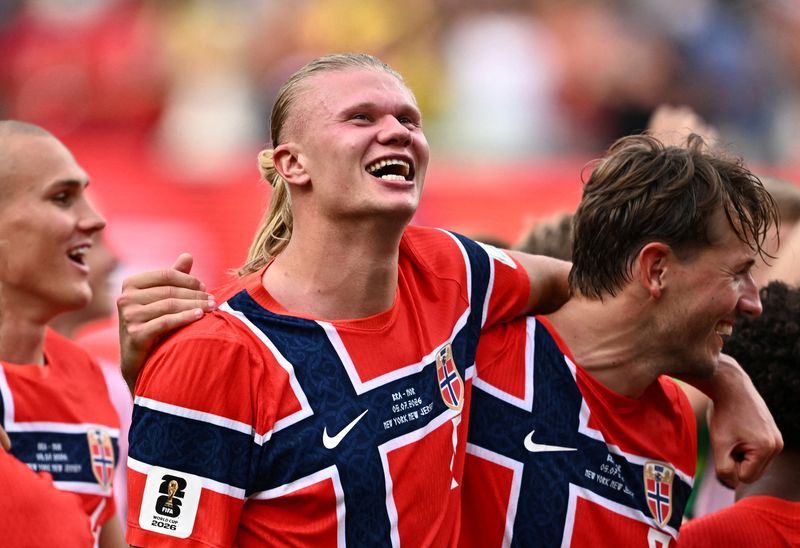
Norway's football faithful descended upon the capital in unprecedented numbers on Sunday following their national team's dramatic 2-1 victory over Brazil at the World Cup, a triumph that secured the Scandinavian nation a berth in the quarter-finals for the first time. The achievement sparked scenes of unbridled jubilation across Oslo, with police estimating that more than 90,000 supporters converged on the city centre to mark what many described as one of the most significant moments in the country's sporting heritage.
The scale of the spontaneous celebrations underscored how deeply the victory resonated with the Norwegian public. Beyond the downtown streets, tens of thousands more assembled outside Ullevaal stadium, the traditional home of Norwegian football, where giant screens had been erected to allow supporters to follow the match in real time. Clustered around long communal tables and benches, the gathered crowds erupted in unison as the final whistle sounded, their euphoria expressed through cascading drinks flung skyward in the jubilant chaos that followed.
Erling Haaland, the standout performer whose decisive double secured the win, emerged as the focal point of the national celebration. The forward's brace represented not merely a personal achievement but a symbol of Norway's capacity to compete on the world's biggest stage against one of football's traditional powerhouses. Reflecting on the magnitude of the moment, Haaland encapsulated the collective sentiment when he remarked that the entire nation deserved to savour what he termed "one of the sickest days ever in Norwegian history."
The celebrations at Ullevaal quickly assumed a distinctive character, with supporters replicating the rowing gesture that had become Haaland's signature celebration during the match. What had begun on the pitch as an individual expression of joy transformed into a mass phenomenon as thousands adopted the motion in the streets and public squares, turning it into a shared ritual of national pride. This spontaneous choreography served to unify disparate groups of supporters in a common expression of belonging and shared purpose.
As darkness fell and fireworks illuminated the Oslo sky, the celebration took on an almost ceremonial dimension. The crowd, energised by the pyrotechnics and mounting collective excitement, spontaneously chanted their intention to march toward the royal palace. This organic decision to converge at the seat of Norwegian monarchy reflected a broader impulse to involve the nation's symbolic leadership in the moment of triumph.
The procession proved symbolically significant when Crown Prince Haakon emerged from the palace to acknowledge the assembled supporters, draped in a Norway football scarf that served as both a gesture of solidarity with the jubilant crowd and a tangible symbol of the monarchy's identification with national sporting achievement. The image of the heir to the throne mingling with ordinary citizens united by football victory encapsulated the democratic and inclusive spirit that the win had unleashed across Norwegian society.
For a nation of roughly 5.5 million people, the quarter-final appearance represented a watershed moment in football consciousness. Norway has long punched above its weight in international sport, but sustained success at the World Cup level had remained elusive until this breakthrough performance. The victory over Brazil, a nation with an unparalleled tradition of football excellence, carried particular symbolic weight, suggesting that Norwegian football had reached a new competitive threshold.
The technical aspects of the achievement warrant consideration alongside the celebratory scenes. Defeating Brazil demands not merely luck but tactical organisation, clinical finishing, and psychological resilience. Haaland's double demonstrated the individual quality that Norway possesses, yet the team's ability to contain one of world football's most attacking-minded nations indicated structural improvements in Norwegian football's development pathway. Coach Stale Solbakken's tactical acumen had proven effective against a high-calibre opponent, validating the strategic direction of the national program.
The quarter-final draw would pit Norway against the winner of the concurrent England versus Mexico fixture, a matchup that promised further intrigue and opportunity. Whether against England's traditional strengths or Mexico's tactical discipline, Norway's advancement fundamentally altered perceptions of the team's capacity to compete among elite international sides. The quarter-final stage itself represents uncharted territory for contemporary Norwegian football, creating both opportunity and uncertainty about whether the momentum generated by the Brazil victory could be sustained.
The spontaneous nature of the celebrations, devoid of corporate sponsorship or manufactured pageantry, reflected authentic popular emotion. Ordinary Norwegians had organised themselves into a collective expression of joy and national identity, creating scenes that transcended sport to speak to deeper notions of shared community and common purpose. In an era when football sometimes struggles to unite rather than divide, Norway's celebrations offered a reminder of sport's capacity to forge genuine bonds across social boundaries.
The psychological impact of such a victory extends beyond immediate euphoria into the realm of collective confidence and national aspiration. Norway's football community, from the youngest academy players to veteran supporters, would carry forward the knowledge that their nation could compete with and defeat the world's traditional powerhouses. This confidence might prove instrumental if the team were to progress further in the tournament, as belief often proves as decisive as technical quality in determining outcomes at elite levels of international competition.

