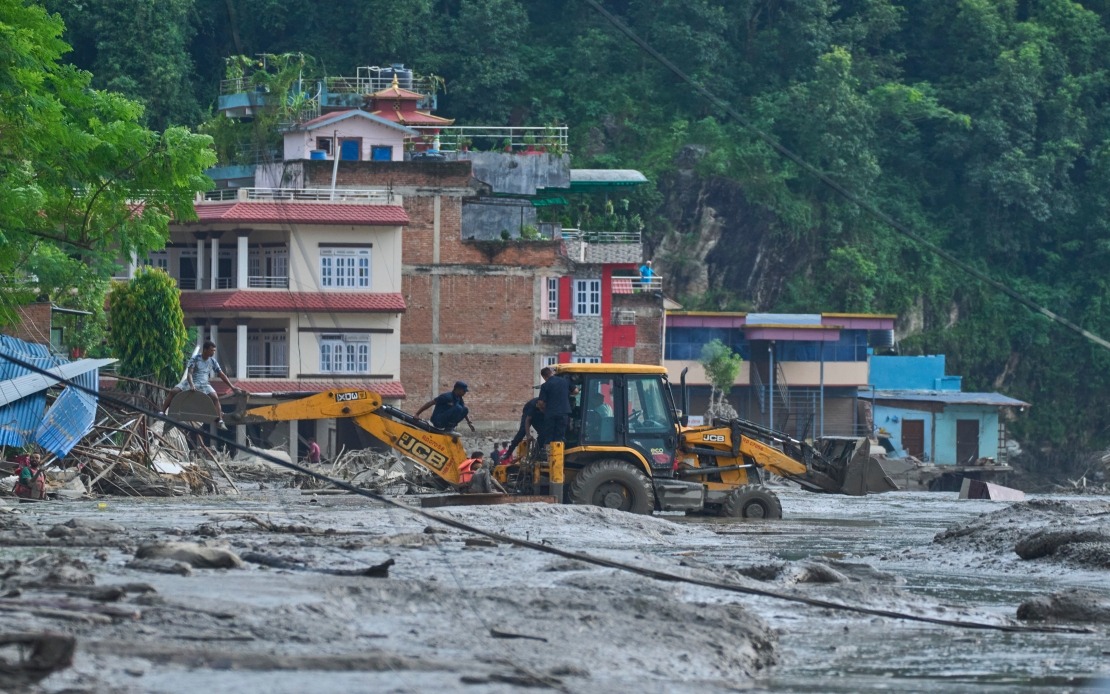
Nine South Korean nationals have vanished in the aftermath of catastrophic flooding that swept through Nepal's Rasuwa district on Wednesday, prompting Seoul's government to launch an immediate crisis response. The missing workers comprised six employees of Doosan Enerbility Co., an industrial plant construction firm, and three from Korea South-East Power Co., the country's state-owned power generation enterprise. All nine were stationed at a hydroelectric power plant construction site when the disaster struck, leaving authorities scrambling to locate them amid challenging terrain and ongoing weather conditions.
The scale of destruction across the Nepal-Tibet border region has proven severe, with international media reporting over 160 deaths and hundreds more unaccounted for, predominantly foreign nationals engaged in various development projects. The flooding represents one of the region's most significant recent natural disasters, overwhelming local rescue capacity and prompting international intervention. For Malaysia and other Southeast Asian nations with workers deployed across the subcontinent, the incident underscores the vulnerability of expatriate labour forces operating in geologically unstable areas during monsoon season.
Beyond the nine missing personnel, South Korea confirmed that ten other Doosan workers who had been trapped in the affected zone are now safe, though they remained stranded and awaiting formal evacuation. These individuals were among approximately 200 foreign employees who managed to flee the construction site as floodwaters surged. Their survival highlights the chaotic and unpredictable nature of such natural disasters, where proximity to evacuation routes and timing proved critical differences between safety and catastrophe.
Recognizing the gravity of the situation, South Korea's Foreign Ministry announced plans to deploy a specialized joint rapid response team directly to Nepal on Thursday. This multi-agency contingent would include representatives from the foreign ministry, national police force, and fire service authorities, coordinating efforts from Kathmandu and establishing direct liaison with Nepalese counterparts. The mobilization reflects Seoul's commitment to leveraging diplomatic channels and professional expertise to maximize chances of locating and rescuing its nationals.
President Lee Jae Myung issued explicit directives to government agencies to exhaust all available resources in the search and rescue mission. Foreign Minister Cho Hyun subsequently chaired an emergency response meeting, outlining comprehensive objectives encompassing immediate rescue efforts, ongoing support for affected families, protection of remaining South Korean citizens in Nepal, and preventive measures against additional casualties. These coordinated priorities demonstrate how governments balance immediate crisis management with longer-term diplomatic and welfare considerations.
Foreign Minister Cho pledged direct engagement with Nepal's foreign ministry to secure governmental cooperation and accelerate access to disaster zones. Such high-level diplomatic communication proves essential in international rescue operations, where jurisdictional authority, resource allocation, and information sharing require formal coordination between nations. The willingness of Seoul's top diplomatic official to personally champion the cause signals both the importance South Korea places on protecting its overseas workforce and the political sensitivity surrounding national citizens in distress abroad.
Parallel to governmental action, both Doosan Enerbility and Korea South-East Power established internal emergency response mechanisms and mobilized their own field teams toward the accident site. Corporate responsibility in such circumstances extends beyond standard disaster protocols, as companies operating in high-risk environments must demonstrate commitment to employee welfare and participate actively in rescue coordination. This public-private partnership approach amplifies overall rescue capacity when state resources face constraints.
The hydroelectric power project in Rasuwa district represented significant infrastructure development work, part of broader South Korean industrial engagement across South Asia. Such ventures carry inherent risks, particularly in regions prone to seasonal flooding and characterized by challenging topography. The incident will likely prompt reassessment of workplace safety protocols for Korean companies operating in Nepal and comparable environments, with implications for project scheduling, insurance requirements, and employee deployment policies throughout the region.
For Malaysian readers, this crisis carries particular resonance given the substantial Malaysian presence across South Asia in construction, manufacturing, and service sectors. The incident illustrates how swiftly natural disasters can transform routine work assignments into life-threatening emergencies, regardless of corporate size or project scale. Malaysian businesses and government agencies managing overseas operations should recognize that even well-established companies like Doosan cannot fully insulate their workers from environmental risks inherent to frontier development projects.
The broader geopolitical dimension involves how Southeast Asian nations coordinate with their South Asian neighbours during cross-border crises. Nepal's capacity to manage disaster response, particularly when handling foreign nationals, remains constrained by limited resources and infrastructure challenges. South Korea's rapid mobilization demonstrates how developed nations can supplement host country capabilities, though such assistance requires diplomatic finesse and institutional cooperation. Malaysia's own experiences with regional disasters suggest that establishing pre-arranged protocols for emergency worker support could significantly improve outcomes during future incidents.
The humanitarian dimension demands attention as families of the missing workers await news from Nepal. Government support extends beyond rescue operations to encompassing emotional and practical assistance for relatives facing uncertainty and potential tragedy. The precedent set by Seoul's response will likely inform how other nations approach similar situations, potentially establishing informal standards for diplomatic engagement during international workplace disasters.
As recovery efforts continue, the incident will generate important lessons regarding workplace safety in high-risk environments, early warning systems for hydroelectric installations, and emergency preparedness protocols across South Asian development projects. For companies and governments across Southeast Asia managing workers in comparable settings, this tragedy serves as an urgent reminder that even routine infrastructure projects demand rigorous safety planning and rapid response capabilities.

