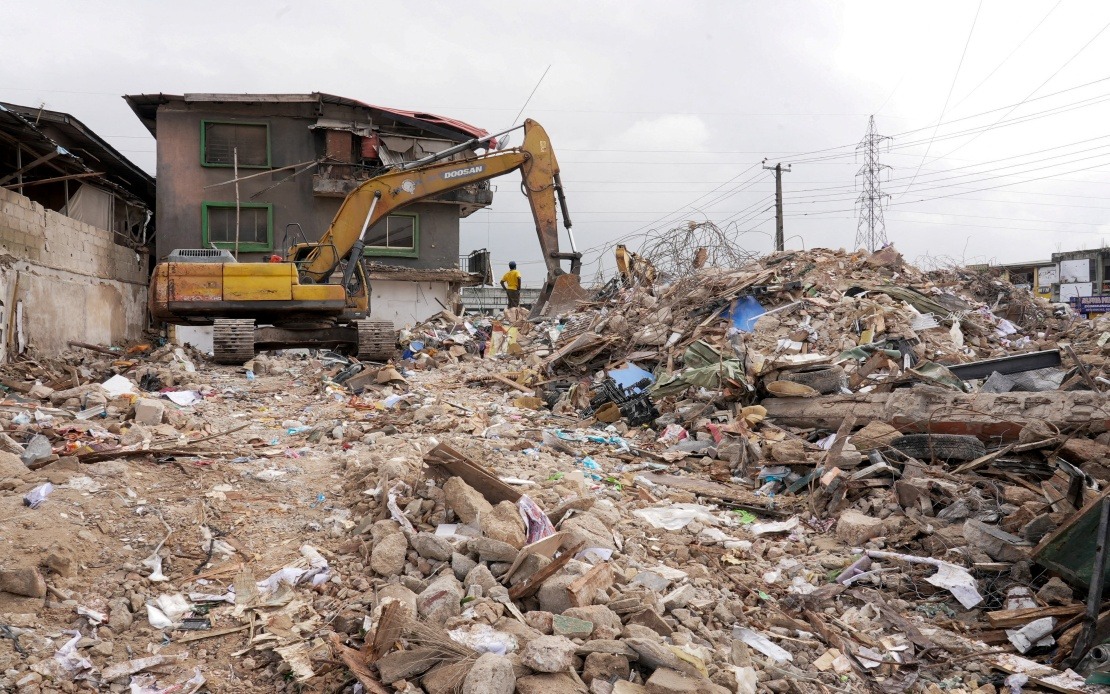
A three-storey shopping complex in the Alakija area of Lagos, Nigeria came down on Thursday morning, claiming nine lives and prompting an intensive rescue effort that extended into Friday. Emergency teams managed to pull 27 people alive from beneath the rubble of the structure, which sits along the busy Lagos-Badagry Expressway in the southwestern state. The multi-agency response, coordinated by the Lagos State Emergency Management Agency, demonstrated the scale of the incident and its impact on a densely populated commercial zone.
Rescue operations began immediately following the Thursday morning collapse, with teams working continuously throughout the night and into Friday to locate and retrieve trapped individuals. Olufemi Oke-Osanyintolu, permanent secretary of the Lagos State Emergency Management Agency, confirmed that all accessible victims had been evacuated by Friday morning, marking the formal conclusion of the search-and-rescue phase. The rescued individuals sustained injuries ranging from minor to severe, with all transported to medical facilities for treatment and assessment.
The victims were primarily shop owners and their customers engaged in routine commercial activities when the structure gave way. The shopping complex had evidently been in active use, with morning business operations already underway at the time of collapse. Additionally, some nearby residents became trapped, expanding the pool of those requiring rescue beyond those directly working in the commercial space. The mixed composition of victims underscores how structural failures in densely occupied urban areas can affect multiple segments of the community simultaneously.
The China Civil Engineering Construction Corporation, which operates a railway development project in the surrounding area, mobilized its resources to support rescue efforts. Their involvement reflected both the proximity of their operations and the broader reality that major infrastructure projects often position companies to respond to local emergencies. The participation of multiple agencies and private contractors illustrates how Nigerian authorities manage large-scale disaster responses, particularly when communities are caught in sudden building failures.
At this stage, authorities have not determined what caused the three-storey structure to collapse. An official investigation has been initiated to establish the underlying factors, with findings expected to inform future safety protocols and potential prosecutions if negligence or violations are discovered. The uncertainty surrounding the cause reflects a pattern seen in similar incidents across Nigeria, where determining responsibility often proves complex and protracted.
Building collapses represent an ongoing challenge across Nigeria, particularly in rapidly urbanizing regions like Lagos where construction demand outpaces regulatory oversight. Engineering experts and safety analysts have long pointed to several interconnected factors driving these catastrophic failures. Aging infrastructure that has not been properly maintained or reinforced constitutes one major risk category, particularly in informal settlements and older commercial districts where buildings have not undergone structural assessment in decades.
Violations of building codes and construction regulations compound the problem considerably. Developers seeking to maximize profits often cut corners on safety measures, use substandard materials, or add unauthorized storeys beyond original design parameters. Bribery and weak enforcement of regulations in some jurisdictions allow non-compliant structures to be completed and occupied without proper inspection. The pressure to develop quickly in high-demand urban areas sometimes overrides adherence to safety standards.
The use of inferior construction materials constitutes a third pillar of the collapse crisis. Concrete mixing below required specifications, structural steel that does not meet load-bearing standards, and compromised aggregates all weaken building integrity. Inadequate professional supervision during construction, combined with lack of independent inspection mechanisms, allows defective materials to be incorporated without detection. Once buildings are occupied, these hidden defects remain unidentified until catastrophic failure occurs.
For Malaysian readers and regional observers, the Lagos incident carries lessons about rapid urbanization patterns affecting multiple Southeast Asian nations. As populations migrate to cities and commercial districts expand to meet demand, similar pressures build in Malaysia, Indonesia, Philippines, and Thailand. The inspection regimes, enforcement mechanisms, and professional accountability structures that distinguish Malaysian construction regulation from patterns evident in Lagos represent significant structural advantages that Malaysian authorities maintain through consistent application.
The psychological and economic impact on surviving families and business owners extends well beyond the immediate rescue phase. Shop owners have lost inventory and premises; workers have lost livelihoods; families have lost breadwinners or loved ones. Lagos, as Nigeria's commercial hub, will absorb these losses within its broader economic ecosystem, yet individual households and small businesses bear concentrated hardship. The incident raises questions about building insurance, compensation mechanisms, and support systems available to disaster survivors in Nigerian contexts.
The rapid conclusion of rescue operations by Friday morning reflects both the scale of destruction and the reality of search-and-rescue operations in debris-filled environments. Once structural stabilization occurs and accessible rubble has been thoroughly searched, additional recovery becomes increasingly difficult and dangerous. The decision to formally conclude operations carried an implicit assessment that further survivors were unlikely to be found alive, a grim but standard protocol in building collapse management.
Investigations into the collapse will likely require months to complete, involving structural engineers examining remaining portions of the building, review of construction records and permits, interviews with workers and owners, and material testing. If the investigation identifies specific violations or negligence, it may result in prosecutions that could set precedent for future enforcement of building codes. However, in many cases, responsibility remains distributed across multiple parties—developers, contractors, inspectors, local officials—making individual accountability difficult to establish conclusively.
The incident serves as a reminder that despite Nigeria's significant economic and demographic importance in Africa, critical infrastructure safety challenges persist. These challenges extend beyond Lagos to other major cities where rapid construction and urbanization create systemic risks. For the region more broadly, the collapse underscores why investment in professional building inspection capacity, training of engineers and inspectors, and transparent enforcement of safety standards remains essential infrastructure that directly prevents loss of life.

