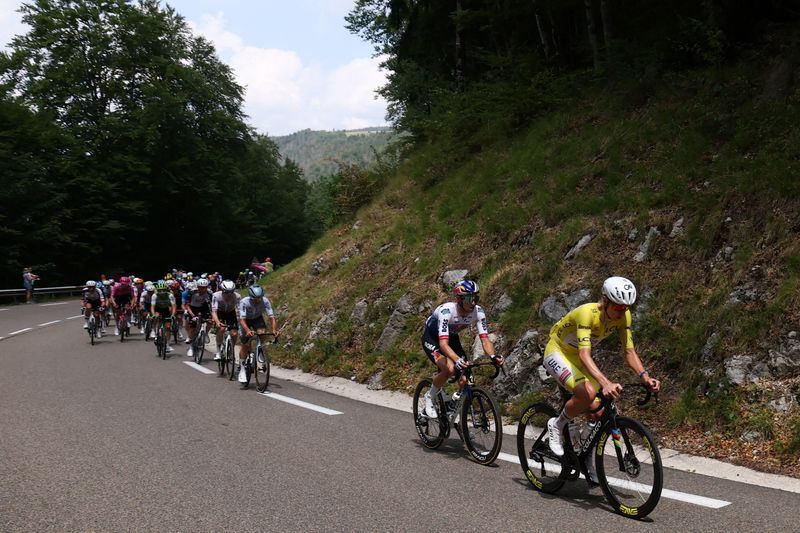
Jonathan Vaughters, the former professional cyclist who now leads the Cannondale-EF team, has entered the growing debate over pre-dawn doping controls at the Tour de France by making a provocative historical argument: had such testing existed during the sport's blood-doping heyday, the entire scandal could have been averted. His intervention carries considerable weight given his direct involvement in one of cycling's darkest chapters and his subsequent transformation into a vocal advocate for anti-doping enforcement.
The controversy erupted after race officials conducted unannounced doping checks in the early hours of Sunday, targeting multiple riders including race leader Tadej Pogacar and second-place contender Jonas Vingegaard ahead of the 15th mountain stage. The sudden wake-ups sparked immediate pushback from competitors who argued that disrupting sleep before a demanding mountain stage was not only unfair but potentially dangerous, given the physical and mental demands of professional cycling at the highest level.
Vaughters took to social media to defend the practice, framing it as a necessary weapon against one of anti-doping's most persistent challenges. He noted that 2am testing represents one of the most effective countermeasures against peptide-based micro-dosing involving EPO, human growth hormone, and testosterone—substances that can clear the body within hours, making them particularly difficult to detect through conventional daytime testing protocols. His historical observation proved especially pointed: had the International Cycling Union deployed such testing strategies in 2001, he suggested, the entire cascade of doping violations that would later engulf the sport might never have occurred.
The credibility of Vaughters' argument derives directly from his personal experience navigating cycling's doping culture. During his professional career spanning the late 1990s and early 2000s, Vaughters was a teammate of Lance Armstrong on the U.S. Postal Service team, one of the most systematically doped squads in sports history. He subsequently admitted to using performance-enhancing drugs, including EPO, before becoming a crucial witness in the U.S. Anti-Doping Agency's investigation that eventually dismantled Armstrong's legacy. When Armstrong's seven Tour de France titles were stripped in 2012 after USADA determined he had orchestrated what it described as the most sophisticated doping program the sport had ever encountered, Vaughters was among those whose testimony contributed to that outcome.
Vaughters' post-cycling transformation adds nuance to his current position. Rather than disappearing from the sport he once dominated through chemical enhancement, he founded what would become Cannondale-EF, deliberately positioning the team as a counterweight to cycling's doping past by establishing rigorous internal anti-doping protocols and becoming an outspoken advocate for clean racing. This rehabilitation of his reputation through institutional change gives his defence of night testing an authenticity that outside commentators might struggle to match.
The riders' objections to Sunday's tests, however, reflect genuine concerns about athlete welfare that extend beyond simple resistance to oversight. Jonas Vingegaard, tested at 2am, reported losing approximately 40 minutes of sleep before facing a mountainous stage where he would later suffer a crash that fractured his collarbone—an injury potentially exacerbated by fatigue and reduced recovery time. Tadej Pogacar, tested at 5am, managed only four hours of sleep. Even stage winner Remco Evenepoel, who was not among the tested riders, described the practice as inhuman, suggesting that the ethical cost of the testing regimen extended beyond its direct targets to reshape perceptions of the race itself.
The International Testing Agency, which administers doping controls under UCI authority, has acknowledged the tension between effective anti-doping enforcement and athlete welfare. In justifying the early-morning tests, officials conceded they were "conscious that night-time testing may be disruptive to riders' rest and recovery" but argued that truly effective anti-doping work must occasionally operate "in limited and justified circumstances" outside conventional daytime hours. This formulation represents an implicit recognition that perfect testing protocols and perfect athlete care sometimes conflict.
The underlying technical reality that drives this conflict is sobering. Micro-dosing regimens involving EPO and human growth hormone represent perhaps the most intractable anti-doping challenge because these substances metabolise so rapidly that predictable daytime-only testing windows create obvious avoidance opportunities. An athlete doping in the evening could theoretically clear detectable levels by morning, making the substance nearly undetectable without night-time surprise testing. This pharmacological reality essentially forces anti-doping authorities into a position where they must choose between accepting that certain doping methods will remain undetectable or accepting the collateral damage to athlete sleep and recovery.
For Malaysian and Southeast Asian readers, this debate carries implications beyond European professional cycling. As sports governance structures develop across the region, the fundamental question Vaughters raises—how aggressively should anti-doping enforcement intrude into athlete welfare and privacy?—will likely surface in local sporting contexts as testing protocols become more sophisticated. The tension between effective oversight and athlete protection represents a governance challenge that transcends individual sports and nations, touching on broader questions about how heavily we should police human performance enhancement in competitive contexts.
Vaughters' intervention suggests that those with direct experience of doping cultures may hold perspectives valuable to the current debate. His argument, though self-serving to some degree given his investment in clean cycling's credibility, articulates a position that anti-doping administrators appear to endorse: that the historical damage inflicted by undetected doping justifies imposing temporary disruption on current athletes. Yet the riders' counterargument—that they should not bear the costs of remedying a problem created by earlier generations—also carries moral weight. Resolving this tension may ultimately require accepting that perfect anti-doping cannot coexist with perfect fairness to individual competitors.

