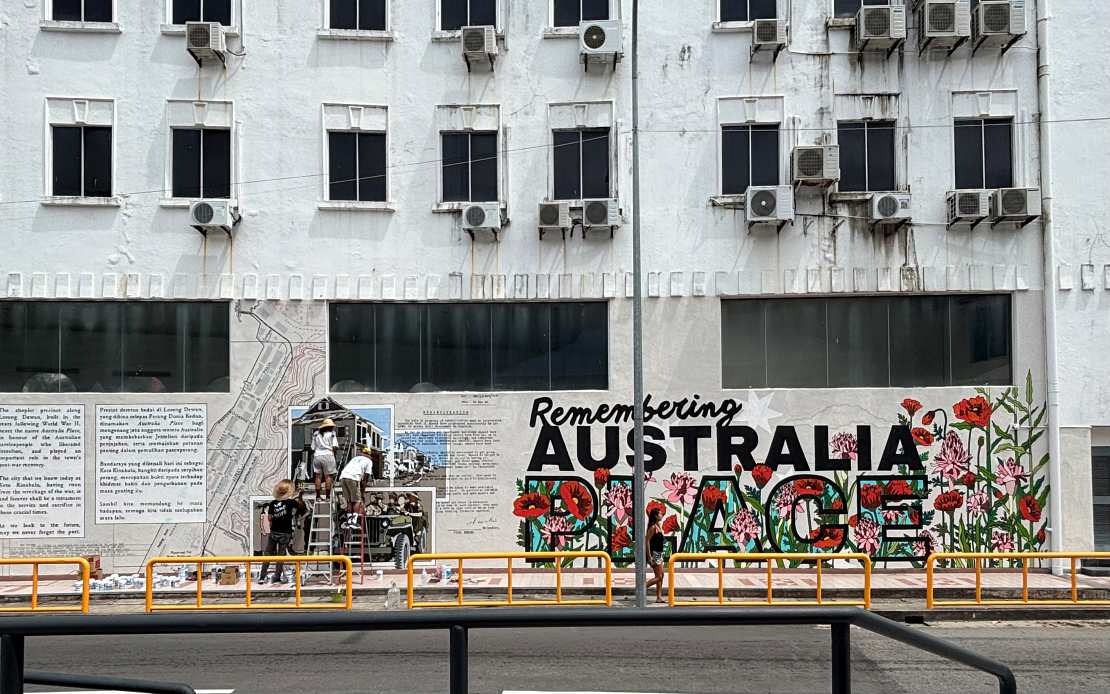
Kota Kinabalu's 'Australia Place'—a locality long recognised by its informal name—now bears visual testament to its historic significance through a striking new public mural that chronicles the interconnected stories of two nations. The unveiling of 'Remembering Australia Place', situated at the Wisma Intiutama building, took place on Friday, strategically timed to coincide with commemorations marking Sandakan Day, an occasion that resonates deeply with both Malaysian and Australian collective memory.
The artwork represents far more than decorative street art. Australian High Commissioner to Malaysia Danielle Heinecke positioned the mural as a crystallisation of sustained diplomatic and cultural engagement spanning decades. In her remarks at the launch, she underscored how the piece encapsulates recurring cycles of collaboration and mutual respect that have defined relations between the two countries, tracing connections that extend beyond governmental structures into the fabric of everyday communities and individual lives.
The mural's creation involved Pillars of Sabah, a community-focused arts organisation that brought together residents across generational lines to participate in the project's realisation. This participatory approach transformed what could have been a one-dimensional celebratory gesture into a communal experience, engaging students and educators from Sekolah Menengah Kebangsaan Sanzac alongside established community figures. The event attracted parliamentarians, civic leaders, and alumni networks of Australian universities, reflecting the breadth of institutional connections that undergird the bilateral relationship.
A particularly poignant dimension emerges through the story of Jared Abdul Rahman, the mural's lead artist and Pillars of Sabah co-founder. His biography embodies the very bridges that the artwork commemorates. Born to a Sabahan father and Tasmanian mother whose romance originated during his father's sojourn in Australia as a Colombo Plan scholar, Jared represents a living manifestation of people-to-people connections that formal diplomacy often struggles to capture. His involvement lends the mural authenticity rooted in personal heritage rather than ceremonial obligation.
The historical context underpinning this artistic gesture cannot be understated. Sandakan Day serves as the annual focal point for remembering the catastrophic Sandakan Death Marches of World War II, a harrowing episode that claimed 2,434 prisoners of war from predominantly Australian and British forces. These marches stand as one of the war's bleaker chapters, yet they simultaneously illuminate remarkable instances of civilian heroism, as Sabahans risked their lives to shelter escapees and facilitate resistance efforts. The mural thus exists as a contemporary counterpoint to historical trauma, demonstrating how shared suffering can transmute into enduring fellowship.
Malaysia's engagement with Australia has evolved substantially since the immediate postwar period. Beyond ceremonial remembrance, contemporary ties encompass educational exchange programmes, trade relationships, and defence cooperation frameworks that position Australia as a significant partner within Malaysia's broader regional architecture. For Sabah specifically, which maintained distinct administrative arrangements during earlier decolonisation processes, the Australian connection carries particular resonance as part of the state's own historical narrative.
The deployment of public art to reinforce diplomatic narratives reflects a broader trend across Southeast Asia, where governments increasingly recognise that cultural expression can achieve messaging objectives that press releases and formal statements cannot. A mural occupies permanent public space, accessible to residents and visitors alike, requiring neither knowledge of political discourse nor fluency in diplomatic language to communicate its essential message about friendship and resilience.
For contemporary Malaysian readers, the mural's emergence carries implications beyond historical sentiment. Educational and professional pathways to Australia remain significant for many Malaysian students, with Australian institutions hosting substantial cohorts from this country. Alumni networks functioning across both nations create informal channels for knowledge transfer, innovation, and sustained personal relationships that subtly influence bilateral dynamics. Kota Kinabalu's art installation thus anchors these abstract flows of human capital and cultural influence in physical, visible form.
The involvement of Mayor Datuk Seri Sabin Samitah in the launch ceremony underscores local government commitment to commemorating these connections. Within Malaysia's federal structure, state governments exercise considerable discretion over cultural programming and civic messaging. Sabah's deliberate choice to prominently celebrate Australian ties through public art reflects nuanced positioning within broader Malaysian diplomatic approaches to neighbouring countries.
The timing of the mural's unveiling, preceding Sandakan Day commemorations, creates a thematic continuum between historical remembrance and forward-looking partnership. Rather than treating wartime sacrifice as an isolated tragic event, the mural positions it within a longer arc of cooperation and mutual understanding. This framing allows communities to honour the past while simultaneously affirming contemporary relationships, avoiding the trap of nostalgia disconnected from present reality.
As regional dynamics continue shifting, with renewed emphasis on Indo-Pacific engagement and middle power diplomacy, cultural institutions like this mural gain heightened significance. They communicate to audiences—both domestic and international—that relationships transcend transactional calculations and strategic interest. They suggest instead that deep historical roots, shared values, and human connections form the bedrock upon which durable partnerships rest. For Sabah and Australia, the 'Remembering Australia Place' mural thus serves as both mirror and compass, reflecting where these nations have journeyed together while subtly indicating directions for continued collaboration.

