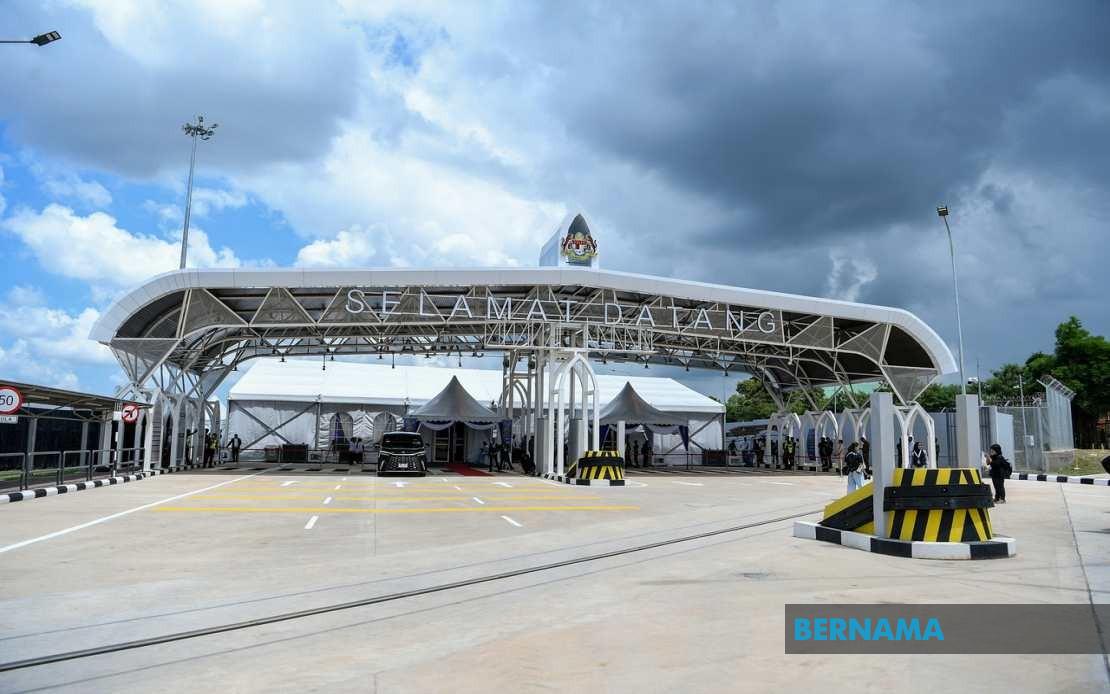
The newly inaugurated Bukit Kayu Hitam-Sadao cross-border corridor is delivering tangible benefits for regional commerce, with early data indicating substantial improvements in trade velocity and logistics efficiency between Malaysia and Thailand. Launched jointly by Thai Prime Minister Anutin Charnvirakul and Malaysian Prime Minister Datuk Seri Anwar Ibrahim on July 10, the 900-metre route connecting Kedah's Bukit Kayu Hitam ICQS Complex with Thailand's Sadao CIQ Complex began operations the following day and has already transformed how goods and people move across one of Southeast Asia's busiest land borders.
The infrastructure project addresses longstanding congestion challenges that have constrained cross-border commerce and tourism. The route features 11 inbound and 11 outbound lanes, substantially expanding processing capacity compared to the previous arrangements. Within weeks of opening, the facility demonstrated near-universal adoption among commercial operators, with nearly all lorries, buses, and vans switching from the congested older pathway to this dedicated corridor. The volume of logistics vehicles now transiting daily exceeds 1,000 trucks, underscoring the pent-up demand for improved border efficiency in this critical trade corridor.
Technological innovation has proven central to the route's success in accelerating cargo clearance. Advanced X-ray scanning systems branded as "Fast Scan" have slashed container inspection times from five minutes to under sixty seconds, eliminating a major bottleneck in the clearance process. The integration of digital cargo information systems allows documentation and preliminary checks to occur through computer networks rather than requiring physical queuing at inspection points. This combination of infrastructure expansion and modernised inspection protocols has fundamentally altered the border-crossing experience, permitting uninterrupted vehicle flow and reducing the dwell time that previously compounded delays.
The commercial impact has been immediate and substantial. Trade data collected by Sadao Customs for the period between July 11 and 31 reveals dramatic year-on-year increases. Import values jumped to 19 billion baht (approximately RM2.35 billion), representing a 58 per cent increase from the 12 billion baht (RM1.48 billion) recorded during the corresponding period in 2024. Export figures proved even more impressive, surging to over 24 billion baht (RM2.97 billion), an 85 per cent leap from the prior year's 13 billion baht (RM1.61 billion). These gains materialised despite the route operating for only three weeks, suggesting that much of the improvement reflects pent-up trade being released rather than wholly new commerce being generated.
For Malaysia and Thailand, these figures carry strategic importance as the nations pursue an ambitious bilateral trade target of US$30 billion (RM122.6 billion) by 2027. The countries mark their 70th anniversary of diplomatic relations next year, providing both symbolic and practical motivation to deepen economic integration. The most recent quarterly bilateral trade data, covering January through March 2026, reached RM31.33 billion (US$7.90 billion), an increase from RM27.35 billion (US$6.15 billion) in the same quarter of 2025. While the new border corridor alone cannot account for the entire increase, the timing and magnitude of improvements suggest it has already begun contributing meaningfully to this upward trajectory.
The route's benefits extend beyond mere logistics efficiency to encompassing broader cross-border mobility. The Hatyai-Songkhla Hotel Association has welcomed the opening, recognising how the expanded capacity and modern facilities will facilitate tourist movements, particularly during weekend and public holiday periods when cross-border traffic traditionally peaks. This dimension reflects how regional economic integration increasingly depends on seamless human and goods movement, with tourism representing a significant component of bilateral value creation alongside merchandise trade.
From Malaysia's perspective, the corridor addresses a critical infrastructure gap that has constrained economic development in the northern region. Kedah has positioned itself as a logistics hub, and the enhanced border crossing capability removes a major constraint on that ambition. The improved clearance times reduce carrying costs for perishable goods and time-sensitive shipments, making Malaysian suppliers more competitive in Thai markets whilst enabling Thai exports to reach Malaysian and broader ASEAN markets more efficiently. The immediate adoption by the transport sector suggests operators have been waiting for precisely this capacity improvement.
Thailand's investment in the Sadao CIQ Complex represents a strategic commitment to facilitating rather than impeding regional trade. Buntoon Oucharoen's remarks as Sadao Customs director emphasise how modern inspection systems create a virtuous cycle: faster clearance times reduce congestion, which encourages more vehicles to use the facility, which allows fixed costs to be spread across higher volumes, improving competitiveness relative to alternative routes. This approach contrasts with enforcement-only border management philosophies that prioritise security checks above throughput.
The broader context matters significantly for Malaysian policymakers. As supply chains increasingly fragment across Southeast Asia, border infrastructure becomes a competitive asset. The Bukit Kayu Hitam-Sadao corridor's success demonstrates that even relatively modest infrastructure investments—a 900-metre connecting route with modern scanning equipment—can unlock substantial economic value. The rapid attainment of nearly complete user adoption suggests pent-up demand has been substantial, and that the private sector will readily deploy capacity through border crossings that offer genuine efficiency improvements.
Looking ahead, the corridor's success may prompt consideration of similar upgrades at other Malaysian land borders, particularly at Padang Besar and Johor Bahru-Singapore crossings, where congestion frequently constrains bilateral and intra-ASEAN trade. The model of joint infrastructure development with neighbouring countries, coupled with modern inspection technology and digitised information systems, has proven effective at Bukit Kayu Hitam-Sadao and potentially offers a template for regional connectivity improvements more broadly.
The first month of operation has validated the investment case for modern border infrastructure as an economic multiplier rather than merely a customs facility. As Malaysia and Thailand pursue deeper economic integration and work towards their 2027 trade target, the Bukit Kayu Hitam-Sadao corridor has provided both practical benefits and confidence that coordinated regional infrastructure development can yield swift returns. For companies operating in both markets, the route has already proven transformative, though the full economic potential likely remains unrealised as supply chains continue adjusting to the new reality of efficient cross-border movement.

