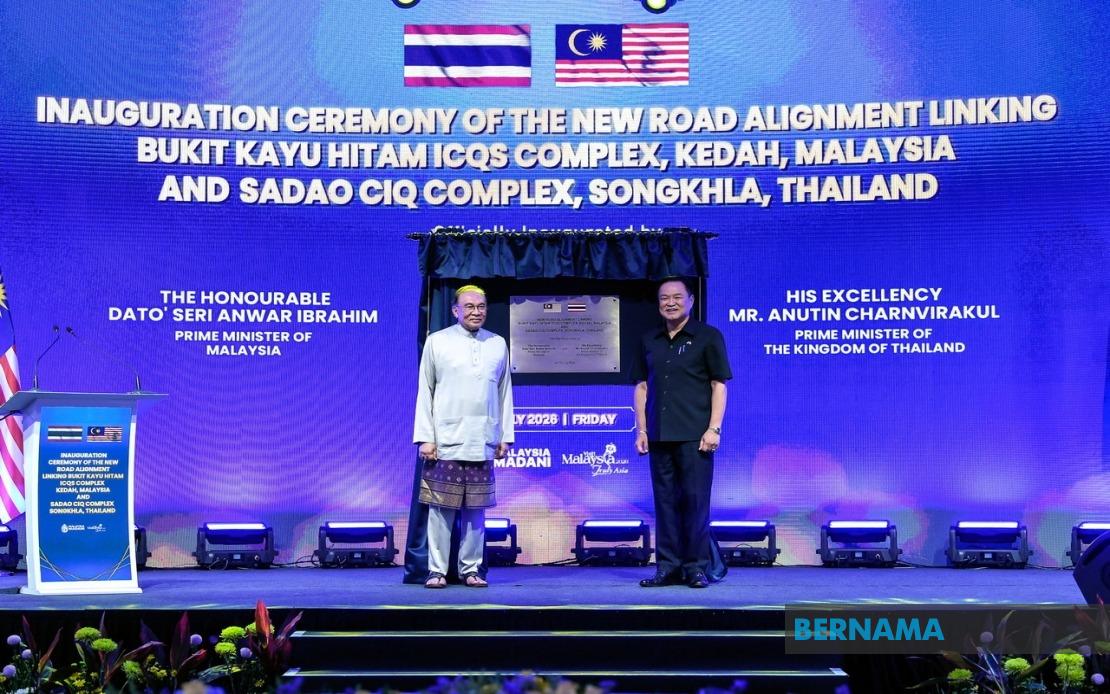
Prime Minister Datuk Seri Anwar Ibrahim and his Thai counterpart Anutin Charnvirakul jointly launched a new road alignment connecting the Bukit Kayu Hitam Immigration, Customs, Quarantine and Security Complex in Kedah to the Sadao Customs, Immigration and Quarantine Complex across the border, marking what officials described as a watershed moment in bilateral relations aimed at stimulating shared prosperity in both border regions.
The infrastructure project represents more than a simple transportation link. According to Anwar, it functions as a strategic instrument to catalyse economic activity on both sides of the frontier, addressing longstanding challenges faced by communities in peripheral areas that have historically remained disadvantaged relative to major urban centres. The initiative signals recognition that geographic proximity alone is insufficient without deliberate policy interventions to harness cross-border potential. For Malaysia's northern states, which have struggled with economic concentration in the southern corridor, this development offers a tangible pathway to diversify growth drivers beyond traditional sectors.
Central to the partnership is an ambitious plan to establish a special economic border zone spanning northern Peninsular Malaysia and southern Thailand. This framework transcends conventional diplomatic protocols by embedding economic incentives directly into bilateral architecture. Anwar emphasised that creating such zones requires patience and sustained commitment, acknowledging that rapid results remain unrealistic despite political will. The designated northern Malaysian states—Perlis, Kedah, Kelantan, Perak and Penang—stand to benefit from new development opportunities should the initiative gain traction, particularly through enhanced trade corridors and potentially integrated manufacturing clusters.
Both governments have committed to accelerating resolution of outstanding disputes that have complicated border commerce. These disputes span customs procedures, immigration protocols, fisheries management and trade regulations—practical obstacles that have frustrated legitimate business transactions for years. Anwar indicated that Malaysian and Thai leadership had recently resolved numerous longstanding issues that had persisted through decades of negotiations, a breakthrough he attributed to heightened political commitment and streamlined diplomatic channels. By harmonising these administrative frameworks, the two nations aim to reduce transaction costs and friction points that currently discourage cross-border investment and entrepreneurship.
The bilateral trade ambition underscores the economic stakes. Malaysia and Thailand have established a target of USD30 billion in annual bilateral trade by 2027, a figure substantially above current levels. Stronger border infrastructure and simplified regulatory mechanisms are prerequisites for achieving this threshold. For Malaysian exporters and manufacturers, improved connectivity opens access to Thailand's substantial domestic market and its position within broader Southeast Asian supply chains. Conversely, Thai businesses gain smoother entry to Malaysian distribution networks and downstream markets across ASEAN. The road alignment serves as the physical manifestation of these commercial aspirations.
For Malaysian stakeholders, particularly those in border states where infrastructure investment has lagged, this development carries significant implications. Rural communities and small-to-medium enterprises in Kedah, Perlis and northern Perak have traditionally experienced limited access to large-scale development projects. The border economic zone initiative, if properly implemented with complementary investments in skills training and business support services, could reshape economic geography in the north. However, success hinges on whether federal and state governments coordinate effectively with Thai counterparts to establish genuine competitive advantages rather than merely facilitating unidirectional trade flows favouring larger Thai enterprises.
Anwar's emphasis on visiting border communities reflects acknowledgment that national development frameworks must account for peripheral populations often overlooked in capital-centric policy discussions. His appreciation for Anutin's presence at the remote border ceremony underscores that senior leadership engagement legitimises local concerns and signals commitment to implementation. In Southeast Asian governance contexts, such symbolic gestures carry substantive weight in building political coalitions supporting infrastructure projects that require sustained funding and cross-party support.
The two-day official visit by Anutin, undertaken at Anwar's invitation, facilitated in-person discussions that reportedly accelerated resolution of bilateral disputes. This pattern of high-level engagement differs markedly from distant diplomatic interactions conducted through formal channels. By bringing Thailand's Prime Minister to the actual border landscape, Malaysian officials ensured he directly observed infrastructure realities and community contexts, potentially fostering greater understanding of Malaysian positions on contentious issues. Such proximity-based diplomacy often produces more durable agreements than remote negotiations.
For broader Southeast Asian regional integration, this Malaysia-Thailand initiative holds significance as a model for deepening ASEAN connectivity. The subregional focus on northern Malaysia and southern Thailand demonstrates how bilateral frameworks can advance regional objectives by addressing specific geographic clusters rather than pursuing uniform integration approaches across all member states. Should the special economic zone succeed in generating measurable economic gains, it could inspire comparable arrangements between other ASEAN neighbours, gradually weaving more sophisticated cross-border cooperation networks.
Implementation challenges should not be minimised. Establishing functional special economic zones requires harmonising tax regimes, labour standards, environmental regulations and investment policies—complex negotiations where competing interests often emerge. Thai provincial governments may have different development priorities than Bangkok's central authorities, creating coordination difficulties mirroring those on the Malaysian side. Additionally, customs and immigration personnel require retraining to implement new protocols, demanding sustained institutional capacity-building. Traders must develop confidence that administrative reforms will persist despite political transitions in either country.
The road alignment itself symbolises commitment, but symbolic infrastructure means little without accompanying policy reforms. Success metrics should encompass measurable indicators: cross-border transaction volumes, new enterprises established in the zone, employment generation in border communities and tax revenue impacts. Transparent monitoring mechanisms involving both governments and private sector stakeholders would help sustain momentum and permit course corrections when initial approaches prove ineffective.
Looking forward, this bilateral initiative positions Malaysia and Thailand as potential architects of innovative regional cooperation models within ASEAN. By treating border areas as development opportunities rather than merely security perimeters, both nations signal evolved thinking about cross-border relationships. For Malaysian stakeholders, particularly those in northern states historically peripheral to national economic narratives, the project offers tangible hope that geographic location need not determine economic destiny. Realising that promise requires unwavering political commitment, substantial investment and careful institutional design—ambitious goals that the new road alignment has placed squarely on both nations' development agenda.

