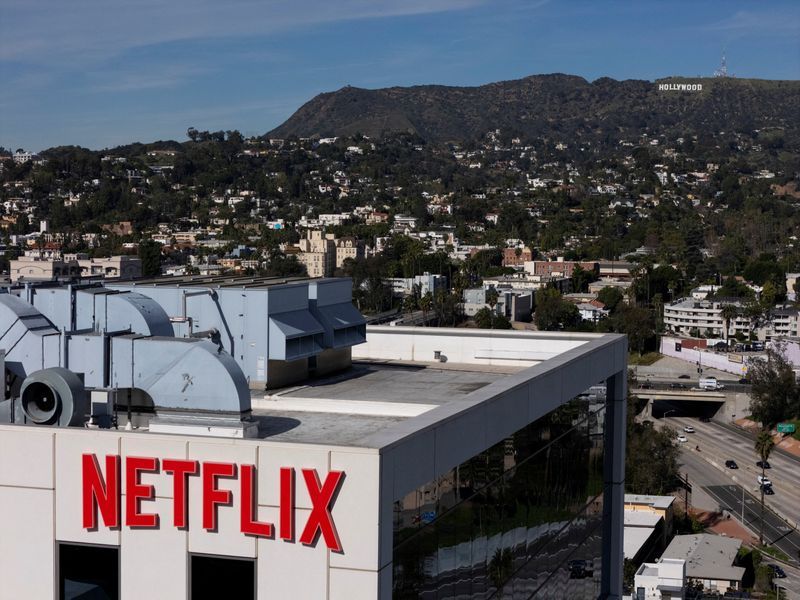
Netflix enters a critical earnings moment this week, releasing second-quarter financial results that will test investor confidence in a company whose market value has contracted by more than one-fifth since the start of the year. The streaming service finds itself at an inflection point, caught between the easy gains of its password-sharing crackdown and price increases from recent years and the harder work of sustaining growth from an already-massive subscriber base. Management will need to convince Wall Street that the company possesses a viable roadmap forward, particularly as engagement metrics suggest viewers are losing interest in returning for subsequent seasons of major releases.
The numbers Netflix is expected to report paint a picture of deceleration. Analysts surveyed by LSEG predict revenue will rise 13.6 per cent to $12.59 billion, marking the slowest quarterly expansion in more than a year. Adjusted earnings per share are forecast at 79 cents. While such figures would represent healthy performance for most entertainment companies, investors have grown accustomed to Netflix's historical trajectory of stronger gains. The margin compression reflects both market saturation in developed regions and the reality that the productivity improvements derived from cracking down on account-sharing have largely exhausted their potential.
The advertising division, originally positioned as Netflix's primary engine for future growth, has emerged as a significant disappointment. The platform's ad-supported tier is forecast to generate $705.8 million in revenue this quarter, but analysts acknowledge the business has expanded far more modestly than initial projections suggested. Ross Benes, an analyst at Emarketer, has downwardly revised his advertising forecasts, citing the gap between optimistic expectations and market realities. This shortfall matters considerably because management had explicitly framed the ad business as crucial to maintaining momentum once the one-time revenue boost from price hikes and subscriber purges began to normalise.
Netflix's response has been to pursue strategic diversification, betting that live events and premium content experiences can revitalise engagement and attract advertisers seeking premium placements. The company has reportedly explored acquiring the rights to broadcast the 2030 and 2034 FIFA World Cup tournaments within the United States market, a move that would position Netflix as a destination for major sporting spectacles alongside its scripted programming. Simultaneously, the platform has entered discussions to acquire Letterboxd, a social media platform focused on film enthusiasts, suggesting a strategy to deepen audience interaction and create advertising inventory tied to passionate communities.
Yet the fundamental problem Netflix must address concerns viewer behaviour rather than content acquisition budgets. Bloomberg News disclosed that audiences for acclaimed shows such as "The Night Agent" and "Beef" demonstrate alarming retention patterns, with many viewers failing to return after first seasons conclude. This attrition represents a qualitative departure from the subscriber stability the company once enjoyed, indicating that accumulated content libraries and switching costs no longer guarantee loyalty. For a platform monetised through both subscriptions and advertisements, declining season-to-season viewership creates a compounding problem—fewer returning viewers means less engagement data for personalisation algorithms and reduced impression volume for advertisers.
Industry observers characterise Netflix's evolution in stark terms. Paolo Pescatore, an analyst at PP Foresight, notes that the company has transitioned from disruption—upending traditional media distribution—to dominance, controlling substantial market share in streaming video. This transition fundamentally alters the nature of Netflix's challenge. During its growth phase, Netflix benefited from structural tailwinds: cord-cutting behaviour, expanding internet penetration, and consumer migration toward on-demand viewing. Today, Netflix must sustain expansion within a largely-penetrated market where growth increasingly comes from price increases rather than net new users, a dynamic that faces natural limits as subscribers begin cancelling amid economic pressures.
Competition has simultaneously intensified across multiple vectors. Traditional media conglomerates including Disney, Warner Bros Discovery, and Paramount have launched streaming services leveraging existing content libraries and distribution relationships. YouTube has captured extraordinary engagement, particularly among younger demographics, by democratising creator participation and offering algorithmically-curated recommendations. Mobile-based platforms and social media services compete aggressively for the streaming hours once assumed to belong predominantly to Netflix. This fragmented landscape means Netflix can no longer assume it will capture the majority of entertainment consumption within households that subscribe to its service.
The company's capital allocation approach now favours smaller, targeted transactions rather than blockbuster acquisitions, suggesting management recognises that scale alone no longer solves growth constraints. Industry speculation surrounding potential major deals—including possibilities arising from Comcast's NBCUniversal spinoff—appears to have cooled as analysts question whether transformational acquisitions would materially alter Netflix's trajectory. Instead, the platform appears focused on surgical investments that can address specific strategic gaps, whether acquiring engaged fan communities through Letterboxd or securing premium live content through sports rights.
For Southeast Asian markets including Malaysia, Netflix's strategic difficulties carry particular significance. The region represents a crucial growth market where subscription penetration remains substantially lower than in North America, Western Europe, and developed Asia-Pacific markets. However, the company's credibility with regional consumers depends partly on its ability to sustain investment in locally-relevant content and competitive feature development. If Netflix's financial pressures lead to content budget reductions or feature rollbacks in emerging markets, this could accelerate subscriber migration toward regional competitors or local platforms that better serve specific cultural preferences. Additionally, the company's struggles in the advertising market may influence its willingness to invest in ad-supported tier expansion in Southeast Asia, potentially limiting revenue growth opportunities in price-sensitive markets.
The earnings announcement will signal whether Netflix's leadership possesses a credible plan to restore investor confidence and prove that the company can navigate this transition successfully. Management's commentary on subscriber growth, engagement metrics, and advertising trajectory will carry outsize weight, as investors search for evidence that Netflix can generate sustainable returns without depending entirely on periodic price increases. The outcome will likely determine whether recent share declines represent a buying opportunity or the beginning of a longer erosion of Netflix's market position as competition, changing viewer habits, and content proliferation reshape the streaming entertainment landscape.

