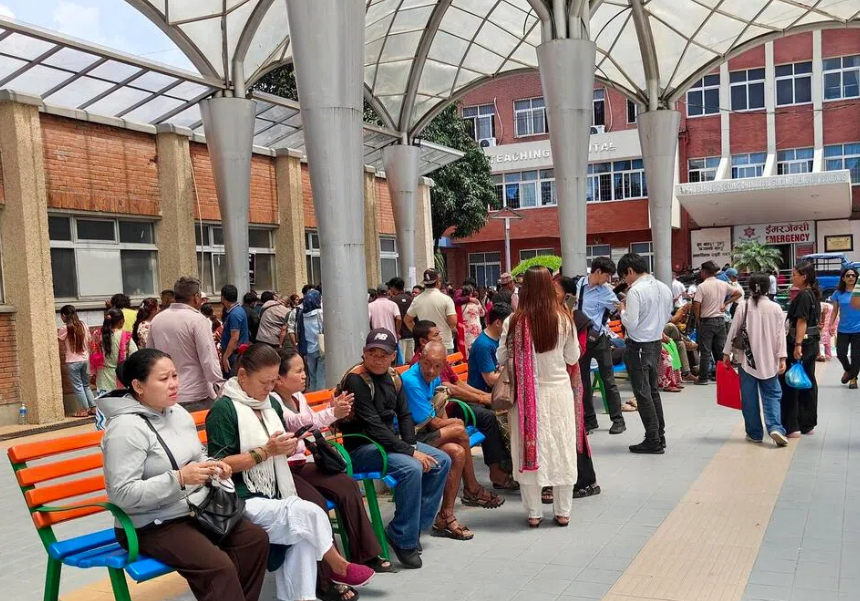
The crisis unfolding in Nepal's capital city has taken on a grim character as the search for survivors transforms into a grim identification process. Since August 26, when a devastating flash flood swept through the country's mountainous border region, Kathmandu has become a hub of desperation, with families converging on hospitals to seek news of missing relatives. The death toll has exceeded 500, whilst search and rescue operations continue combing through the Bhotekoshi river system and downstream areas, though officials warn that hundreds remain unaccounted for.
At Tribhuvan University Teaching Hospital, one of Kathmandu's two major public facilities, the human cost of the disaster has been rendered starkly visible. Photographs of unidentified victims have been pinned to the hospital gates, creating an anguished pilgrimage site where family members gather daily, scanning faces in hopes of recognition. The missing persons register at TUTH alone exceeded 1,500 individuals by the afternoon of August 28, reflecting the scale of displacement and loss. Hundreds of relatives have been moving between medical facilities throughout the capital, armed with printed photographs and images stored on mobile phones, desperately searching for spouses, siblings and children.
The personal stories emerging from the hospital grounds illustrate the emotional toll of the disaster. Dolma Tamang, a 36-year-old woman, has spent three days traversing Kathmandu's hospitals searching for her sister and brother-in-law, who were transporting goods from the Chinese border when the flood struck on August 26. When she last contacted them, they were driving through Rasuwa district; since then, their phones have remained silent. Similarly, Sushila Shrestha, just 23 years old, is searching for her younger brother Bir Bahadur, a driver headed toward the Chinese border when the disaster occurred. Though Sushila has found no trace of her brother, she clings to the hope that his absence from death lists might indicate survival. These accounts reveal how the disaster has shattered families across multiple districts, with many victims having been engaged in routine commercial activities when the floodwaters struck.
The scale of Nepal's emergency response has been substantial, with over 4,400 police personnel deployed alongside personnel from the Nepali Army and Armed Police Force. Search operations have been hampered by the challenging geography of the affected areas, with rescuers discovering survivors trapped under debris, in collapsed tunnels and within destroyed buildings. However, rescue efforts experienced a temporary halt on August 28 when officials raised concerns about a barrier lake potentially breaching and releasing another destructive flash flood. By evening, operations resumed after officials determined there was no immediate danger, though the situation remained precarious and fluid.
The international dimension of the disaster has added complexity to the crisis. Nine Singaporeans remain missing following the floods, whilst approximately 288 Indian nationals have also been reported unaccounted for. Many of these foreign victims were pilgrims returning from or en route to the Kailash-Mansarovar sacred pilgrimage at Mount Kailash and Lake Manasarovar in Tibet, which operates via a popular route through Rasuwa district, the region most severely impacted by the flash flood. The Gyirong border crossing between Nepal and Tibet, a critical crossing for these pilgrims, suffered severe damage from mudslides and floodwaters, with dramatic footage of the disaster having circulated widely online. By August 28, the Nepal Tourism Board confirmed that 121 foreign tourists had been rescued, including 85 Indians and 16 Chinese nationals, though hundreds of others remained missing.
The arrival of international family members in Kathmandu has intensified the human dimension of the search efforts. A group of men from Tamil Nadu in south India flew into Kathmandu on August 28 to assist in locating members of their travel group who had been returning from the Mount Kailash pilgrimage but were caught in the disaster. One visitor from Coimbatore came specifically to support his friend in tracing his wife and son, offering emotional solidarity as the families faced an uncertain outcome. These arrivals underscore how the disaster has extended its reach across borders, creating international ramifications and straining Nepal's already stretched support systems.
The logistics of managing the deceased has itself become a critical challenge. The Kathmandu Post reported that hospitals across multiple districts have begun exhausting their capacity to store bodies. In Chitwan district, located downstream from the disaster zone and adjoining the Indian border, circumstances have become particularly acute. By afternoon on August 28, local authorities had recovered 186 bodies from Chitwan alone, yet the district's hospitals possessed collective morgue capacity for only 30 to 50 bodies. This severe shortage has forced authorities to explore alternative storage solutions whilst the full scale of casualties continues to emerge. Chitwan, typically known for its wildlife sanctuary and elephant populations, has been devastated, with roads blocked by debris and silt, impeding relief operations and creating secondary humanitarian challenges.
Nepal's political leadership has adopted a distinctive approach to international assistance following lessons learned from the 2015 earthquake. Prime Minister Balen Shah has declined offers from China, India and other countries to deploy foreign search and rescue teams, fearing that the coordination challenges encountered after the previous earthquake would recur and potentially hamper response efforts. Instead, the government has requested direct financial assistance channelled through a unified mechanism yet to be officially announced. International agencies and bilateral partners have been invited to contribute resources toward reconstruction and rehabilitation, with the Nepal government maintaining centralised control over the response framework. This strategic decision reflects institutional memory of past crises and attempts to balance the need for international support with concerns about operational coherence.
Immediate humanitarian assistance has nonetheless begun arriving through bilateral channels. India initially dispatched 47 tonnes of humanitarian supplies via military transport aircraft, including temporary shelters, blankets, hygiene kits, solar lamps, medicines and food packets. New Delhi has additionally offered prefabricated truss bridges to support reconstruction efforts, given that dozens of both major and minor bridges were destroyed or damaged in the disaster. These contributions address immediate needs whilst the scale of reconstruction becomes clearer. However, as families remain desperately searching through hospitals and the missing persons lists continue growing, the focus remains on locating survivors and identifying the deceased before addressing longer-term rebuilding.
The emotional landscape in Kathmandu reflects a community in shock grappling with unprecedented loss. Bikesh Shrestha, searching for his cousin Rakesh, found himself unable to view the photographic displays of unidentified bodies, averting his eyes whilst simultaneously hoping against hope that his relative might yet return alive. This conflicting emotional terrain—the simultaneous confrontation with mortality and desperate optimism for survival—characterises the experience of thousands of family members moving through the capital's hospitals. As search operations continue and the full human toll becomes clearer, Kathmandu has transformed into a city defined by collective trauma and the fragile hope that some of those counted among the missing might yet be found alive in the days ahead.

