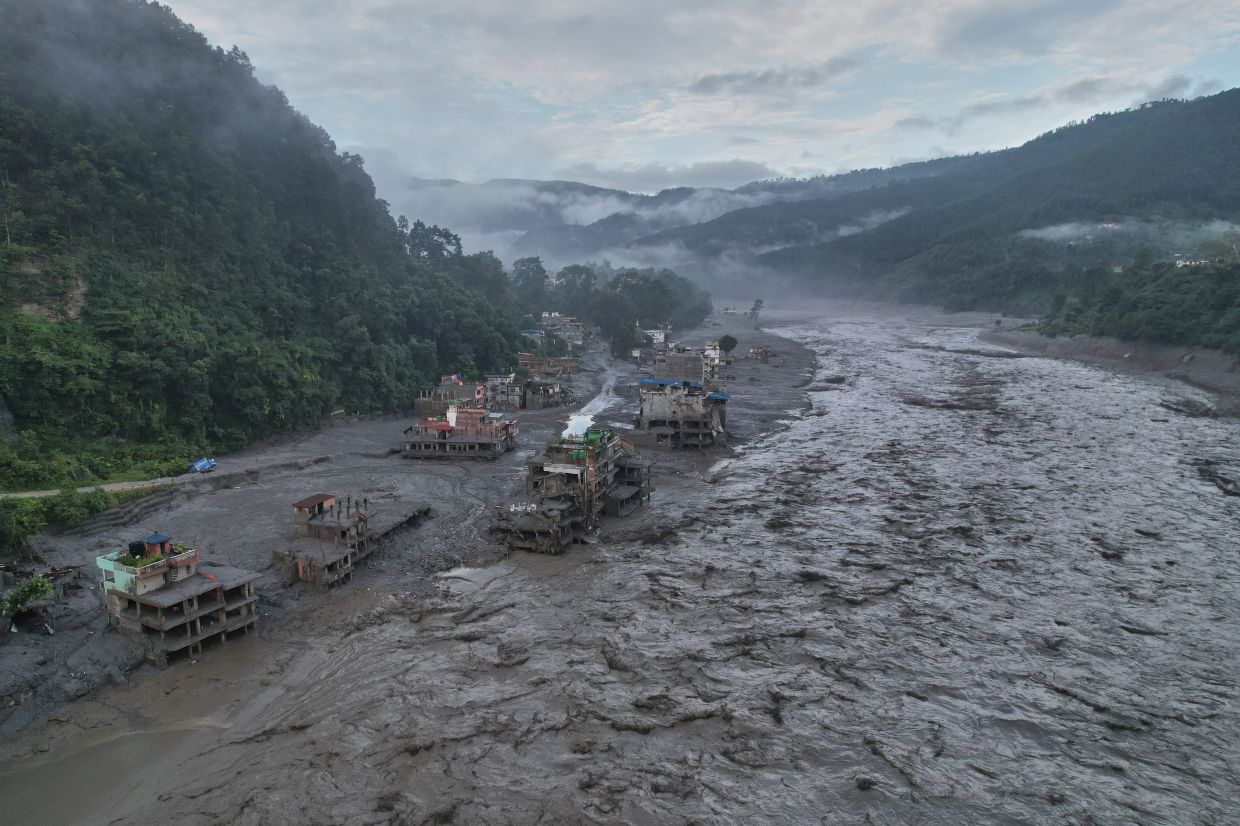
Survivors of last week's devastating floods in Nepal had mere moments to react before walls of water and debris swept through mountain valleys, obliterating entire settlements and claiming at least 800 lives whilst leaving over 3,000 missing. The disaster has laid bare a dangerous vulnerability in the region's disaster preparedness infrastructure: the almost complete absence of early-warning mechanisms in high-altitude zones where catastrophic events originate. Dharam Raj Uprety, chief executive of Nepal's National Disaster Risk Reduction and Management Authority, acknowledged that residents received less than five minutes of notice, a timeframe wholly insufficient for evacuation or protective measures. This critical failure stems from fundamental gaps in transnational cooperation on environmental monitoring, particularly inadequate data exchange between Nepal and its northern neighbour China, through whose territory many of the region's weather systems and glacial hazards develop.
The root cause of this crisis lies in Nepal's inability to establish and maintain weather observation networks across the high Himalayas, where the most consequential meteorological and geological processes unfold. Building and operating monitoring stations at extreme altitudes demands substantial financial resources and technical expertise that Nepal currently lacks, leaving vast stretches of mountainous terrain unobserved and unknowable. Uprety identified the absence of what he termed "trans-boundary data seeding mechanisms" as perhaps the most fundamental obstacle facing disaster managers. Without shared information flowing across the Nepal-China border about weather patterns, glacier stability, and permafrost conditions in the Tibetan Plateau, forecasters operate with incomplete situational awareness. This information asymmetry proves particularly dangerous given that climate-driven changes originating in Chinese territory cascade directly into Nepalese valleys, where vulnerable communities live in complete ignorance of developing hazards upstream.
The immediate trigger for last week's catastrophe was a glacial collapse that unleashed ice, mud, rocks and torrential water through a Himalayan valley on August 26, annihilating everything in its path. Satellite analysis subsequently revealed that bedrock beneath the glacier had failed, initiating the cascading disaster that unfolded with terrifying speed. Whilst scientists remain cautious about attributing this specific event directly to anthropogenic climate change, researchers acknowledge that warming temperatures weaken permafrost that ordinarily binds high-altitude slopes together, increasing the likelihood of such failures. The broader context is unmistakable: as global temperatures rise, the entire Himalayan system faces accelerating destabilisation, with glaciers retreating and mountain infrastructure becoming increasingly unstable, yet Nepal's warning capacity has failed to keep pace with this emerging threat.
China has publicly acknowledged the seriousness of the situation, with President Xi Jinping calling for accelerated surveys of glaciers and glacial lakes across the Tibetan Plateau to prevent further tragedies. The Communist Party subsequently issued directives on August 28 mandating stronger monitoring and early-warning systems to improve identification of interconnected disaster risks. However, regarding whether China had specifically alerted Nepal to the developing threat before August 26, ambiguity persists. The Chinese Embassy in Kathmandu issued a statement claiming that China has "always made every effort, within the limits of existing technologies, to conduct monitoring, assessment and analysis and have shared important information with the Nepali side in a timely manner." The careful wording and absence of specific details about pre-disaster communication suggest that if information was shared, it may have been either insufficient or arrived too late to enable meaningful protective action.
The economic implications of this disaster extend well beyond the immediate death toll and humanitarian crisis. Binod Chaudhary, Nepal's sole billionaire and chairman of the Chaudhary Group conglomerate, estimates that reconstruction costs will reach at least US$5 billion, with the rebuilding process likely consuming seven to eight years—comparable to the lengthy recovery following Nepal's 2015 earthquake. This financial burden arrives at a particularly vulnerable moment for an economy heavily dependent on tourism for employment and foreign currency generation. The destruction of infrastructure, settlements and natural attractions within the disaster zone will suppress visitor arrivals precisely when economic recovery is essential. Beyond immediate reconstruction expenses, Nepal faces ongoing vulnerability until warning and monitoring systems are substantially upgraded, creating persistent uncertainty that could depress long-term investment and development.
For the broader Southeast Asian region, Nepal's experience carries sobering lessons about the intersection of climate change, infrastructure vulnerability, and cross-border governance. The Himalayas form the hydrological heart of Asia, generating rivers that sustain hundreds of millions of people across multiple nations. Yet monitoring and early-warning capabilities remain fragmented, with each country operating largely independently despite the transnational nature of atmospheric and hydrological systems. Similar vulnerabilities likely exist along other major international borders where one nation's geological hazards pose threats downstream. The principle that Uprety articulated—that "unless we stop making boundary for climate information, disasters originating in remote mountain areas will remain difficult to anticipate"—resonates across the entire region, suggesting that Southeast Asian nations sharing watersheds and atmospheric systems should examine their own data-sharing arrangements.
Nepal's disaster management authority has commenced developing a comprehensive roadmap to strengthen early-warning systems, with endorsement anticipated in the near term. The strategy prioritises extending monitoring capacity into high-altitude zones and establishing protocols that provide communities with sufficient advance notice to undertake protective actions. However, such improvements require not only domestic investment but also formalised agreements with China regarding real-time sharing of meteorological and glaciological data from the Tibetan Plateau. Without binding commitments to transnational data exchange, improvements to downstream monitoring systems alone will remain insufficient. The challenge extends beyond technology procurement to encompassing diplomatic agreements and institutional arrangements that currently exist only in nascent form.
The implications for Nepal's governance and regional relationships are substantial. The disaster has exposed deficiencies that no amount of domestic expenditure can fully remedy without Chinese cooperation. This reality places Nepal in a position where effective disaster prevention depends partly on its ability to negotiate information-sharing arrangements with a far more powerful neighbour. China's framing of the issue in terms of accelerated surveys and improved monitoring on the Tibetan Plateau suggests openness to addressing the problem, yet the specifics of what data will be shared, how frequently, and through what mechanisms remain undefined. Nepal's authority has the opportunity to leverage current international attention to establish formal protocols, though whether it possesses sufficient negotiating leverage remains uncertain.
Looking forward, the window for implementing meaningful improvements is constrained by both technical and bureaucratic timelines. Installing weather stations at high altitude and integrating their data into forecasting systems requires months of engineering and testing. Negotiating and implementing transnational data-sharing agreements typically consumes years. Meanwhile, the Himalayan climate system continues its destabilisation, with permafrost degrading and glacier systems becoming increasingly unstable. Communities living in the shadow of these hazards remain in acute danger whilst institutional responses unfold at bureaucratic pace. The 800 deaths and thousands missing represent not merely a historical tragedy but a stark warning that current preparedness levels are fundamentally inadequate to the challenge posed by rapid environmental change in the world's highest mountain range.

