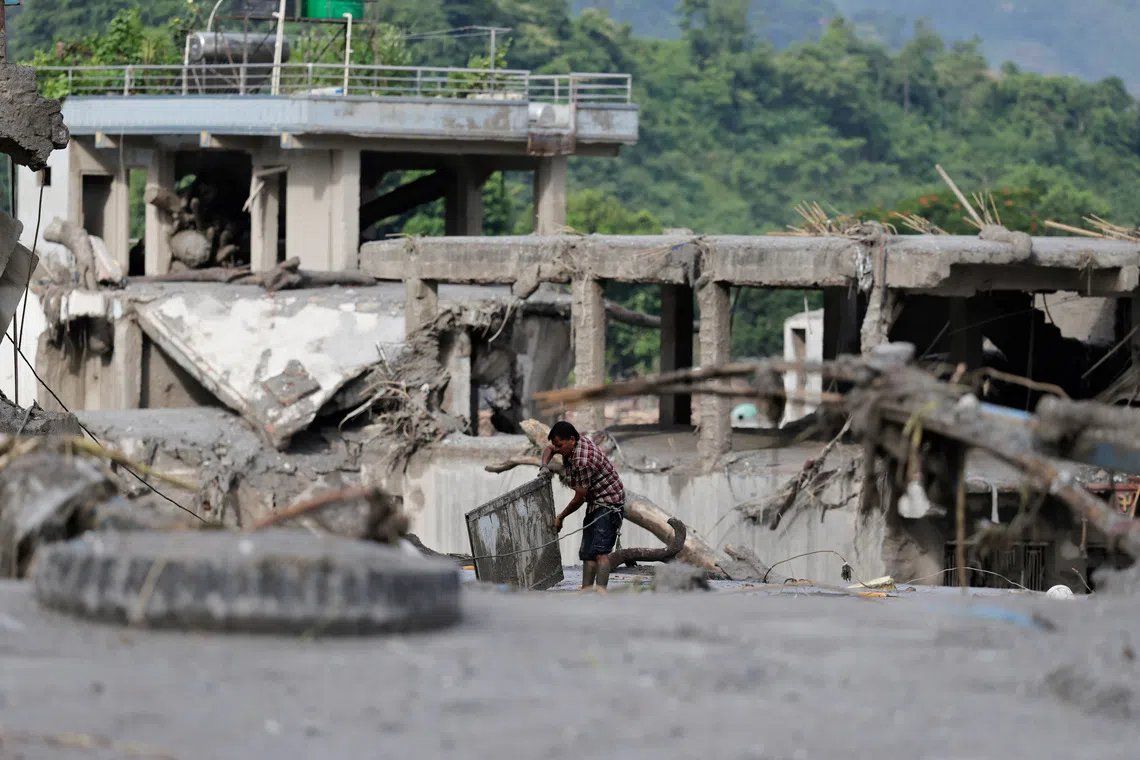
The humanitarian crisis unfolding across the Nepal-Tibet border has entered a perilous second phase as authorities in both countries grapple with an unfolding geological catastrophe. A devastating glacier collapse earlier this week unleashed torrents of rock, ice, mud and debris that swept through mountain valleys, killing at least 362 people and leaving more than 1,000 unaccounted for. But the immediate threat of further loss of life has only intensified, with two separate lakes created by the catastrophic debris accumulation now swelling to dangerous levels and threatening to breach on either side of the border.
In Nepal, the disaster authority issued an urgent public notice warning residents and ongoing rescue teams that a natural dam formed by massive quantities of material clogging the Trishuli river is rapidly filling with water and has become unstable. The authority's carefully worded statement reflected the gravity of the situation, explicitly directing all people in downstream areas to immediately vacate river banks and move to elevated, secure locations. Rescue workers laboring in the debris-choked valleys below were particularly targeted in the warning, as their proximity to the waterway puts them in direct peril should the improvised barrier fail.
The warning carries particular urgency given China's assessment of the situation on its side of the border. State authorities have calculated that approximately three million cubic metres of water—equivalent to filling roughly twelve hundred Olympic-size swimming pools—will drain into an already-stressed artificial reservoir over the coming seventy-two hours. This massive influx into an existing dam system creates an extraordinarily dangerous scenario, as engineers struggle to manage flows that were never designed into the facility's capacity. Chinese water resources ministry officials have modeled peak inflows arriving around September 1, suggesting the critical window of danger extends well beyond the immediate aftermath of the glacier collapse.
The compound effect of predicted rainfall patterns throughout the coming week substantially elevates these risks beyond what static calculations alone might suggest. Zhu Jinfeng, a specialist researcher at the water resources ministry's hydrology department, conveyed the escalating nature of the threat during an interview with state broadcaster CCTV. His assessment—that both water volume and breach probability are rising in tandem—underscores the dynamic and unpredictable character of the emergency. Himalayan weather patterns can shift suddenly, and any significant precipitation in the coming days could tip an already precarious situation into outright disaster.
The response from rescue personnel on the ground demonstrates the seriousness with which local teams are treating the secondary threat. Pawan Koirala, coordinating a rescue unit of thirteen workers, made the difficult decision to withdraw his team from the debris zone and relocate to higher ground upon receiving the formal warning from authorities. This pullback, while necessary from a safety perspective, reflects the tragic calculus facing rescue coordinators—the knowledge that staying in position to search for survivors exponentially increases the danger to the searchers themselves should a surge of water suddenly descend upon the valley floor.
The geological context of this unfolding emergency highlights the extreme vulnerability of Himalayan communities to glacier-related hazards. The region's towering peaks, subject to intense seasonal warming and increasingly erratic climate patterns, contain billions of tonnes of ice under constant stress. When these massive frozen repositories suddenly collapse—whether triggered by temperature fluctuations, seismic activity, or structural fatigue—the resulting debris moves with tremendous force and volume down confined river valleys with nowhere to dissipate energy. The initial Monday flood demonstrated this force with catastrophic human cost; the secondary threat posed by dammed lakes now compounds the region's vulnerability.
For Nepal and China, managing this cross-border emergency presents complex logistical and diplomatic challenges. Both countries must coordinate evacuation procedures, share real-time hydrological data, and potentially prepare for coordinated reservoir release operations if the dams begin to fail. The absence of functioning regional early-warning systems in some areas means that communities downstream may have only minutes to respond once a breach occurs. This reality has driven both governments to issue precautionary notices far more aggressive than the situation alone might warrant—a necessary overestimation of risk in circumstances where underestimating danger could prove catastrophic.
The broader implications for Southeast Asia and the Hindu Kush-Himalayan region are substantial. Climate change is fundamentally altering the behavior of high-altitude glaciers throughout the region, creating new failure modes and hazard profiles that traditional engineering and disaster management frameworks were never designed to address. Nepal, Bhutan, and the bordering regions of India and China all face similar risks from destabilized ice masses and the emerging threat of glacier lake outburst floods—a phenomenon that will likely increase in frequency and severity as temperatures continue rising.
For Malaysia and other nations in the region, this crisis offers urgent lessons about the interconnected nature of climate hazards in Asia's mountain systems. Rivers originating in the Himalayas flow through multiple countries; disaster cascades do not respect political borders. The capacity of Nepal and China to manage this emergency, coordinate information, and prevent compounding catastrophes will influence how prepared the broader region can become for similar events. Regional cooperation frameworks focused on glacier hazard monitoring, early warning systems, and joint evacuation protocols deserve immediate investment and political priority given the populations at stake and the escalating frequency of such events.

