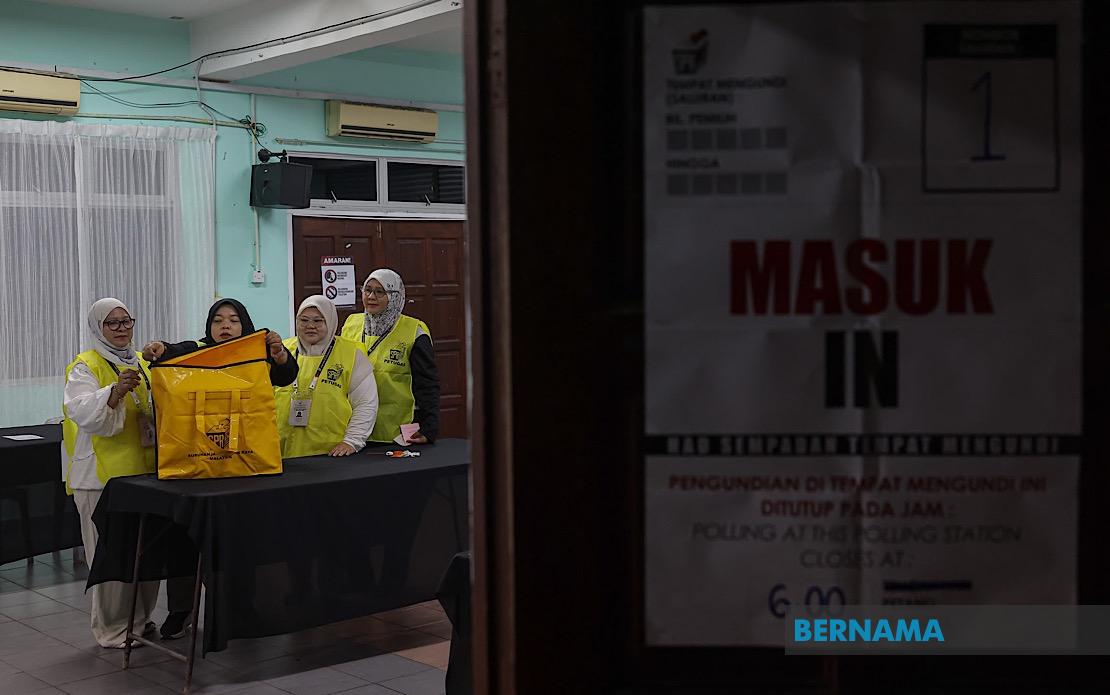
Voters across Negeri Sembilan today cast their ballots in a closely watched state election, with nearly 860,000 registered citizens eligible to determine which political coalition will steer the state's direction over the coming mandate. The 16th Negeri Sembilan State Election represents a significant democratic exercise in the ongoing reshaping of Malaysia's political landscape, coming just months after national elections fundamentally altered the country's governing dynamics. The exercise culminates a two-week campaign period that concluded at midnight, during which competing coalitions sought to convince voters across seven districts—Seremban, Jempol, Jelebu, Kuala Pilah, Tampin, Port Dickson, and Rembau—that they possessed the best vision for the state's future development and governance.
Election officials opened 401 polling stations simultaneously at 8:00 am, with 1,668 individual voting streams operating throughout the day to process the anticipated voter turnout. The Election Commission established a target voter participation rate between 72 and 75 percent, reflecting expectations that the election would generate strong engagement among the electorate. Results began emerging from 10:00 pm onwards, with comprehensive tallying expected to conclude before midnight, allowing party leaders and media organisations to assess the outcome during the same evening. This timeline provides clear visibility to Malaysian political observers tracking the broader regional political evolution, as Negeri Sembilan's direction carries implications for neighbouring states and federal coalition stability.
Early voting demonstrated robust participation levels, with military and police personnel together with their spouses achieving a 91.06 percent turnout among the 7,391 eligible postal voters registered for advance balloting. This strong performance among uniformed services and their families suggested underlying momentum heading into the main polling day, though it remained uncertain whether such engagement rates would translate across the general population. The exceptional early-voting participation rate indicated that voters viewed this contest as significant enough to warrant prioritising their democratic responsibilities despite logistical constraints.
Thirty-six State Legislative Assembly seats across Negeri Sembilan attracted intense competition from multiple political groupings, with 103 candidates vying for representation. Pakatan Harapan fielded the broadest slate with candidates contesting all 36 seats, signalling ambitions to comprehensively contest the state's political terrain. Barisan Nasional presented 25 candidates, reflecting selective strategy focusing on winnable constituencies, while Bersatu and Perikatan Nasional each mounted substantial challenges with 24 and 11 candidates respectively. Smaller parties including Berjasa, the Orang Asli Malaysia Party, and the Socialist Party of Malaysia each contributed single candidates, while four independent candidates entered the race. This fragmentation across the ballot meant that many contests featured complex multi-candidate scenarios rather than straightforward two-way battles.
The nature of these contests revealed significant competitive dynamics across the state. Twenty-two constituencies witnessed three-cornered contests where voters faced meaningful choices between three candidates, while eleven seats featured direct two-candidate races expected to produce clearer mandates. Additional seats generated four-candidate and five-candidate contests, complicating strategic calculations for both voters and political strategists assessing which camps possessed realistic pathways to victory. These varied contest formats meant that different regions across Negeri Sembilan presented fundamentally different electoral dynamics, requiring parties to tailor messaging and resource allocation accordingly.
MetMalaysia issued weather forecasts predicting clear skies during morning and midday hours across all seven districts, suggesting favourable conditions for voter participation during initial polling phases. However, meteorologists warned that afternoon hours would bring heavy rain and thunderstorms across nearly all districts, potentially complicating voting logistics and reducing turnout during later hours. Election Commission officials prepared contingency arrangements to accommodate weather disruptions while maintaining voting integrity and accessibility for registered voters wishing to cast ballots despite deteriorating conditions.
The previous 2023 Negeri Sembilan State Election provided the competitive baseline for assessing today's results. Pakatan Harapan secured 17 of 36 seats in that contest, establishing it as the incumbent governing coalition, while Barisan Nasional captured 14 seats and Perikatan Nasional won five. Since that election, the state assembly faced dissolution on June 5, triggering the requirement for fresh elections and providing political actors with opportunities to reshape their electoral positioning and messaging. Performance metrics from the 2023 contest would enable observers to gauge whether political fortunes shifted, remained stable, or underwent realignment reflecting evolving voter sentiments.
For Malaysian political observers, Negeri Sembilan's election outcome carried implications extending beyond state boundaries. The result would provide data regarding broader coalition dynamics following the 2022 federal election reshuffling, offering insights into whether Pakatan Harapan's federal positioning translated into sustained state-level support or whether voters applied different criteria when evaluating state-specific governance. Barisan Nasional's performance would signal whether the coalition maintained recovery momentum from its 2022 federal nadir, while Perikatan Nasional's showing would clarify whether its federal coalition partnership arrangements possessed resonance beyond its core constituencies. The smaller parties' aggregate performance would indicate whether voters entertained alternatives beyond the dominant coalitions or remained committed to the established political frameworks.
The state election occurred within Malaysia's broader political realignment period, where federal-state governance relationships continued evolving. Negeri Sembilan's relatively balanced political composition—lacking dominant single-coalition control—meant that coalition arithmetic and potential post-election negotiations potentially carried significance for state administration formation. Unlike states with commanding majoritarian outcomes, Negeri Sembilan's competitive characteristics meant that the winning coalition's margin and the defeated coalitions' resilience would influence how effectively governing mandates could be implemented and whether legislative cooperation might prove necessary across factional lines.
Voter turnout data would provide important indicators of democratic engagement in the state. The Election Commission's target of 72 to 75 percent participation would establish whether Negeri Sembilan voters demonstrated enthusiasm matching or exceeding typical state-election participation rates. Comparing actual turnout against targets would illuminate whether voters prioritised this election relative to other simultaneous or recent electoral exercises, offering insights into which constituencies and demographic groups engaged most actively in the democratic process. Such participation patterns would inform future election planning and party strategies for subsequent contests.
The evening of counting would reveal whether any significant political surprises emerged or whether results broadly aligned with pre-election predictions and polling assessments. Rapid result availability from 10:00 pm onwards would enable immediate analysis of whether coalition strategies succeeded, whether particular candidates overperformed or underperformed expectations, and whether demographic or geographic voting patterns shifted meaningfully from previous contests. Party leaders would rapidly assess implications for their state and federal positioning, potentially triggering strategic recalibrations affecting Malaysian politics beyond Negeri Sembilan's borders.

