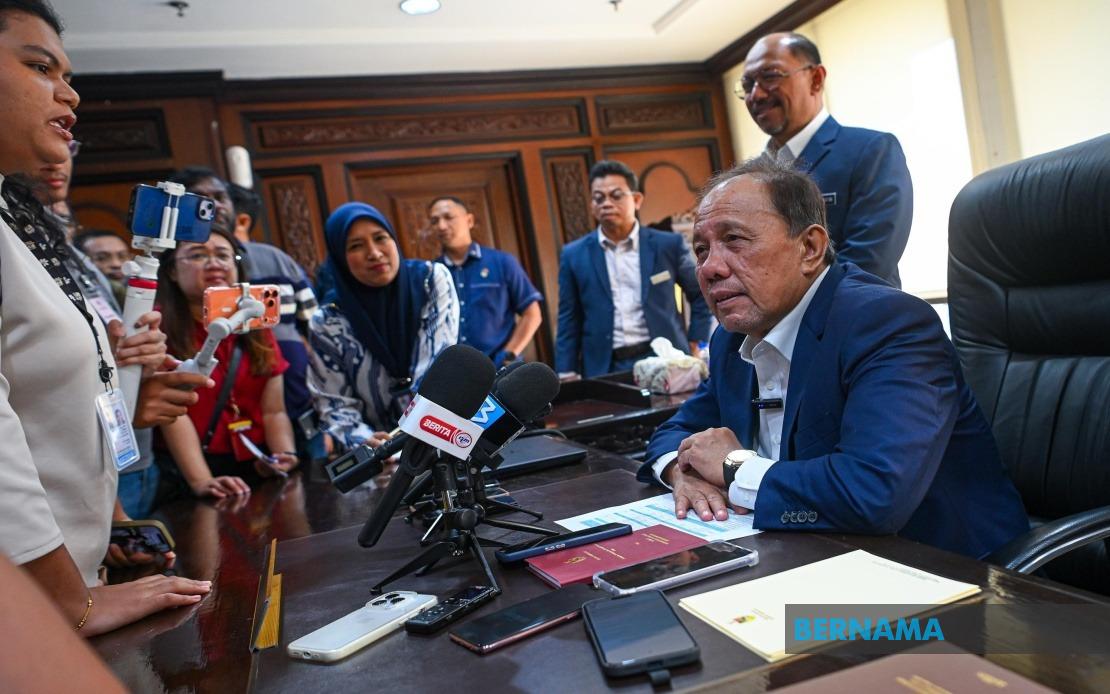
Negeri Sembilan's newly installed Menteri Besar Datuk Ismail Lasim has signalled that his administration will pursue an unconventional approach to the state's cabinet structure, proposing the creation of Deputy Executive Council positions to supplement the existing allocation of ministerial roles. The announcement, made during his first official engagement after assuming office, reflects a pragmatic response to the pressures of coalition governance in a state where political representation spans multiple parties with differing organisational strengths.
The proposal emerged from a fundamental constraint: the number of traditional Exco positions available within the formal structure of the Negeri Sembilan government does not accommodate all the state assemblymen from the governing coalition seeking roles in the administration. By introducing Deputy Exco positions—a tier of responsibility beneath the full Executive Council—Lasim aims to distribute leadership responsibilities across a broader cross-section of coalition legislators without formally expanding the cabinet itself. This arrangement would allow assemblymen from Barisan Nasional's component parties as well as from PAS and Parti Wawasan Negara to claim executive roles within the government.
For Malaysian observers familiar with state-level governance, such structural innovations are not unprecedented but remain relatively uncommon. Most state administrations operate within rigid ministerial configurations set out in constitutional provisions, leaving little flexibility when coalitions grow unwieldy or when junior partners demand executive representation. Lasim's approach suggests a willingness to test the boundaries of administrative practice, operating within the letter of the law while stretching its practical application. This reflects both the realities of contemporary coalition politics in Malaysia and the creative problem-solving required when governing coalitions span ideologically diverse partners.
The Menteri Besar acknowledged that the final architecture remains under deliberation. No decision has been reached on how many Deputy Exco positions will ultimately be established, nor have appointments to Senior Exco roles—another potential tier of distinction—been finalised. This extended timeline for announcement signals that negotiations between coalition partners are likely ongoing, with different factions seeking to secure their members' placement within the hierarchy. Such deliberations are typically conducted away from public view, involving careful calibration of party strengths, factional interests, and perceived policy competencies.
Lasim, a 67-year-old assemblyman representing Juasseh, formally commenced his tenure on the date of the announcement. He reported to the Menteri Besar's Office at Wisma Negeri in the morning, where he was received by the State Secretary and departmental leadership—a protocol that marked the ceremonial transition of executive authority. His swearing-in had occurred two days prior before Tuanku Muhriz Tuanku Munawir, the Yang Dipertuan Besar of Negeri Sembilan, cementing his constitutional legitimacy to lead the state.
The configuration of the Negeri Sembilan assembly that emerged from the recent state election provides the bedrock for this government's stability. Barisan Nasional secured 18 of the 43 seats, while its coalition partner Perikatan Nasional won seven seats, collectively yielding a two-thirds supermajority when combined. Pakatan Harapan's 11 seats consign it to opposition status. The BN-PN coalition's commanding majority—25 of 43 seats—provides substantial cushion against defections and grants the administration considerable latitude in its governance agenda and legislative priorities.
This electoral outcome represents a consolidation of support for the BN-PN partnership in a state that had previously oscillated between different political alignments. The two-thirds majority is particularly significant, as it enables the coalition to amend state constitutional provisions if needed, pass legislation without concern for opposition obstruction, and potentially reshape state institutions according to their preferences. For Lasim's administration, this translates into considerable legislative authority to implement the cabinet restructuring without needing to navigate fractious parliamentary debate.
The inclusion of PAS and Parti Wawasan Negara within the executive framework reflects the broader realignment of Malaysian politics over recent years. Both parties represent constituencies beyond traditional BN demographics, suggesting that the Negeri Sembilan government will need to accommodate diverse governance expectations. PAS brings its own organisational base and ideological perspectives, while Wawasan—a newer political entity—may represent specific regional or demographic interests. Integrating these partners into executive structures requires sensitive portfolio allocation and clear protocols to prevent inter-party friction on policy implementation.
The timeline for finalising the cabinet announcements—stated to be either Friday or Monday at the latest—suggests that Lasim's team has set internal deadlines for resolving outstanding negotiations. The compressed schedule reflects both the need to project stability and the administrative imperative of having a functioning executive in place. New state governments typically establish their core administration swiftly to begin policy agenda-setting and bureaucratic coordination, particularly when significant mandates have been secured through elections.
For Malaysian readers monitoring state-level governance, this structural innovation carries broader implications. If the Deputy Exco model successfully accommodates coalition tensions in Negeri Sembilan, other states with fragmented political landscapes might adopt similar approaches. Conversely, if such arrangements dilute accountability or create confusion in the administrative hierarchy, the experiment could be viewed as a cautionary tale about coalition governance stretched to its limits. The outcome will likely influence how future coalition negotiations approach cabinet architecture in other Malaysian jurisdictions.
The transition also offers insight into the mechanics of power consolidation at the state level. Lasim's emphasis on consultation and deliberative timeline-setting contrasts with some administrations that have moved swiftly to reward coalition partners. This measured approach may reflect his experience or simply the realities of managing multiple partners whose expectations must be balanced. How effectively this cabinet structure functions in practice—whether Deputy Exco positions deliver meaningful executive authority or become merely honorary designations—will become apparent as policy decisions are made and portfolios are exercised in the months ahead.

