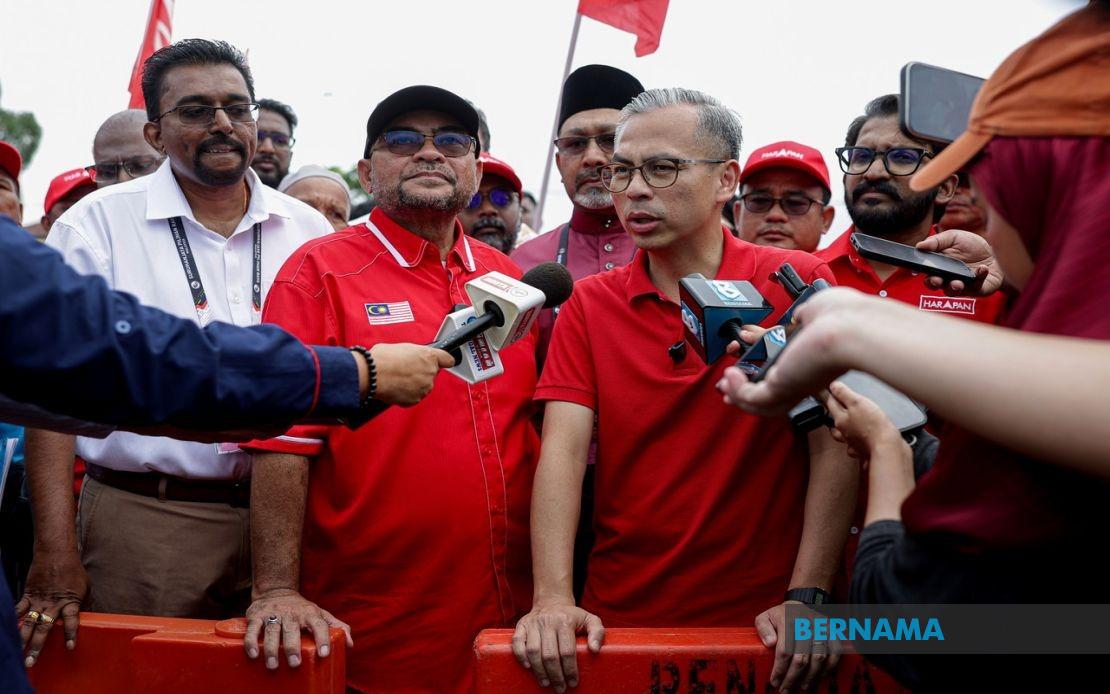
Pakatan Harapan is entering the Negeri Sembilan state election with a campaign strategy grounded in continuity, banking on the economic record and governance performance of Menteri Besar Datuk Seri Aminuddin Harun to persuade voters that maintaining the current administration serves their interests. The coalition's leadership, through Communications director Datuk Seri Fahmi Fadzil, has signalled that the campaign will deliberately emphasise proven performance over promises, a tactical choice reflecting confidence in measurable results delivered across the state since 2018.
The tangible achievements that PH intends to showcase form a compelling narrative for any incumbent seeking re-election. Since Aminuddin assumed leadership, Negeri Sembilan has recorded expanded zakat collection figures, bolstered state government revenue streams, and sustained momentum in attracting foreign capital—including the notable development of a new port facility. These accomplishments represent the bedrock of PH's electoral messaging, crafted to demonstrate that the administration has not merely governed but has actively generated economic dividends that reach ordinary residents through job creation and improved public finances.
This approach reflects a broader calculation within Malaysian politics about what moves voters in state elections. Rather than tilting toward ideological appeals or opposition narratives, PH has elected to position itself as the steward of incremental but tangible progress. For Negeri Sembilan residents—particularly in the Jempol parliamentary constituency where four state seats were up for nomination—the message translates into a simple proposition: disruption through a change of government carries uncertainty, while continuation of the current trajectory offers familiarity and proven economic management. The strategy becomes particularly salient in a state where local economic conditions directly influence household prosperity and employment prospects.
The candidate slate reflects PH's intention to field figures with capacity to articulate this message credibly. In Jeram Padang, the coalition has nominated G. Manivannan, a lawyer and political secretary to Prime Minister Datuk Seri Anwar Ibrahim, to contest what is being framed as a four-cornered fight. The choice of Manivannan, a professional with connections to the federal administration, signals PH's desire to project competence and administrative access—qualities that might appeal to constituents concerned with employment opportunities, a concern Fahmi specifically identified as prevalent among younger voters in the seat. Manivannan will face incumbent Datuk Mohd Zaidy Abdul Kadir representing Barisan Nasional, R. Sri Sanjeevan from Perikatan Nasional's Bersatu partner, and Dayana Dal, positioned as the sole Orang Asli candidate, making the contest genuinely competitive rather than predetermined.
Across the Jempol parliamentary constituency, the electoral landscape presents varied challenges and opportunities for PH. In Bahau, the coalition enjoys what appears to be a relatively straightforward contest, with incumbent Teo Kok Seong of DAP facing only Barisan Nasional's Chong Fui Ming of MCA. However, both Serting and Palong involve three-way contests that require PH to consolidate voter support in potentially fragmented fields. Serting pits PH's Yaacob Mahmood against Perikatan Nasional incumbent Mohd Fairuz Mohd Isa and Bersatu's Muhammad Noraffendy Mohd Salleh @ Affendy Salleh, while Palong features Barisan Nasional's sitting representative Datuk Mustapha Nagoor confronted by PH's Muhammad Zahin Zinal Abidin and Bersatu's Rebin Birham. These contests underscore the fragmentation of the Malaysian electoral landscape at state level, where traditional two-coalition structures have dissolved into more complex multi-polar contests.
Fahmi's remarks emphasised disciplined conduct throughout the campaign period, a concern that extends beyond mere procedural propriety. The request that all participants avoid the sensitive terrain of religion, race, and rulers—the so-called 3Rs—reflects awareness that Negeri Sembilan, like other Malaysian states, contains fault lines along these dimensions that can rapidly destabilise campaigns if exploited carelessly. By framing responsible campaigning as a matter of national communications standards, Fahmi positioned PH as the guardian of electoral decorum, an implicit contrast with potential opponents who might be tempted toward provocative messaging. The emphasis on combating misinformation and false narratives carries particular weight in an era when social media spreads unverified claims faster than fact-checkers can debunk them.
The Election Commission's timeline—establishing July 28 for early voting and August 1 as polling day—compresses the campaign into a two-week sprint. This condensed period requires that PH's messaging about economic achievements and administrative continuity gain traction quickly, before voters settle into final voting preferences. The acceleration also limits opportunities for sustained narrative-building around Aminuddin's record, making the initial framing of campaign priorities critical. PH's decision to frontload discussions of economic performance and stability reflects awareness that early momentum often shapes electoral outcomes in compressed campaigns.
For Malaysian observers tracking regional political trends, the Negeri Sembilan contest offers instructive lessons about how incumbent administrations at state level now campaign. The decline of ideology-driven politics has given way to performance-based appeals, where voters increasingly evaluate governments on delivery of concrete benefits rather than partisan affiliation. This shift has profound implications for Malaysian federalism, suggesting that state capitals are becoming sites where pragmatic economic governance carries greater weight than national political narratives. Negeri Sembilan's economic growth trajectory, if the coalition's claims withstand scrutiny, provides a case study in this reorientation.
The broader context of Malaysian state politics reveals that PH's strategy in Negeri Sembilan is not isolated but part of a wider pattern of incumbent coalition governing behaviour. Governments at state level, having secured power and implemented programmes, now campaign on what they have built rather than on promises of what they will build. This maturation of electoral tactics reflects deeper professionalisation within Malaysian political machinery, where candidates and party machinery increasingly operate on the assumption that voters reward delivery. Whether this assumption holds true in Negeri Sembilan—and whether PH's emphasis on Aminuddin's track record resonates with sufficient force to secure electoral continuation—will provide data for understanding how Malaysian voters weigh performance against other considerations in determining state electoral outcomes.
The nomination process itself, which Fahmi reported proceeded without untoward incident, sets a baseline for orderly conduct. That four state seats saw their nominations completed smoothly, with appropriate representation across competing coalitions and independent candidates, suggests the institutional machinery of Malaysian elections continues to function according to established protocols. As the campaign accelerates toward polling day, this foundation of institutional normality will require careful maintenance, particularly as parties seek competitive advantage in a political environment where the boundaries between vigorous contestation and destabilising rhetoric have become increasingly porous.

