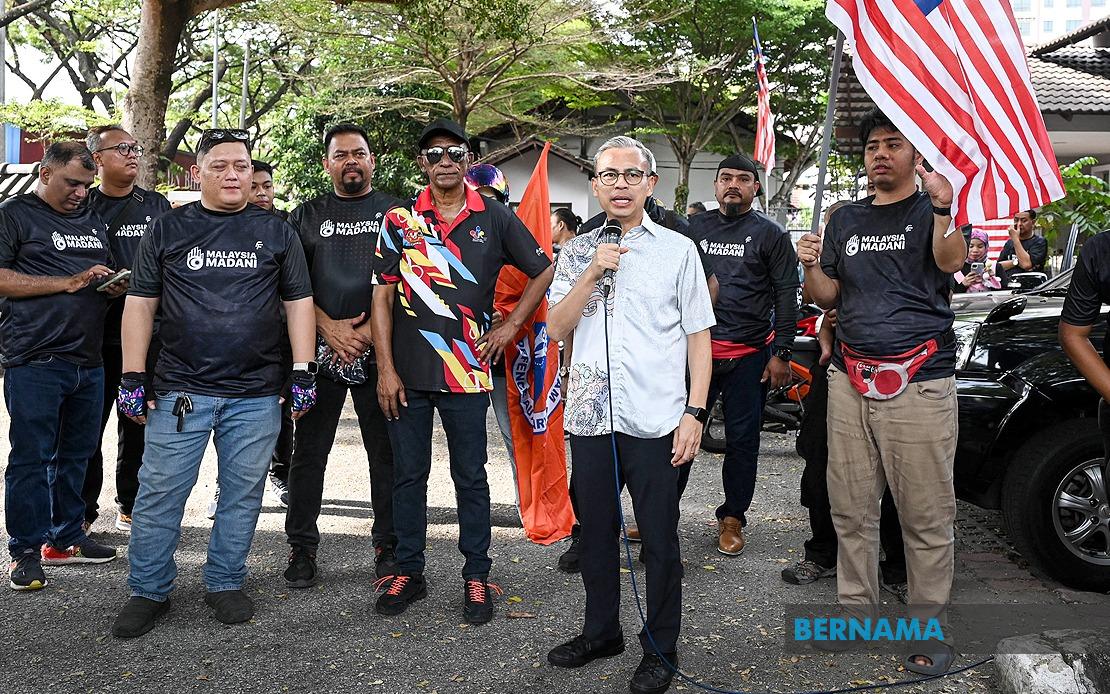
Nearly 300 motorcyclists converged on Lembah Pantai to participate in a patriotic convoy on the eve of Malaysia's independence celebrations, demonstrating commitment to national unity across the diverse constituency. The Kembara Merdeka Convoy brought together residents from different ethnic and religious backgrounds in a show of solidarity timed to amplify the festive mood as the nation prepared to mark Merdeka.
Communications Minister Datuk Seri Fahmi Fadzil, who also represents Lembah Pantai as its Member of Parliament, positioned the event as a platform for celebrating Malaysia's multicultural identity. His presence underscored the government's emphasis on national cohesion at a time when grassroots engagement remains a priority for maintaining social stability. The convoy served dual purposes: creating a visible spectacle of unity while engaging constituents directly through participatory activity rather than passive observation.
Fahmi articulated the core message that Lembah Pantai's strength lies in its demographic diversity and the friendships that transcend communal divides. His framing—that unity itself becomes a tool for progress—reflects a broader political narrative emphasising social harmony as prerequisite for economic development. For urban constituencies like Lembah Pantai, which encompass affluent areas and working-class neighbourhoods, such messaging attempts to bridge potential socioeconomic divisions through appeals to shared national identity.
The physical route of the convoy carried symbolic weight beyond mere celebration. Beginning at Taman Seri Sentosa, the motorcade traversed five designated stops including Kampung Pasir, IWK Eco Park, and Vista Angkasa in Kampung Kerinchi before terminating at Bangsar LRT station. This routing deliberately connected different geographical zones within the constituency, ensuring visibility across multiple communities and preventing the event from becoming concentrated in any single demographic enclave.
At each pit stop, organisers performed a ceremonial handover of Jalur Gemilang flags to representatives from Resident Representative Councils and community groups. This ritualistic element transformed the convoy from mere procession into structured civic engagement, allowing local leadership to participate formally and providing tangible symbols of patriotism that residents could physically receive and display. The flag distribution strategy ensured that the patriotic message reached neighbourhood-level organisations with actual community roots.
Fahmi's speech emphasised continuity between this single event and sustained community programming. Rather than positioning the convoy as a standalone celebration, he framed it as launching point for ongoing initiatives encompassing both social assistance and cultural activities. This rhetorical move attempted to convert momentary participation into habitual engagement, suggesting that the relationships forged during the convoy would motivate future involvement in government-supported programmes.
For the broader Malaysian political context, such grassroots mobilisation events carry significance beyond their immediate local impact. They demonstrate on-ground presence by elected representatives, generate positive media coverage, and create photographic evidence of multiethnic participation that counters narratives of communal polarisation. In urban constituencies particularly, where social media and citizen journalism amplify political narratives, successful community events become valuable political assets.
The timing—immediately preceding Merdeka—reflects deliberate political scheduling. National independence celebrations offer legitimate frameworks for patriotic appeals that transcend partisan politics, allowing government officials to engage voters around shared national symbols without appearing overtly factional. The motorcycle convoy format itself appeals to specific demographics, with riders representing both working-class and middle-class participant bases.
Lembah Pantai has historically been a competitive constituency, making grassroots engagement strategically important. Fahmi's emphasis on community programmes and ongoing assistance represents a political investment in demonstrating tangible constituency services. By highlighting future initiatives alongside the convoy itself, he positioned his office as actively working to improve residents' lives beyond ceremonial appearances.
The convergence of nearly 300 motorcyclists, while impressive as participation numbers, also reflects the selective nature of such events. Participation requires advance knowledge, free time, motorcycle ownership or access, and willingness to engage in a government-organised activity. These factors mean that convoy participants likely skew toward more politically engaged and relatively stable segments of the community, rather than representing comprehensive cross-sections of constituency demographics.
For Southeast Asian observers, Malaysia's approach to celebrating independence through community mobilisation and multiethnic participation reflects particular regional dynamics. Nations in the region wrestle with balancing national unity narratives against historical communal tensions and contemporary migration patterns. Malaysia's strategy—explicit celebration of multicultural identity as strength rather than challenge—distinguishes its approach from some neighbours where national identity remains more contested terrain.
The success of such initiatives ultimately depends on whether participants experience genuine community connection or perceive events as superficial political theatre. Fahmi's commitment to sustaining engagement through future programming will determine whether the convoy catalyses meaningful community organising or functions merely as symbolic gesture. The Merdeka eve convoy represented visible investment in cohesion at precisely the moment when such messaging carries maximum cultural resonance across Malaysia's diverse population.

