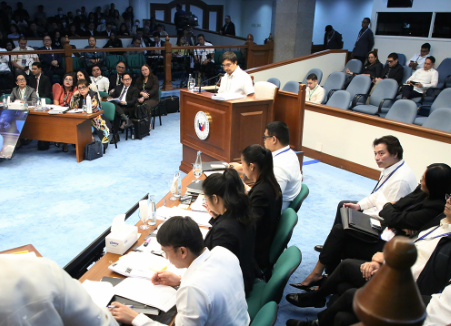
The National Bureau of Investigation presented a stark assessment during the fifth day of Vice President Sara Duterte's impeachment trial on Tuesday, with regional director Jeremy Lotoc arguing that the country's second-highest official possessed both the means and intention to act on her publicly stated threats against President Ferdinand Marcos, First Lady Liza Araneta-Marcos, and former Speaker Martin Romualdez. Testifying before the Senate impeachment court, Lotoc contended that Duterte's remarks constituted the grave crime of threatening and represented a fundamental betrayal of public trust, the legal foundation underpinning the current proceedings against her.
The NBI's conclusion rested on a straightforward but controversial premise: Lotoc argued that Duterte's position as Vice President, combined with her family's substantial political influence, provided her with the material capacity to orchestrate the violence she had threatened. When pressed by Senate President Sherwin Gatchalian on whether Duterte possessed such capability, Lotoc offered an unequivocal affirmative response. He then elaborated that her paternal lineage—her father having served as a former Philippine president—reinforced the bureau's assessment that she retained access to networks and resources that could facilitate such actions. This reasoning revealed a critical argument in the prosecution's strategy: that threats uttered by someone with Duterte's political standing carry heightened gravity precisely because of their demonstrable capacity for execution.
A central point of contention emerged around the NBI's claim that Duterte had allegedly engaged someone to carry out potential attacks on the three officials should she herself be targeted. When Gatchalian questioned the evidentiary foundation for this serious allegation, Lotoc acknowledged a significant limitation in the investigation: the NBI possessed no independent evidence of any actual intermediary or conspirator. Instead, the bureau's conclusion derived entirely from Duterte's own public statements, particularly remarks made during a November 23, 2024 online press conference and a subsequent November 26 interview in which she referenced having spoken to someone about exacting revenge if she were killed. This reliance on the suspect's own words rather than corroborating physical or testimonial evidence became the focal point of the defense's subsequent challenges to the NBI's credibility.
Lotoc's testimony underscored a methodological frustration that has plagued the investigation since its inception: Duterte never appeared before the NBI despite the bureau's desire to conduct a personal interrogation. The NBI official explained that such a session would have allowed investigators to probe whether she had genuinely contracted an assassin, to explore the identity of any alleged intermediary, or to assess whether her public utterances reflected calculated intent or rhetorical hyperbole. Duterte's absence from questioning, combined with what the NBI characterized as her merely denying the hiring of a hitman without directly retracting her original statements, shaped the bureau's interpretive framework. Lotoc argued that her denial was insufficient to negate the threatening utterances she had undoubtedly made, a position that underscores the prosecution's broader argument that Duterte's conduct violated constitutional standards regardless of the actual outcome she may have intended.
During cross-examination, the defense attempted to undermine the NBI's investigative rigor by highlighting typographical and clerical errors contained in the bureau's documents. Lotoc, however, dismissed these technical shortcomings as immaterial to the substance of the investigation's findings. He maintained that such errors reflected nothing more than administrative imprecision and possessed no bearing on the bureau's core conclusion that Duterte had committed grave threats and incited sedition. This exchange illustrated a persistent tension in the trial: whether the prosecution must meet evidentiary standards appropriate to criminal prosecutions, or whether the impeachment process operates under a different, potentially less stringent threshold of proof appropriate to a political proceeding against a sitting constitutional officer.
For Malaysian observers of Philippine politics, the trial raises instructive questions about the intersection of democratic accountability and the institutional vulnerabilities that attend high-level political conflict. The impeachment mechanism, designed to remove officials who have forfeited public trust, becomes a vehicle for contested political grievances when disagreements between branches of government intensify. The Duterte case, occurring within the context of a broader falling-out between the Vice President and the Marcos administration, illustrates how constitutional mechanisms can become weaponized during periods of executive fracture. In Southeast Asia's broader context, where concerns about democratic backsliding and institutional instability frequently surface, the Philippine experience offers insights into how the formal structures of democratic accountability operate under stress.
Lotoc's testimony also addressed an alternative explanation Duterte has offered for her antagonistic statements: the existence of a purported "Operation Romanov," which she has cited as evidence that actors close to the President had targeted her for elimination. The NBI's investigation revealed that the term originated not with Duterte's camp but rather with Davao City Mayor Sebastian "Baste" Duterte, the Vice President's brother, during a January 2024 rally, and that the operation was directed at President Marcos and his family rather than at the Vice President herself. When vlogger Princess Maui introduced claims about Operation Romanov during Duterte's November 23 briefing, Lotoc explained that the NBI attempted to validate this information but ultimately deemed it unreliable after Maui failed to appear before investigators to substantiate her allegations. The bureau found no independent confirmation of any validated threat against Duterte, a finding that complicated her self-defense narrative.
The prosecution's assertion that Duterte has demonstrated conduct unbecoming of the nation's second-highest official carries substantial weight given that she occupies the constitutional succession line to the presidency. Should Marcos become incapacitated, Duterte would automatically assume the nation's highest office—a prospect that the prosecution contends raises grave concerns given her public statements. The prosecutors argue that her threatening rhetoric, directed at the sitting President and his immediate family members, represents not merely a personal dispute but a breakdown in the institutional relationships necessary for stable governance. This framing transforms the trial from a narrow legal proceeding into a referendum on Duterte's fitness to potentially command the full executive apparatus, a consideration that influences how senator-judges evaluate the evidence.
During redirect examination, private prosecutor Amado Virgil Ligutan emphasized a critical distinction that favored the prosecution's narrative: Duterte has never actually denied making the controversial statements themselves, only denied engaging an assassin. When Lotoc referenced her November 26 interview, he noted that she had reiterated her earlier remarks rather than withdrawn them, indicating to the prosecution that she stood by her threatening language. This distinction between disavowal of the statements and disavowal of the hiring allegation became strategically significant in the prosecution's effort to establish premeditation and deliberation—hallmarks of grave threats rather than mere heated rhetoric delivered in the heat of political disagreement.
Prosecution adviser Robert Ace Barbers concluded his argument by contending that the defense's cross-examination had failed to substantially undermine Lotoc's testimony, instead focusing on peripheral matters of documentary accuracy while leaving the core allegations unaddressed. This characterization of the defense strategy suggested that prosecutors believed they had effectively established a factual foundation for their allegations, though the ultimate judgment rests with the senator-judges who must evaluate whether the evidence meets the threshold for removing a sitting constitutional officer. The impeachment trial now proceeds toward its conclusion with the prosecution having presented testimony asserting that Duterte possessed both capability and mens rea—the guilty mind—necessary to establish grave threats, though questions remain about whether the evidence satisfies the high bar for removing an incumbent Vice President.

