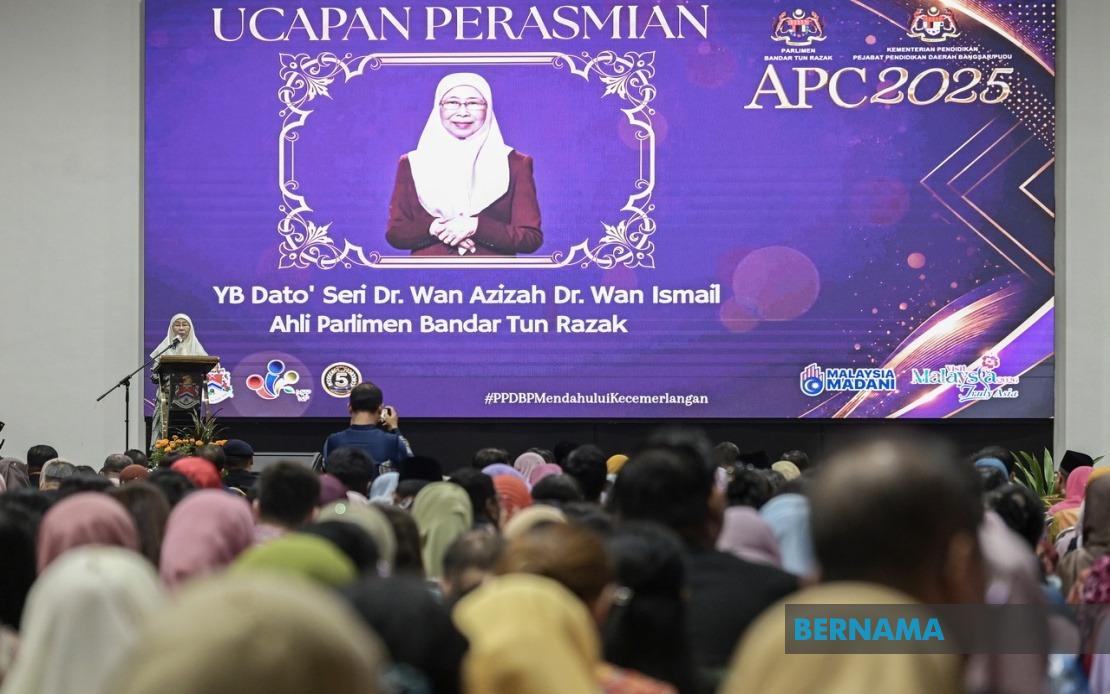
A nation's prosperity cannot be measured solely by economic performance, technological innovation, or infrastructure development, but fundamentally by its capacity to foster individuals of integrity, wisdom, and compassion. This message, delivered by Prime Minister's wife Datuk Seri Dr Wan Azizah Wan Ismail at an education sector event in Kuala Lumpur, underscores a growing concern among Malaysian policymakers that national advancement requires a holistic approach transcending material indicators alone.
Dr Wan Azizah, who represents Bandar Tun Razak in Parliament, articulated this vision while presiding over the 2025 Excellent Service Award ceremony hosted by the Bangsar/Pudu District Education Office at the Kuala Lumpur City Hall Training Institute. Her remarks struck at the philosophical heart of Malaysia's educational mission, challenging stakeholders to recalibrate how success in schools is conceptualized and measured. The occasion honoured 746 teachers and school administrators drawn from 143 institutions across the district, recognizing their contributions throughout the year.
Central to her address was the pivotal role educators occupy in shaping societal values. Teachers, she emphasized, shoulder responsibility far exceeding the transmission of academic content; they function as architects of character during formative years when young Malaysians are particularly malleable. This observation gains particular resonance in urban contexts, where dual-income household dynamics mean students spend extended periods within school environments, making educators de facto custodians of moral development alongside conventional instruction.
The education system's purpose, according to Dr Wan Azizah, transcends knowledge delivery to encompass the deliberate cultivation of virtuous citizens possessing refined conduct and genuine empathy for others. This framing aligns with Malaysia's constitutional aspirations and the Rukun Negara's emphasis on character-based citizenship. By repositioning teachers as "nation-shapers" whose influence extends beyond academic achievement, she articulated an understanding of education as fundamentally developmental rather than purely utilitarian.
A particularly salient dimension of her commentary addressed artificial intelligence and information saturation. As digital technologies proliferate and misinformation becomes increasingly sophisticated, Dr Wan Azizah contended that traditional pedagogical approaches require evolution. Values-anchored education paired with robust critical thinking capacities becomes essential for students to navigate complex information landscapes and discern authenticity from deception. This concern reflects broader regional anxieties about digital literacy and cognitive resilience amid technological disruption.
For Malaysian educators confronting resource constraints and mounting administrative burdens, Dr Wan Azizah's recognition carried symbolic weight. By amplifying the significance of their work beyond bureaucratic efficiency metrics, she sought to reinvigorate professional pride and commitment. The award recipients, she suggested, exemplify the standard to which all educators should aspire, their recognition intended both as celebration and aspiration-setting for the broader teaching fraternity.
The 2025 awards programme itself reflected scale and institutional commitment: approximately 1,000 attendees participated in ceremonies acknowledging educators and administrative personnel across the Bangsar/Pudu jurisdiction. This magnitude indicates education authorities' investment in recognizing excellence and fostering cultures of accountability and aspiration within institutional hierarchies. Such recognition ceremonies serve multiple functions—validating individual effort, signalling systemic priorities, and creating peer pressure toward elevated standards.
The Bangsar/Pudu district encompasses areas of considerable socioeconomic heterogeneity, from affluent suburban communities to urban kampungs. Recognition of educators across this spectrum underscores education's democratic function: regardless of school context or student demographics, principled teaching contributes to nation-building. This geographical and demographic inclusivity in award distribution suggests deliberate efforts to recognize excellence wherever it emerges, rather than concentrating accolades within advantaged zones.
Dr Wan Azizah's emphasis on values-based education resonates with Malaysia's broader policy discourse around nation-building. As the country confronts challenges ranging from social polarization to economic transformation, educational institutions are increasingly positioned as countervailing forces against fragmentation and moral relativism. The teacher thus becomes not merely a content facilitator but a stabilizing social agent, an interpreter of shared values in an increasingly pluralistic society.
The involvement of senior officials—including the Prime Minister's Political Secretary Datuk Azman Abidin and Kuala Lumpur Federal Territory Education Department director Megat Affandi Ismail—signalled political investment in the education portfolio. Their presence elevated the ceremony's profile beyond routine administrative functions, suggesting recognition at senior governmental levels that educator morale and public acknowledgment of educational contributions merit executive attention. For an education sector often perceived as under-resourced relative to demands placed upon it, such visible support carries organizational significance.
Looking forward, Dr Wan Azizah's articulation of education's character-formation mandate invites deeper consideration of curriculum balance. While Malaysia maintains competitive academic achievement in regional comparisons, questions persist regarding whether institutional structures adequately cultivate the ethical reasoning and emotional intelligence she emphasized. Reconciling examination-driven accountability with character development represents a persistent pedagogical tension unresolved across most systems globally.
The recognition of educational excellence in Bangsar/Pudu provides a microcosm reflecting national education aspirations. Whether such initiatives translate into systemic transformation—through adjusted assessment frameworks, teacher training modifications, or resource reallocation—remains an open question. Dr Wan Azizah's articulation of values-centric education offers conceptual clarity regarding priorities; translating aspiration into institutional practice requires sustained policy coherence and investment extending considerably beyond ceremonial recognition events.

