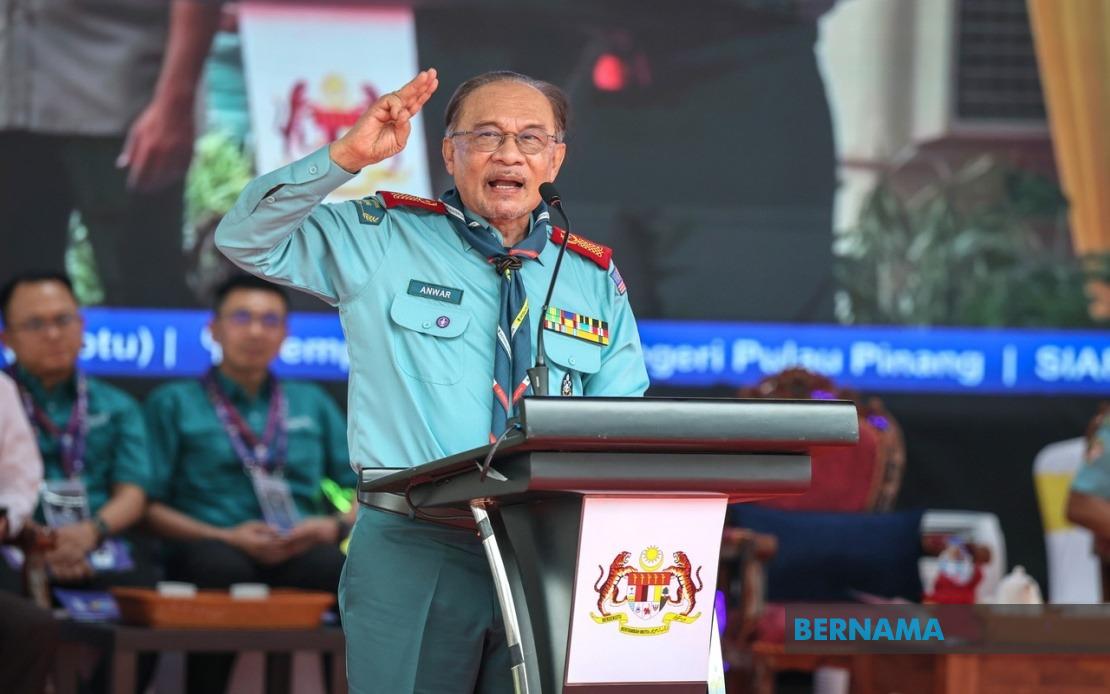
Prime Minister Datuk Seri Anwar Ibrahim has drawn a stark distinction between material advancement and genuine national progress, arguing that Malaysia's trajectory depends fundamentally on cultivating a generation grounded in ethical principles and social responsibility. Speaking at the opening ceremony of the 15th Malaysian Scouts Jamboree in Batu Kawan on August 29, Anwar cautioned against measuring a nation's achievements through economic metrics and technological innovation alone, insisting instead that sustained success requires young citizens who understand their obligations to family, community and state.
Anwar's remarks underscore an emerging tension within Malaysia's development narrative. While the country has invested heavily in digital infrastructure and positioned itself as a technology hub within Southeast Asia, the Prime Minister suggests these gains risk becoming hollow without a corresponding emphasis on character formation. He articulated this concern through a rhetorical flourish, questioning what economic progress actually means if younger Malaysians lack spiritual grounding, educational depth, and affection for their nation. This framing reflects broader anxieties within Malaysian leadership about whether rapid modernization is adequately accompanied by intergenerational transmission of civic values.
The Prime Minister outlined a specific educational philosophy that extends beyond conventional classroom instruction. He advocated for schooling systems, whether at primary, secondary or tertiary level, that deliberately weave moral development into their curricula. According to Anwar, knowledge acquisition should ultimately serve a higher purpose: producing individuals who are not only intellectually capable but also ethically anchored, capable of contributing meaningfully to society while honouring filial obligations and broader national interests. This perspective challenges purely utilitarian approaches to education that prioritize skills and credentials divorced from values formation.
Anwar placed particular emphasis on the relationship between technological change and cultural continuity. As Malaysia navigates the complexities of artificial intelligence and digital transformation, he warned that the younger generation must resist the gravitational pull of technological solutionism that treats innovation as an end in itself. Rather, he advocated for a balanced approach wherein technological adoption enhances rather than displaces the cultural and traditional foundations that provide social cohesion and individual identity. This reflects awareness that rapid digitalization can generate social fragmentation and cultural displacement, particularly among youth populations most immersed in digital environments.
The jamboree itself provided a tangible expression of these principles. Bringing together more than 5,450 scouts from Malaysia and ten other countries including South Korea, Indonesia, Singapore and Sri Lanka, the gathering embodies a model of youth development emphasizing practical skills, outdoor competency, community service and character building. The Penang State Stadium event carries additional symbolic weight as it marks the return of this national competition to Penang after a six-decade gap, the last hosting occurring in Teluk Bahang in 1966. This historical context suggests that scouting has longstanding institutional relevance within Malaysia's approach to youth formation.
Anwar's insistence on unity in diversity represents another layer of his argument about youth development. As Malaysia contends with increasing pluralism and periodic intercommunal tensions, investing in a generation comfortable navigating cultural heterogeneity becomes strategically important. The Prime Minister framed this not as mere tolerance but as active appreciation for Malaysia's multicultural fabric, suggesting that tomorrow's leaders must be equipped to convert diversity from potential vulnerability into organizational strength. This emphasis takes on heightened significance given regional geopolitical uncertainties and internal pressures on national cohesion.
The patriotism dimension of Anwar's address carries temporal specificity. With Malaysia's 2026 National Day celebrations approaching, the Prime Minister sought to activate nationalist sentiment among younger cohorts while simultaneously preparing them psychologically for future challenges. This dual framing—honoring the past while steeling for adversity ahead—suggests official recognition that maintaining patriotic commitment among youth cannot be assumed as automatic but requires deliberate cultivation and periodic reinforcement. The phasing also hints at anticipated difficulties the nation may confront in coming years, whether economic, security-related or geopolitical.
For Malaysian policymakers and educators, Anwar's intervention provides both validation and critique. It affirms the legitimacy of values-based education approaches sometimes dismissed as insufficiently practical in market-oriented contexts. Simultaneously, it implicitly criticizes educational institutions where moral formation receives insufficient emphasis relative to examination performance and credential accumulation. Schools, universities and skills-training centers across Malaysia may interpret his remarks as a call for institutional rebalancing, potentially reshaping curriculum development and pedagogical priorities.
The broader Southeast Asian context enriches interpretation of Anwar's position. The region has experienced dramatic economic transformation over recent decades alongside troubling indicators of social fragmentation, mental health challenges among youth, and declining civic participation. Malaysia's experience reflects these regional patterns. Anwar's articulation of an alternative development model—one privileging ethical formation alongside technological capability—may resonate with policymakers across Southeast Asia grappling with similar tensions between rapid modernization and social stability.
Implementation challenges remain substantial. Translating Anwar's philosophical framework into concrete institutional changes across Malaysia's diverse educational ecosystem will require sustained political will, adequate resource allocation, and consensus-building among educators, parents and religious leaders. Different communities may interpret "values" and "discipline" through divergent cultural and religious lenses, requiring sensitive navigation. Nevertheless, his public emphasis on these dimensions signals that Malaysian leadership perceives youth character development as a matter of national strategic importance, not merely personal or family concern, reshaping how educational outcomes are evaluated and institutional success is measured.

