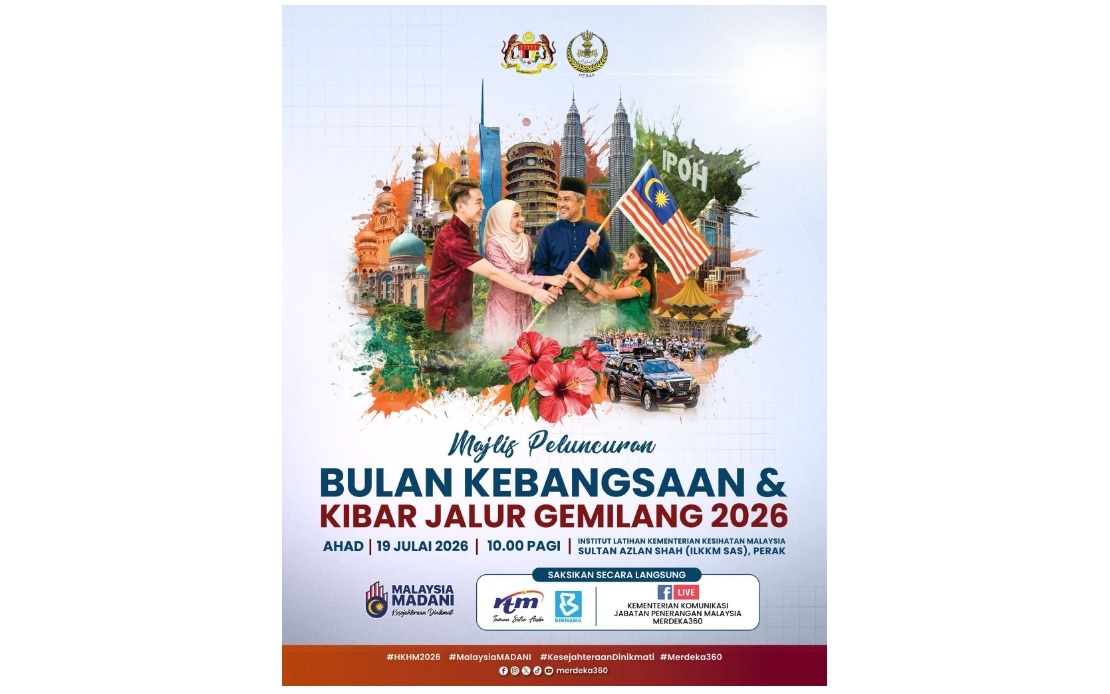
The inaugural ceremony for Malaysia's National Month 2026 and the Fly the Jalur Gemilang campaign will take place on July 19 at Institut Latihan Kementerian Kesihatan Malaysia Sultan Azlan Shah in Perak, setting the tone for the country's patriotic observances throughout the year. Beginning at 10 am, the event will reach audiences nationwide through simultaneous broadcasting on Radio Televisyen Malaysia, BERNAMA TV, and digital platforms including Facebook Live channels operated by Merdeka360, the Ministry of Communications, and the Department of Information Malaysia.
The launch represents the government's structured approach to building momentum around the annual celebration, which traditionally culminates in festivities on National Day on August 31 and Malaysia Day on September 16. By initiating the campaign in mid-July, authorities aim to provide sufficient lead time for public and private sector participation, allowing communities across the peninsula and East Malaysia to prepare their own observances and cultural programmes.
Under the banner "Malaysia MADANI: Kesejahteraan Dinikmati"—translating to welfare enjoyed by all—this year's celebrations encapsulate the government's development philosophy centred on equitable prosperity. The chosen theme emphasizes the principles of justice, human dignity, and collective welfare that underpin the Malaysia MADANI framework, signalling that national progress must benefit all citizens comprehensively rather than concentrating advantages among selected groups.
The Malaysia MADANI logo, which debuted during previous national commemorations, has been retained as the visual identity for 2026's festivities, providing continuity and reinforcing the government's commitment to this overarching development agenda. The consistency in branding demonstrates an intention to embed Malaysia MADANI principles deeply into public consciousness and national identity discourse.
Communications Minister Datuk Seri Fahmi Fadzil previously disclosed that the National Day celebrations will unfold at Dataran Putrajaya on August 31, deliberately scaled as a modest yet vibrant affair rather than an extravagant state spectacle. This measured approach reflects contemporary sensibilities regarding public spending and resource allocation during an era when fiscal prudence remains a governmental priority.
Meanwhile, Malaysia Day observances on September 16 will be hosted in Sarawak, demonstrating the government's commitment to rotating major commemorative events across different states to foster regional inclusivity and ensure that East Malaysian perspectives and contributions receive prominent recognition on the national stage. This decision carries symbolic weight for Sarawak and Sabah, whose voluntary federation with Malaya in 1963 created modern Malaysia.
To sustain the celebratory momentum throughout the campaign period, organisers have choreographed seven supporting programmes and patriotic initiatives spanning the nation. These include Kembara Bahasa HKHM, focusing on linguistic and cultural heritage; Quran Hour, accommodating religious observances; Ambang Merdeka, building anticipatory energy; Merdeka Countdown, creating temporal milestones; RIUH Merdeka, likely engaging grassroots participation; and the National Statesmen Commemoration Ceremony, honouring leadership legacies.
Participants and community organisers can access comprehensive resources through Merdeka360.my, where official logos, patriotic musical compositions, and extensive promotional materials are available for download. This digital-first approach democratizes access to campaign materials, enabling grassroots organisations, educational institutions, and local councils to execute coherent patriotic activities without substantial financial barriers.
The widespread distribution network and multi-platform broadcasting strategy reflects an understanding that Malaysian society spans diverse geographical, linguistic, and technological contexts. Rural communities, urban centres, and digitally-connected populations can all engage meaningfully with the campaign through their preferred information channels.
For Malaysian readers and regional observers, these celebrations represent more than ceremonial observances. They function as periodic national reflection points where government articulates its development vision and society contemplates collective identity and shared purpose. The emphasis on inclusive prosperity in the Malaysia MADANI theme gains particular relevance amid global economic uncertainties and regional disparities in development outcomes.
The July 19 launch from Perak carries geographical significance too, as the state holds historical weight in Malaysian federalism and represents the geographic and cultural diversity that comprises modern Malaysia. Selecting this venue grounds the celebration in territorial authenticity rather than concentration solely on federal centres.

