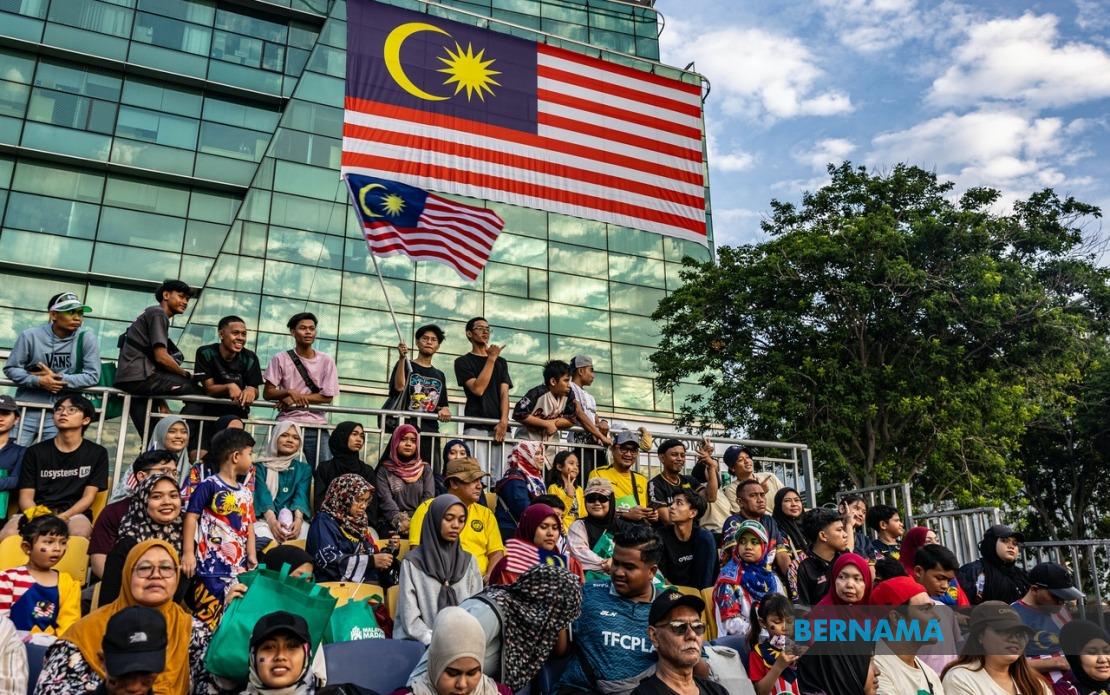
Malaysia's 69th National Day celebration in Putrajaya on August 31 drew crowds exceeding initial projections, with over 100,000 people gathering to mark the occasion, according to Communications Minister Datuk Seri Fahmi Fadzil. The attendance figure surpassed the government's original target of 80,000, reflecting strong public participation and national sentiment during the commemorative event.
Fahmi, who chairs the 2026 National Day and Malaysia Day Main Committee, attributed the seamless execution to meticulous planning and coordinated efforts across multiple government agencies and departments. Favourable weather conditions throughout the day facilitated outdoor activities and the extended celebration, allowing families and groups to remain on-site longer than anticipated. The absence of security incidents or logistical disruptions underscored the effectiveness of the organising committee's preparation and risk management protocols.
The minister specifically acknowledged the contributions of the Department of Environment, Malaysian Meteorological Department and National Disaster Management Agency, which maintained weather surveillance and prepared contingency measures including potential cloud seeding operations. This inter-agency collaboration demonstrated how coordinated government response ensures major national events proceed without incident, even when dealing with unpredictable factors such as weather patterns. Such cooperation reflects broader trends in Malaysian governance emphasising whole-of-government approaches to public celebrations.
Beyond the main parade and ceremonial elements, organisers provided diverse programming to sustain engagement throughout the day. Attendees accessed national defence assets displayed at Anjung Floria, participated in Riuh Merdeka celebrations at Monumen Alaf Baru, and enjoyed numerous food and beverage options. These supplementary activities extended the celebration's reach, transforming it from a concentrated event into an extended family experience that encouraged extended stays and broader participation across demographic groups.
The 2026 observance featured substantially scaled participation, with 76 contingents, 22 marching bands and 11 decorated vehicles forming the parade procession. More than 10,800 individuals representing government agencies, security forces, uniformed bodies, government-linked companies, students from secondary and tertiary institutions, and civil society organisations participated actively. This diverse representation symbolised nationwide engagement with national identity, transcending bureaucratic participation to incorporate youth and community voices.
Several debut components enhanced the celebration's contemporary relevance. The Royal Johor Military Force participated for the first time, reflecting evolving defence force integration within national commemorative frameworks. The inclusion of a South-East Asian Games 2027 contingent provided forward-looking symbolism, connecting Malaysia's immediate national celebration to the region's upcoming sporting showcase. An Orange Economy Sustainability cluster contingent highlighted government commitment to environmental awareness and economic transformation aligned with MADANI principles, embedding policy priorities within ceremonial contexts.
The artistic dimension encompassed both innovation and tradition. The Gema Inovasi MADANI percussion performance brought together 150 musicians wielding Rebana Inovasi, Kompang Inovasi and traditional instruments, demonstrating cultural adaptation and modernisation within heritage frameworks. Complementing this artistic expression, 1,500 human graphic performers created visual narratives reflecting Malaysia's cultural plurality. These elements transformed the parade from procedural movement into cultural exposition, enabling international audiences and local observers to encounter national identity through artistic prisms.
The celebration's closing featured Royal Malaysian Air Force displays, including fighter aircraft, transport planes and helicopter squadrons showcasing national defence capabilities. These dramatic visual performances provided technological spectacle while reinforcing defence sector visibility and capability demonstration. The finale incorporated 2,350 participants in "Rentak MADANI, Paluan Tradisi," a performance synthesising contemporary governance themes with traditional rhythmic elements, creating symbolic conclusion that linked past cultural continuity with future-oriented development frameworks.
Under the overarching theme "Malaysia MADANI: Kesejahteraan Dinikmati," the celebration articulated government messaging regarding prosperity and wellbeing accessible across demographic backgrounds. This thematic framing positioned national day commemoration as affirming specific policy directions and development philosophies rather than merely honouring historical independence. The integration of governance narratives within celebratory frameworks reflects contemporary trends globally, where national commemorations serve dual functions as historical reflection and policy affirmation.
Fahmi articulated aspirational dimensions, emphasising that the celebration aimed to strengthen national unity and deepen Malaysian affinity for their country. This rhetoric positioned national day observations beyond ceremonial obligation, framing them as mechanisms for psychological reinforcement of national cohesion. For a multiethnic, multireligious nation like Malaysia, such symbolic unification carries particular significance, with state-sponsored celebrations serving as validated spaces where diverse communities affirm shared national belonging.
The participation from geographically dispersed regions, including attendees from Sandakan, Johor Bahru and Jeli, demonstrated pull extending across peninsular Malaysia and East Malaysian territories. This territorial representation, acknowledged explicitly by Fahmi, illustrated genuine nationwide engagement rather than concentration among urban Klang Valley participants. The travel commitments undertaken by regional populations underscored National Day's continued salience as binding occasion transcending local parochialism.
The successful execution and attendance surplus carry implications for future national event planning. The demonstrated capacity to accommodate 100,000-plus attendees safely establishes precedent for scaling future celebrations, potentially in alternating locations beyond Putrajaya. Government agencies involved recognised operational frameworks and coordination mechanisms that functioned effectively, creating institutional knowledge deployable in subsequent commemorations.
For Malaysian observers and Southeast Asian audiences, the 2026 celebration represented normalised recovery and scaled-up public gathering following pandemic-constrained years. The enthusiasm and multifaceted participation suggested sustained public investment in national commemoration, reinforcing democratic societies' capacity to unite around shared symbolic moments. As Malaysia approaches continued regional integration and global engagement, these periodic unifying occasions remain significant anchors for collective identity affirmation.

