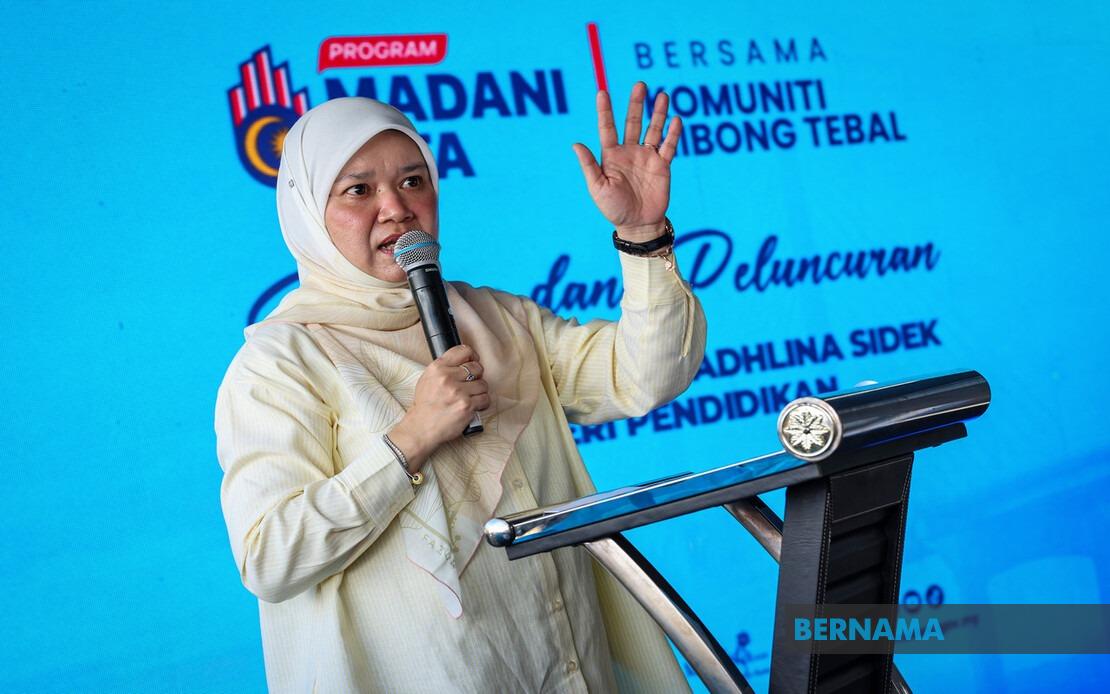
Education Minister Fadhlina Sidek has praised the National Information Dissemination Centre's (NADI) Mahir uniform initiative as a practical solution to lighten the financial load carried by Malaysian families at the start of the school year. Speaking in Nibong Tebal after launching the MADANI Kita programme, Fadhlina noted that the instalment-based purchasing system for school uniforms represents a meaningful intervention in household budgeting, particularly for lower and middle-income families who often struggle with back-to-school expenses.
The NADI Mahir scheme operates as a social enterprise model, combining consumer benefit with entrepreneurial support. School uniforms are manufactured by 120 entrepreneurs who graduated from the NADI Mahir Jahit skills training programme, demonstrating how targeted vocational education can transform lives while simultaneously addressing community needs. These producers underwent intensive training through NADI's Pintar Services initiative and now operate as independent businesspeople, generating sustainable livelihoods from a steady revenue stream created by the uniform programme itself.
Fadhlina's emphasis on the dual benefit of the scheme reflects a broader policy philosophy within Malaysia's education ministry—that government initiatives should whenever possible create multiplier effects across the economy. Rather than simply distributing uniforms or subsidising their purchase, NADI Mahir channels money through local artisans and small manufacturers, keeping wealth circulating within communities while reducing dependency on large-scale industrial production. This approach has particular relevance in states like Penang, where informal economies and micro-entrepreneurship form significant parts of the livelihood landscape.
The impact extends beyond uniform procurement. According to Fadhlina, NADI's portfolio of community programmes has achieved measurable reach across Malaysia. The NADI Tuisyen Rakyat tutoring initiative alone has enrolled more than 42,000 students nationally, with Nibong Tebal hosting 73 participants. These students produced tangible academic results, with 65 achieving outstanding performance in the 2025 Sijil Pelajaran Malaysia examination—a benchmark that suggests the programme addresses genuine educational gaps in resource-constrained communities.
Youth engagement forms another pillar of NADI's work, particularly through its esports platform. The NADI E-Sukan programme positions competitive gaming as a legitimate avenue for talent identification, confidence-building, and collaborative skill development among young people. Nibong Tebal has demonstrated success at this level, winning the national NADI E-Sukan MADANI Mobile Legends championship and achieving runner-up finishes in state-level esports and culinary competitions. These achievements signal that NADI's youth programming succeeds in generating measurable wins for participants while building pride within constituencies.
The integration of artificial intelligence literacy into NADI's framework demonstrates responsiveness to Malaysia's digital transformation agenda. The 1 NADI 1 Prompt Engineer initiative, which has attracted 11 participants in Nibong Tebal so far, introduces foundational AI competencies to community members—an investment in workforce adaptability as industries increasingly incorporate machine learning and automation. This positioning of NADI as an AI awareness platform, rather than limiting focus to traditional skills alone, suggests the organisation understands that Malaysia's economic trajectory depends on broad-based digital capability across all demographic groups.
The constellation of NADI programmes—uniforms, tutoring, esports, skills training, and AI exposure—reflects a comprehensive approach to community development that moves beyond single-issue interventions. By bundling diverse initiatives under one administrative framework, NADI creates efficiencies in outreach and establishes itself as a recognisable brand for social support within constituencies. Residents engaging with NADI for one purpose encounter information about other available programmes, potentially expanding programme participation across demographic lines.
Fadhlina's public advocacy for NADI initiatives carries political significance beyond the ministerial role. As Member of Parliament for Nibong Tebal, her endorsement signals that these programmes deliver visible, locally relevant benefits to constituents—a crucial validation in competitive electoral environments where government effectiveness directly influences electoral calculations. The visible presence of federal support through NADI activities strengthens the governance narrative in the constituency.
However, the scale of current participation suggests NADI remains in growth phase in many areas. With only 73 Tuisyen Rakyat participants and 11 Prompt Engineer learners in Nibong Tebal—a constituency with substantial student and youth populations—significant untapped demand likely exists. Expanding awareness and accessibility of these programmes represents an ongoing challenge, particularly in reaching families with the greatest financial constraints who may lack awareness of instalment-based uniform schemes or subsidised tutoring options.
The NADI Mahir uniform initiative also addresses a persistent structural problem in Malaysian education: how school cost barriers affect educational access and completion rates. While uniforms represent a discrete expense that can be managed through instalment systems, related costs—textbooks, stationery, transport, fees—collectively create accumulating pressure on household budgets. The uniform programme demonstrates that government can intervene at specific pressure points, but comprehensive affordability requires addressing this broader cost ecosystem through coordinated policy responses across education, social protection, and transport portfolios.

