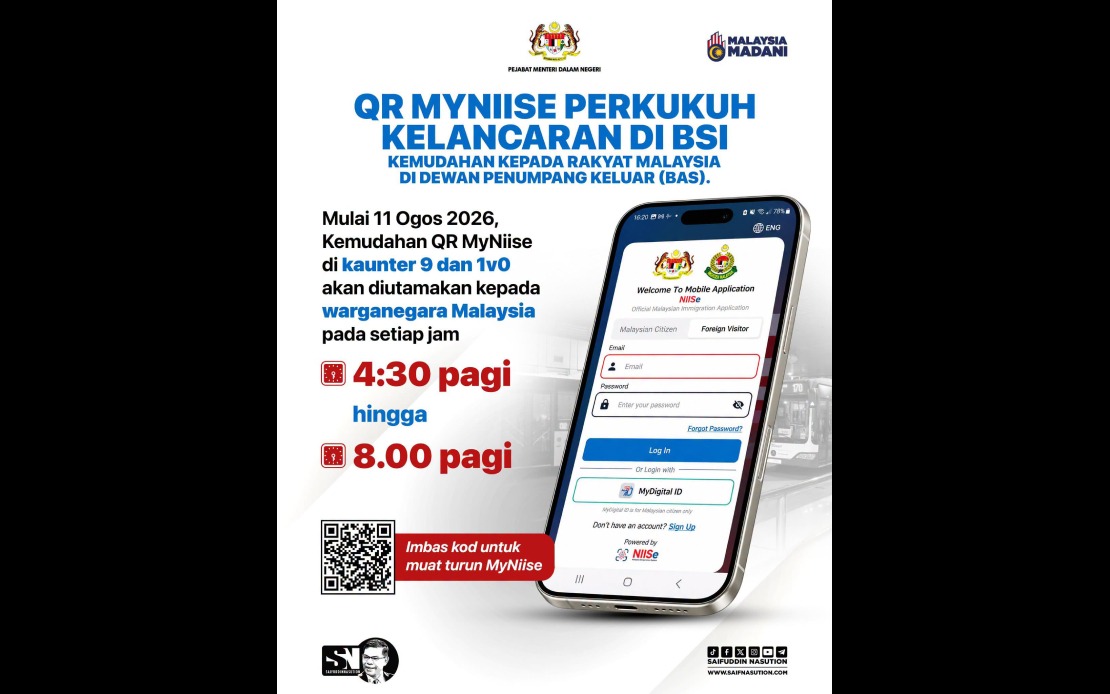
Malaysia's Home Minister Datuk Seri Saifuddin Nasution Ismail has unveiled an expedited immigration processing system for travellers using the National Integrated Immigration System (MyNIISe) QR code at Bangunan Sultan Iskandar (BSI), the primary land crossing between Malaysia and Singapore. Beginning August 11, commuters equipped with the mobile application will receive priority clearance at dedicated counters during the critical morning departure window, from 4.30 am to 8 am. This initiative targets the thousands of Malaysians who traverse the border daily for employment and business activities in Singapore, addressing a longstanding pain point in cross-border movement.
The dedicated fast-track arrangement operates exclusively from counters 9 and 10 in the Bus Departure Hall at BSI, strategically positioned to serve the peak commuter period. By concentrating resources on QR-enabled users during these hours, immigration authorities aim to segregate processing flows and prevent bottlenecks that routinely characterise dawn movements. Saifuddin Nasution acknowledged in his announcement that the early morning commute presents genuine hardship for the cross-border workforce, with many departing while dark and racing against transport schedules to meet work obligations in Singapore's business district.
The MyNIISe platform represents a cornerstone of the Malaysian government's broader digital transformation agenda within the immigration apparatus. Available across multiple application stores including Apple App Store, Google Play Store, and Huawei App Gallery, the system enables travellers to pre-process departure documentation electronically, substantially reducing physical counter interaction time. The application consolidates traveller information and documentation into a standardised QR code, which immigration officers scan for instant verification, creating a friction-free experience compared to traditional manual processing methodologies.
For Malaysia's cross-border commuter population, particularly professionals employed in Singapore's financial services, technology, and manufacturing sectors, this initiative carries significant practical implications. Many individuals undertake this journey multiple times weekly or even daily, accumulating considerable time expenditure at border checkpoints across their careers. The psychological and economic burden of unpredictable clearance times extends beyond individual frustration to broader considerations of labour market efficiency and competitiveness in the region's integrated economy.
Singapore and Malaysia maintain one of the world's highest bilateral cross-border worker flows, with nearly one million individuals commuting between the two nations regularly. This volume necessitates continuous innovation in processing infrastructure to maintain smooth trade and labour movement. The MyNIISe QR initiative reflects growing recognition among policymakers that digital solutions can substantially improve throughput without requiring proportional investments in physical infrastructure or personnel expansion. By shifting the administrative burden upstream to pre-departure processing, the system optimises the limited space and personnel available at physical checkpoints.
The timing of this announcement occurs within a broader context of post-pandemic border management evolution across Southeast Asia. As international travel has normalised, governments throughout the region have prioritised digitising immigration systems to manage capacity constraints more effectively. Malaysia's rollout of MyNIISe priority processing at BSI positions the country among regional leaders in implementing traveller-centric technology solutions, potentially influencing approaches adopted at other international gateways throughout ASEAN.
Adoption patterns for MyNIISe will prove instructive for policymakers evaluating further digital integration at Malaysia's multiple international borders. Success at BSI could justify expansion to Kuala Lumpur International Airport, secondary land crossings with Thailand, and maritime entry points, creating a comprehensive digital immigration ecosystem. Conversely, technical challenges, user adoption barriers, or operational inefficiencies could highlight gaps requiring remediation before broader deployment. The Home Ministry's willingness to commit dedicated processing counters signals institutional confidence in the system's reliability and public receptivity.
From a user perspective, MyNIISe adoption requires technological accessibility that may not uniformly distribute across the commuter population. Smartphone ownership and familiarity with mobile applications, while increasingly ubiquitous, still presents barriers for certain demographics. Additionally, travellers must navigate download installation, account registration, and documentation upload procedures independently, creating potential friction points for less digitally-native users. The government has not yet announced support mechanisms for assisting first-time users or addressing technical difficulties that may arise during deployment.
The priority clearance arrangement at counters 9 and 10 creates an implicit two-tier system that may generate equity considerations among immigration users. While efficient technologies deserve encouragement, unequal treatment based on technological adoption could create tension with those unable or unwilling to utilise digital platforms. Authorities managing this transition must balance promotional incentives for technology adoption against fundamental principles of equitable border access. Future communications should clarify whether conventional processing remains adequately resourced for non-QR users.
Longer-term success requires sustained investment in system stability, user support infrastructure, and continuous refinement based on operational feedback. The government should establish mechanisms for collecting performance data, identifying bottlenecks, and implementing improvements iteratively. Regular public communication about processing times, user satisfaction metrics, and system availability would build confidence and encourage broader adoption across the commuter population. Transparent operations foster public trust in digital government initiatives.
This MyNIISe initiative demonstrates how targeted application of digital technology addresses specific operational challenges within the immigration domain. By focusing implementation on the highest-volume crossing during peak periods, authorities maximise impact relative to implementation complexity. Success here could establish momentum for broader digital transformation across Malaysia's border infrastructure, potentially yielding significant efficiency gains and improved traveller experiences across international gateways.

