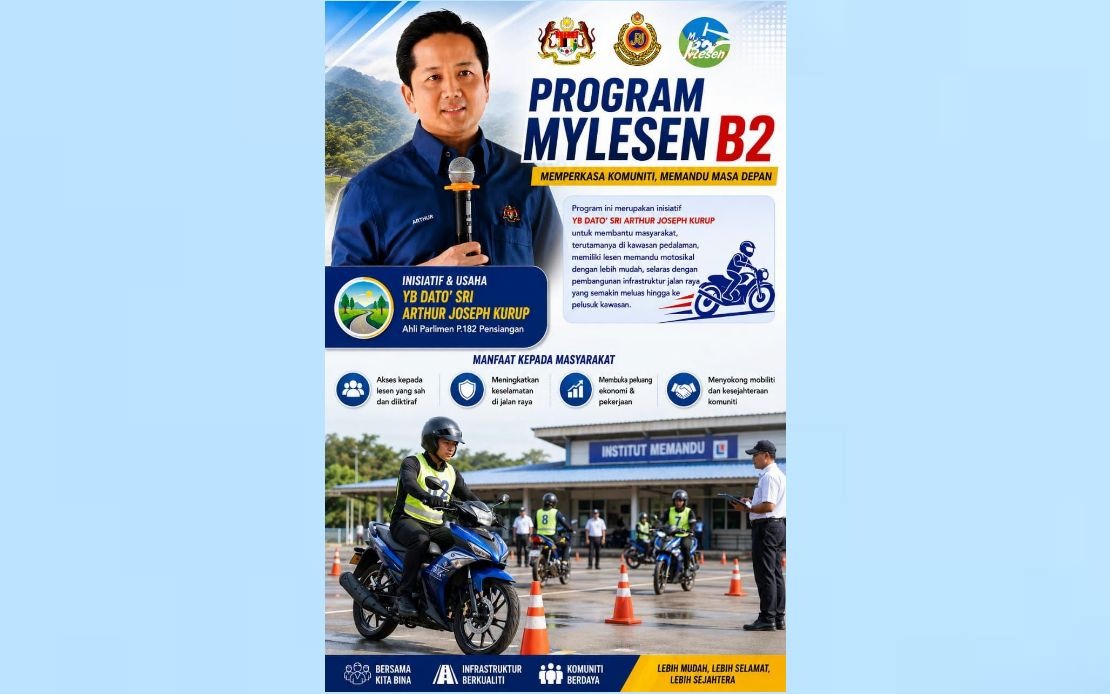
The MyLesen B2 programme has resumed its outreach efforts in Pensiangan, Sabah, bringing motorcycle licensing services directly to rural areas where residents traditionally faced significant obstacles in obtaining valid credentials. The initiative represents a targeted effort to address infrastructure gaps that have long disadvantaged communities in Malaysia's interior regions, where the nearest driving schools and licensing centres often require lengthy travel commitments that prove impractical for many aspiring riders.
Datak Seri Arthur Joseph Kurup, the Pensiangan Member of Parliament and Minister of Natural Resources and Environmental Sustainability, unveiled the programme's return with an emphasis on accessibility and safety. His intervention reflects growing recognition within policymaking circles that decentralising licensing services can meaningfully improve compliance rates while simultaneously enhancing road safety outcomes. By eliminating geographical barriers that previously forced rural residents to navigate distant urban centres, the programme directly addresses equity concerns that have historically marginalised communities outside major population hubs.
The MyLesen B2 initiative maintains rigorous standards despite its mobile delivery model. Participants still must complete mandatory coursework and successfully pass prescribed examinations, ensuring that the relaxation of geographical constraints does not compromise licensing integrity or road safety standards. This balanced approach preserves the regulatory framework's credibility while genuinely expanding access, a crucial consideration for public confidence in Malaysia's road licensing system.
Eligibility criteria establish the programme's scope with precision. Residents aged between 16 and 63 qualify to participate, with particular emphasis on individuals who have never previously held a driving licence. This targeting acknowledges that rural communities often contain significant populations of unlicensed riders—a phenomenon driven less by disinterest than by practical constraints. The programme's age parameters reflect both developmental readiness considerations for younger applicants and the reality that licensing remains economically and socially relevant across Malaysia's working-age population.
The economic dimensions of this initiative extend beyond immediate licensing convenience. Valid motorcycle licences function as formal documentation that facilitates employment verification, enabling rural residents—particularly young men and women—to access opportunities in formal labour markets that otherwise might remain restricted. This credential-based access to economic participation represents a significant but often underappreciated benefit of formalising licensing across rural Malaysia, where informal economic activity has historically dominated.
Arthur emphasised that licensing credentials carry lifelong utility, subject to compliance with renewal and regulatory requirements. This permanence contrasts with temporary solutions or informal arrangements that characterise unlicensed riding in many rural contexts. By framing the licence as a lasting asset rather than a temporary accommodation, the programme encourages participants to view formal compliance as a worthwhile investment in their legal and economic standing.
The programme's positioning as a road safety initiative responds to Malaysia's persistent challenges with traffic fatalities and injuries. Rural areas often experience disproportionately severe accident outcomes despite lower traffic volumes, partly attributable to insufficient awareness of road traffic regulations and protective practices. By integrating mandatory road safety education into the licensing process, MyLesen B2 attempts to address these knowledge gaps at their source, potentially generating sustained behavioural improvements across participating communities.
Practical registration arrangements facilitate seamless participation. The Pensiangan Parliamentary Service Centre and the Sook State Assemblyman's Service Centre serve as registration points, leveraging existing constituency infrastructure to minimise participant friction. This integration with established service delivery networks demonstrates institutional awareness that successful rural programmes require minimal additional bureaucratic burden on their beneficiaries.
The broader implications of this initiative merit consideration within Malaysia's governance landscape. Rural service provision has traditionally lagged urban delivery, creating disparities in access to government programmes and essential documentation. MyLesen B2's return to Pensiangan signals movement toward more equitable, decentralised service delivery models that recognise rural residents as legitimate beneficiaries of comprehensive government support. Such approaches, when scaled systematically, can progressively narrow equity gaps that currently characterise Malaysia's administrative landscape.
For Sabah specifically, the programme addresses a regional context where motorcycle usage remains economically and socially central to community life, yet licensing compliance remains inconsistently achieved. Pensiangan's geographical characteristics—its interior location and dispersed settlement patterns—made it precisely the type of constituency where mobile licensing services could generate maximum participation gains. The programme's success here may inform subsequent rollouts to similarly situated regions across Malaysian Borneo and peninsular interior areas.
The initiative also reflects broader policy recognition that enforcement alone cannot achieve licensing compliance in communities where compliance carries significant practical costs. By addressing underlying barriers rather than merely penalising non-compliance, MyLesen B2 adopts a more sophisticated governance approach that acknowledges the rational calculations shaping resident behaviour. This preventive, access-oriented methodology contrasts with purely punitive frameworks and may prove more effective at improving overall compliance rates.
Looking forward, the programme's performance in Pensiangan will provide valuable insights into mobile licensing delivery at scale. Participant feedback, completion rates, and subsequent accident statistics in the region can inform decisions about expanding similar initiatives to other underserved areas. As Malaysia pursues its Vision 2050 aspirations, ensuring that rural communities enjoy comparable access to essential services and documentation represents an increasingly recognised prerequisite for genuine inclusive development.

