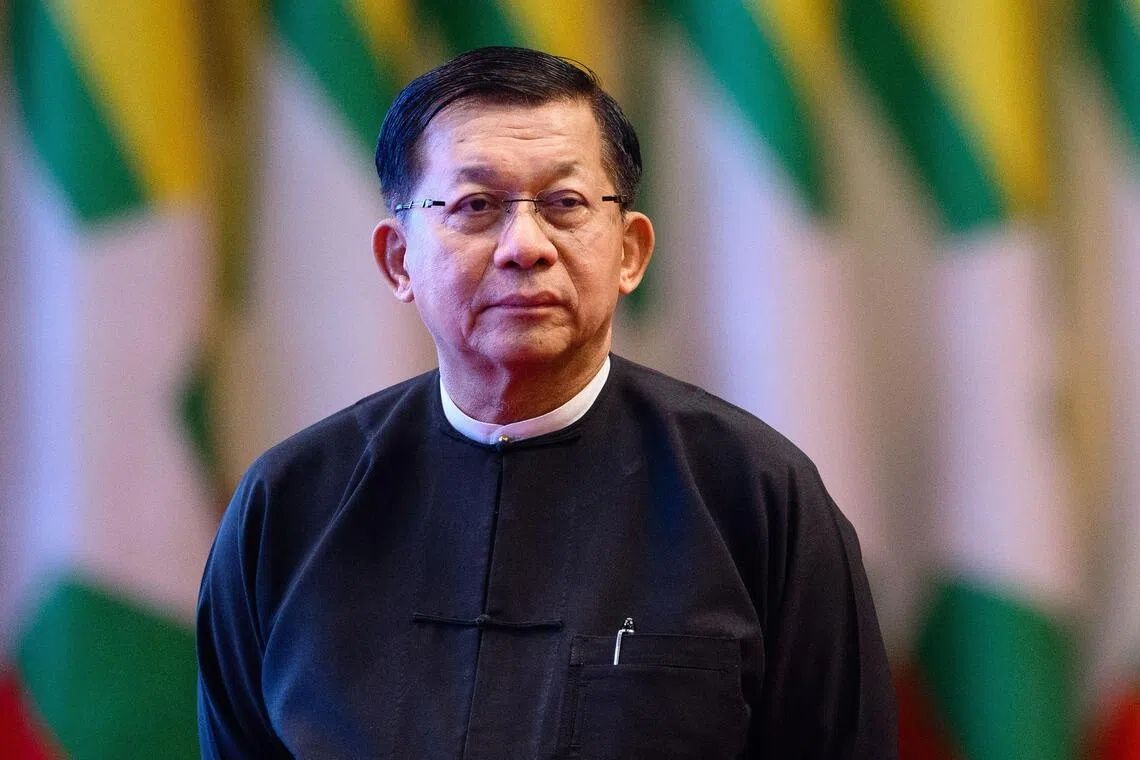
Myanmar's former military ruler Min Aung Hlaing arrived in Thailand on Thursday for his first official visit since shedding his general's uniform to become Myanmar's civilian president, signalling a calculated attempt to rehabilitate his country's international image and restore it to the regional diplomatic mainstream after three years of international isolation.
The August 6 visit marks a significant moment in the evolving relationship between Myanmar and its Southeast Asian neighbours. Min Aung Hlaing, who orchestrated the February 2021 military coup that deposed democratic leader Aung San Suu Kyi, has been working methodically to position himself as a statesman capable of leading Myanmar back into the fold of regional affairs. Yet the contradiction at the heart of this diplomatic strategy remains stark: the man received with official ceremony in Bangkok ordered the military takeover that plunged his nation into civil conflict and humanitarian catastrophe.
The scale of Myanmar's internal conflict underscores why the international community remains deeply troubled by his rehabilitation efforts. Since the putsch, fighting between government forces and diverse armed opposition groups has devastated the country, with credible estimates suggesting the violence has claimed more than 100,000 lives across all factions. Entire communities have been displaced, infrastructure destroyed, and the economy severely damaged. Despite these consequences, Min Aung Hlaing orchestrated elections in April that international observers and Western governments uniformly dismissed as theatrical exercises designed to provide democratic veneer to what remains fundamentally a military regime.
Thailand's willingness to welcome Min Aung Hlaing reflects Bangkok's pragmatic calculation that engagement offers greater leverage than continued estrangement. Thailand shares a lengthy, porous border with Myanmar and faces immediate transnational security challenges that Bangkok believes require constructive dialogue. Millions of Myanmar refugees have sought sanctuary in Thailand, straining resources and creating humanitarian concerns. Perhaps more pressing for Thai officials are the criminal networks operating from Myanmar's borderlands—cyberscam operations targeting Thais and the region, plus trafficking of narcotics that destabilise Thai communities. Thai Foreign Minister Sihasak Phuangketkeow publicly indicated that cyberscam networks would feature prominently in talks with Min Aung Hlaing, reflecting Bangkok's belief that a functional Myanmar government might assist in addressing these cross-border criminal enterprises.
Min Aung Hlaing's diplomatic itinerary reveals the strategic nature of his post-coup positioning. Beyond Thailand, he has already visited India, cultivating relationships with major powers, and spent time in China, Myanmar's most significant regional ally and economic lifeline. A trip to Laos, a fellow Asean member, demonstrated his systematic approach to building bilateral relationships. Each visit serves the larger purpose of signalling to the 11-nation Association of Southeast Asian Nations that Myanmar remains a legitimate member deserving of inclusion rather than an international pariah requiring containment.
Asean's response to Myanmar's crisis has been characterised by cautious ambivalence that reflects the bloc's internal tensions over how to handle member state misconduct. While Myanmar's military junta was excluded from high-level Asean summit meetings following the coup, the bloc stopped short of expelling or severely sanctioning its own member. Last month, Myanmar's foreign minister attended an informal gathering with regional counterparts in Thailand, a subtle signal that diplomatic doors were not entirely closed. This incremental thawing of ties, orchestrated substantially by Thailand, offers Min Aung Hlaing the prospect of gradual reintegration into regional forums and decision-making processes.
Yet Asean's five-point consensus framework—designed to promote dialogue between Myanmar's military leadership and all armed opposition forces to achieve ceasefire and political accommodation—has become a flashpoint revealing the regime's true intentions. Myanmar's leadership has consistently refused to genuinely embrace this consensus, effectively rejecting the notion that meaningful reconciliation requiring consultation with democratic forces or armed groups could be acceptable. This apparent contradiction puzzles observers; Min Aung Hlaing appears simultaneously to crave recognition as a responsible regional player whilst categorically denying the legitimacy of the very dialogue processes that would underpin such responsibility. Myanmar analyst David Mathieson characterised this posture as reflective of "zero-sum logics," where the regime pursues status rehabilitation without accepting the substantive compromises such rehabilitation ordinarily demands.
The timing of the Thailand visit coincides with a minor thaw in international pressure on Myanmar's imprisoned leadership. Aung San Suu Kyi, still held under house arrest, was permitted to meet a representative from the International Committee of the Red Cross in early August, her first documented encounter with a foreign official since her overthrow. While the Red Cross meeting represents only a modest humanitarian concession, it signals regime willingness to project an image of cooperation with international humanitarian concerns—carefully calibrated to avoid appearing entirely unreasonable whilst maintaining complete political control.
Thailand's reception of Min Aung Hlaing includes symbolic gestures reflecting official hospitality: an honour guard at Government House, bilateral meetings with Prime Minister Anutin Charnvirakul, a business forum designed to signal economic normalisation, and a formal state dinner. The two governments are expected to formalise a memorandum of understanding regarding labour cooperation, establishing a framework for managing the substantial Myanmar migrant workforce in Thailand. These institutional arrangements lend bureaucratic legitimacy to the relationship and create mechanisms for ongoing engagement.
However, Myanmar's rehabilitation efforts confront substantial international barriers. Min Aung Hlaing remains under sanctions imposed by multiple Western governments, and the International Criminal Court has issued warrants for his arrest based on allegations of crimes against humanity. Human rights organisations and Myanmar civil society groups have vigorously objected to Thailand's diplomatic overtures, contending that extending recognition to a leader facing serious accountability mechanisms undermines justice and provides unwarranted legitimacy to military rule. The Justice For Myanmar campaign group articulated this concern starkly, arguing that Min Aung Hlaing should face accountability rather than receive diplomatic honours that normalise his regime.
For Malaysia and the broader Southeast Asian region, Myanmar's diplomatic rehabilitation presents a complex challenge. Regional stability depends partly on Myanmar's functionality, yet accepting military rule without securing genuine commitment to conflict resolution and reconciliation may entrench authoritarianism and prolong instability. The emergence of a Myanmar regime that successfully resists international accountability whilst gradually restoring regional standing could establish a troubling precedent for how military coups are managed within Asean's non-interference framework. Malaysia, as a fellow regional power with significant Myanmar diaspora communities and economic interests, will likely observe closely how Thailand's engagement strategy evolves and whether it yields tangible improvements in Myanmar's governance or merely provides diplomatic cover for continued military control.

