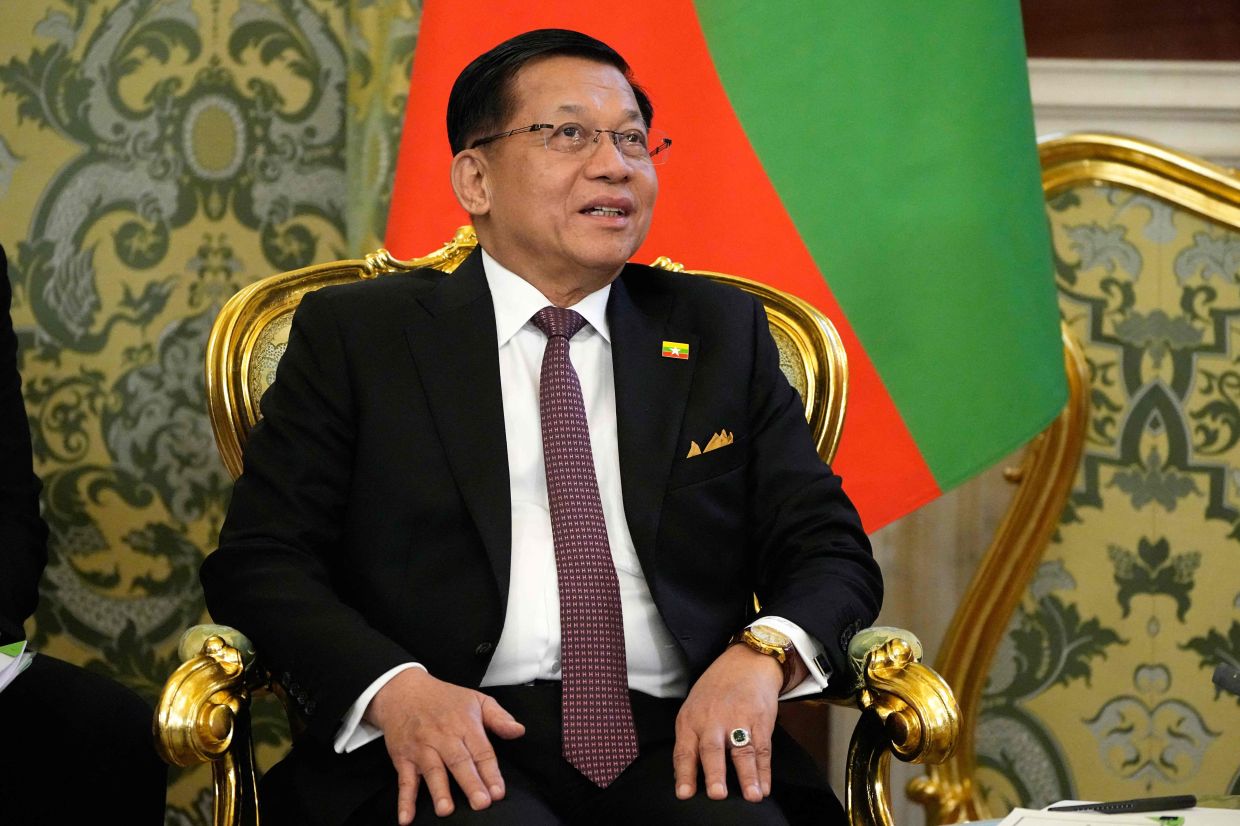
Myanmar's military leader Min Aung Hlaing is set to make an official visit to Cambodia in early September as part of an expanding international diplomatic effort that observers view as a calculated strategy to secure international legitimacy in the face of sustained criticism over his 2021 coup and subsequent political consolidation. Cambodian Senate officials have begun logistical preparations for the visit, with key government figures inspecting potential venues to receive the Myanmar leader. The announcement underscores growing ties between Phnom Penh and Naypyidaw at a time when Myanmar remains largely isolated within the Association of Southeast Asian Nations due to the military junta's governance record.
Cambodia's government characterises the visit as a straightforward effort to deepen bilateral cooperation between two neighbouring nations. Senate spokesperson Chea Thyrith told local media that the trip represents an opportunity to "strengthen the friendship between Cambodia and Myanmar," emphasising that cooperation between the countries serves mutual interests. This framing reflects Cambodia's traditional diplomatic approach of engaging major regional powers regardless of international concerns about their internal governance, a stance that has defined Phnom Penh's foreign policy for decades.
However, the visit arrives amid mounting scrutiny of Min Aung Hlaing's worldwide tour, which has already taken him to India, China, Laos, Thailand and Russia since his election as president in April. Rights advocates and democracy campaigners argue that this succession of state visits functions primarily as a legitimacy-building exercise designed to normalise international relations with a military regime that critics regard as inherently illegitimate. The April election itself has been widely dismissed by observers as fundamentally flawed, conducted within a framework dominated by military interests and lacking genuine democratic credentials.
The substance of international concern centres on Myanmar's documented human rights record under military rule. Since the 2021 coup that deposed democratically elected leader Aung San Suu Kyi and led to her prolonged detention, Myanmar has faced credible allegations of systematic human rights violations. Thousands of pro-democracy activists, political dissidents, and civil society figures have reportedly been arrested and imprisoned. These actions prompted ASEAN, normally reluctant to make strong political statements, to take the unprecedented step of excluding Myanmar from summit meetings—a measure reflecting the severity with which the bloc views the junta's conduct.
Kin Phea, president of Cambodia's International Relations Institute, offered a more nuanced interpretation of Min Aung Hlaing's diplomatic campaign. While acknowledging that the visit likely serves to reinforce the Myanmar leader's domestic and international standing, Phea suggested that Cambodia's engagement with Myanmar also reflects Phnom Penh's earlier efforts at regional mediation. During Cambodia's 2022 ASEAN chairmanship, the country attempted to facilitate dialogue and ease tensions surrounding Myanmar's political crisis, positioning itself as a constructive actor in regional conflict resolution.
Phea further noted that Cambodia possesses potential value as a partner in Myanmar's longer-term political recovery, given Phnom Penh's own historical experiences navigating reconciliation, national unity and peace-building processes following its traumatic past. He indicated that Cambodia could theoretically share institutional knowledge and diplomatic lessons learned from its own transition efforts, though he cautiously noted that external support has inherent limits. Sustainable political change in Myanmar, Phea suggested, ultimately depends on internal actors and political movements within the country itself rather than diplomatic overtures from neighbouring states.
A critical constraint on any individual country's ability to influence Myanmar's international standing involves ASEAN's stated framework for addressing the crisis. The bloc's five-point consensus, established as a collective response to the 2021 coup, establishes specific benchmarks for Myanmar's reintegration into ASEAN's full diplomatic structure and summit participation. These criteria include ceasing violence, initiating dialogue among all stakeholders, allowing humanitarian assistance, and progressing toward democratic transition. Whether Min Aung Hlaing's Cambodia visit qualifies as a formal state visit remains technically distinct from ASEAN's broader consensus requirements.
Phea's analysis underscores a reality often overlooked in coverage of individual bilateral visits: no single country, including Cambodia, possesses the authority to unilaterally determine Myanmar's ASEAN standing. The five-point consensus establishes a collective threshold that transcends bilateral diplomatic gestures. This means that while Cambodia's reception of Min Aung Hlaing may enhance his international profile and signal willingness to engage Myanmar's military leadership, such bilateral courtesies do not automatically translate into Myanmar's restoration of full ASEAN membership privileges or increased international legitimacy within the bloc.
For Malaysia and other Southeast Asian neighbours, the Cambodia visit illustrates broader regional tensions between competing principles. ASEAN's traditional non-interference doctrine clashes with growing pressure to take principled stances on governance and human rights. Myanmar's situation has created fissures within ASEAN, with some members maintaining stricter positions on engagement conditions while others, including Cambodia, adopt more permissive approaches. Malaysia has historically positioned itself as supportive of stronger ASEAN action on Myanmar, though the bloc's consensus-driven decision-making often produces compromises that satisfy few parties completely.
The visit also reflects the complex geopolitical positioning that characterises Myanmar's current isolation. Min Aung Hlaing's visits to Russia and China represent particularly significant diplomatic manoeuvres, signalling potential alignment with powers that have shown willingness to maintain relations despite international criticism. Regional visits to Thailand, Laos and now Cambodia serve to reinforce Myanmar's embeddedness within Southeast Asia and suggest that international isolation remains incomplete. For regional observers, this pattern suggests a Myanmar leadership focused on maintaining operational space and international engagement despite being excluded from formal ASEAN summit processes.
As Cambodia prepares to receive Min Aung Hlaing, the visit encapsulates broader questions about how Southeast Asian states should respond to governance crises affecting fellow members. Cambodia's approach—maintaining diplomatic channels while avoiding explicit endorsement of the junta's legitimacy—represents one pragmatic middle ground. Yet this stance also implicitly supports continued international engagement with Myanmar's military leadership, potentially enabling the very consolidation of power that critics fear. The Cambodia visit thus becomes another chapter in the ongoing regional debate over how best to influence Myanmar's political trajectory.

