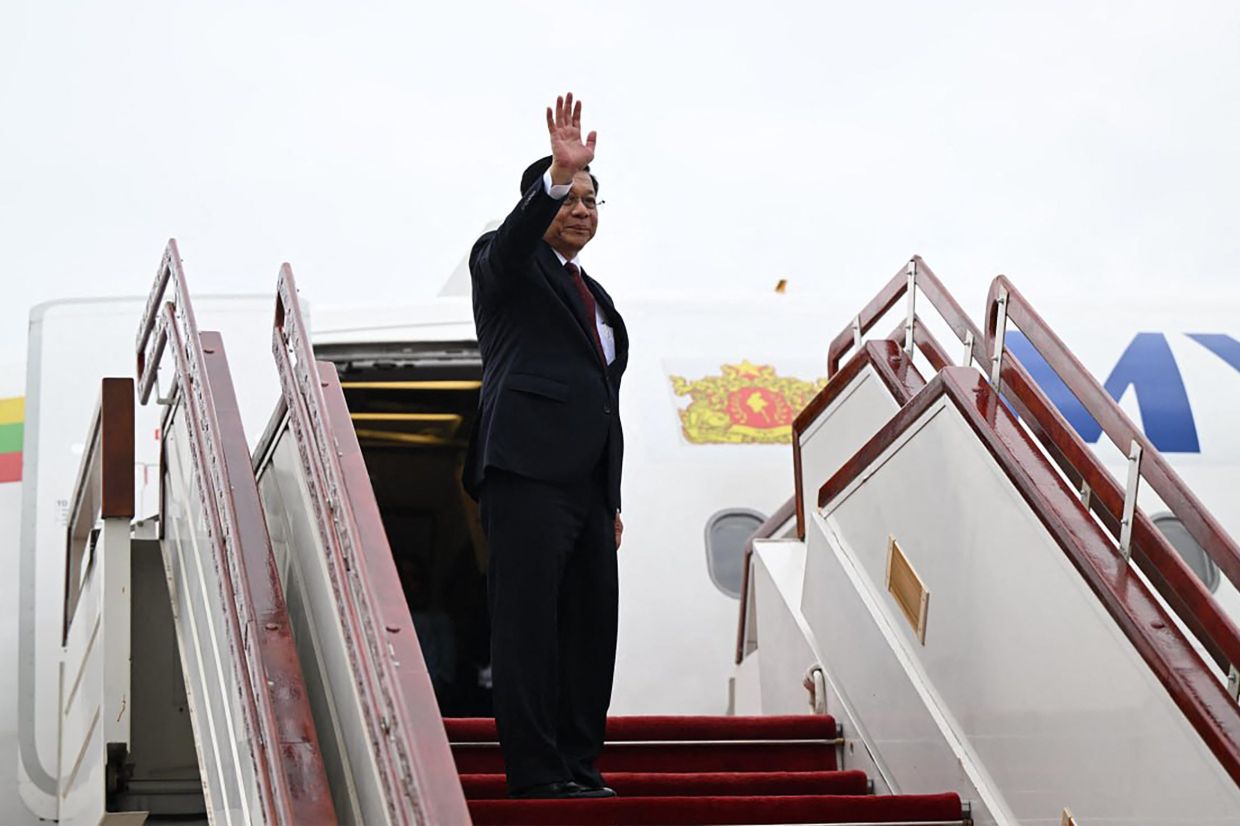
Myanmar's military chief Min Aung Hlaing boarded a flight from Naypyidaw on Monday morning headed for Moscow, embarking on what officials describe as a strategic visit to strengthen bilateral relations with Russia and President Vladimir Putin. The journey represents the first time the Myanmar leader has travelled to the Russian capital since assuming the civilian presidency in April, a position he secured through elections widely dismissed as fraudulent by Western democracies and international observers focused on democratic governance.
The timing of this diplomatic mission underscores Myanmar's increasingly precarious international standing and its dependence on a shrinking circle of sympathetic nations. Russia emerged as one of the handful of countries willing to extend meaningful support to Myanmar's military establishment following the February 2021 coup that toppled the democratically elected government led by Aung San Suu Kyi. That upheaval triggered a prolonged internal conflict that has devastated the nation, with credible estimates suggesting the violence has claimed upwards of 100,000 lives and displaced millions more, creating one of Asia's most severe humanitarian crises in recent decades.
The official rationale for Min Aung Hlaing's Moscow visit centres on deepening what Naypyidaw characterises as Myanmar's time-honoured partnership with Russia. According to statements from the Myanmar presidency, the discussions will focus on consolidating security cooperation and expanding economic ties between the two countries. These broad policy objectives carry particular significance given Myanmar's economic deterioration and its urgent need for military capability to maintain control over territory contested by various opposition forces and ethnic armed organisations.
Military cooperation between Yangon and Moscow has already deepened substantially. Myanmar's armed forces rely heavily on Russian-made fighter jets and other weaponry to project power against armed resistance movements scattered across the country. International human rights organisations and conflict monitoring groups have documented concerning patterns whereby these Russian-supplied aircraft have been employed in strikes targeting civilian areas, incidents that some monitors characterise as potentially constituting war crimes under international humanitarian law. This pattern of alleged abuses has further complicated Myanmar's international reputation and drawn criticism from human rights advocates globally.
The military partnership took formal shape in February when both nations inked a five-year cooperation agreement focused on defence matters, though the specific provisions and commitments outlined in that accord remain largely opaque to outside observers. The confidentiality surrounding such arrangements is typical of military agreements, yet it raises questions about the depth and nature of commitments Myanmar may have made to its Russian counterpart. Regional analysts suggest these agreements likely encompass training, equipment transfers, and potentially intelligence sharing arrangements.
Min Aung Hlaing's delegation includes a substantial entourage of senior government officials, reflecting the high-level nature of the engagement. During his stay in Moscow, the Myanmar leader will hold meetings not only with President Putin but also with Russia's prime minister and the speaker of the State Duma, the lower house of the Russian parliament. Additionally, the visit will feature Myanmar and Russian participation in an economic forum designed to explore commercial opportunities and potential investment flows between the two nations.
This Moscow trip forms part of a broader diplomatic campaign by Min Aung Hlaing to rehabilitate Myanmar's international image and secure recognition from key powers despite the circumstances of his government's ascension. Since assuming the presidency in April, he has embarked on several overseas journeys, including high-profile visits to neighbouring Thailand, strategically important India, and neighbouring superpower China. Each of these missions appears calibrated to signal to both regional and global audiences that Myanmar, despite widespread condemnation from Western capitals, maintains viable diplomatic relationships with major powers and neighbouring states.
Yet the fundamental challenge underpinning Myanmar's diplomatic efforts remains the legitimacy deficit plaguing Min Aung Hlaing's administration. The elections orchestrated in August 2020 and culminating in his presidential appointment lack credibility among democratic nations and international bodies. The military's consolidation of power through what amounted to a managed electoral process has triggered sustained international criticism and sanctions regimes from Western countries. Meanwhile, the ongoing civil conflict continues to exact a devastating human toll, with armed resistance movements controlling significant portions of Myanmar's territory and the military's counter-insurgency operations generating continued civilian casualties.
For Southeast Asia and regional stability, Myanmar's deepening alignment with Russia carries wider implications. The country's pivot towards Moscow and Beijing reflects the constraints imposed by Western isolation and the strategic necessity of securing military and economic support from non-Western powers. This dynamic has effectively pushed Myanmar into closer orbit around China and Russia, diminishing the influence of Southeast Asian neighbours who might otherwise serve as mediating forces. Regional organisations like the Association of Southeast Asian Nations have struggled to effectively engage Myanmar on political reform, creating a vacuum that external powers have increasingly filled.
The economic dimensions of Myanmar's Russia engagement deserve scrutiny given the country's severe financial distress. Myanmar's currency has collapsed, foreign exchange reserves have dwindled, and economic activity has contracted sharply since the coup. Any opportunity to access Russian investment or credits holds theoretical appeal for struggling Myanmar officials. However, the practical scope for meaningful Russian economic support appears limited, particularly given Russia's own economic challenges stemming from international sanctions. The economic forum accompanying Min Aung Hlaing's visit may therefore be largely symbolic, serving primarily to demonstrate publicly that alternatives to Western economic engagement exist.
Looking ahead, Myanmar's trajectory will likely remain heavily influenced by its relationships with Russia and China, particularly if the military maintains its grip on power and Western isolation persists. The visit to Moscow signals that Min Aung Hlaing intends to pursue this strategic orientation while simultaneously attempting selective diplomatic outreach to nearby nations. Whether such efforts can eventually restore Myanmar to broader regional acceptance remains uncertain, dependent ultimately on internal political developments and the military's willingness to pursue reconciliation with opposition elements.

