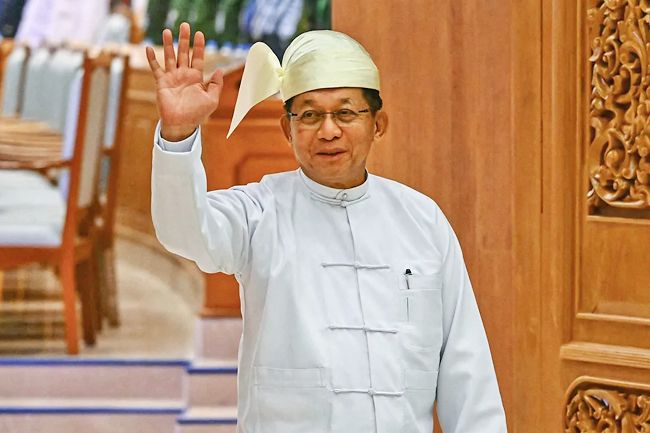
Myanmar's military leader Min Aung Hlaing will travel to Bangkok on August 6 and 7 for high-level discussions with Thai Prime Minister Anutin Charnvirakul, according to an announcement by Thailand's foreign minister. The visit underscores a carefully calibrated diplomatic effort to navigate Myanmar's contentious status within Southeast Asia's premier regional bloc, a challenge that has increasingly divided member nations since the 2021 military coup that overturned Aung San Suu Kyi's elected government.
Thailand's Foreign Minister Sihasak Phuangketkeow disclosed the bilateral engagement following what he characterised as frank exchanges among ASEAN foreign ministers gathered in Manila. These discussions centred on finding a sustainable path towards reintegrating Myanmar, whose coup and subsequent military consolidation of power have created a diplomatic impasse for the 10-member organisation. While Myanmar formally retains ASEAN membership, the junta has been systematically barred from the bloc's principal forums and decision-making structures, a punitive measure prompted by the 2021 power seizure.
Thailand's prominent role in championing Myanmar's gradual return to ASEAN's good graces reflects both geography and pragmatism. Sharing an extensive border with a nation now convulsed by civil conflict, and hosting a refugee population numbering in the millions, Bangkok has emerged as the de facto negotiator pushing for engagement over isolation. Yet this positioning has exposed fractures within ASEAN, with several members questioning whether dialogue with an undemocratic regime compromises the bloc's stated commitment to democratic governance and human rights.
The proposed August visit exemplifies what Sihasak termed a "dual-track approach," balancing bilateral pragmatism with broader regional political objectives. Thailand's immediate concerns centre on concrete security issues affecting both nations: the sprawling transnational criminal networks operating across the border, the lucrative scam infrastructure that has earned Myanmar notoriety throughout Southeast Asia, and the region's persistent narcotics trafficking problem. These tangible challenges provide a framework for engagement that transcends the ideological questions surrounding Myanmar's political legitimacy.
Simultaneously, Thailand and its regional partners are attempting to establish benchmarks for measuring progress in Myanmar's journey towards some form of normalisation. The Foreign Minister posed several potential indicators: whether the military junta permits ASEAN's special envoy to meet with detained former leader Aung San Suu Kyi; whether violence along the conflict-ridden Thai-Myanmar border diminishes measurably; and whether the regime demonstrates willingness to engage with armed ethnic organisations and democratic opposition forces. These metrics acknowledge that substantive change in Myanmar will likely emerge incrementally rather than through dramatic transformation.
Sihasak's candid acknowledgment that meaningful progress "is not going to happen overnight" reveals the pragmatic recalibration occurring within ASEAN's approach. Rather than maintaining the rigid conditionality that has characterised the bloc's stance since 2021, Bangkok appears to be advocating for a more flexible engagement model that recognises Myanmar's geopolitical importance while avoiding the appearance of wholesale capitulation to the junta. This recalibration poses significant implications for ASEAN's credibility on governance and human rights issues, particularly as smaller or more democratic members weigh their institutional obligations against regional stability concerns.
Thailand's suggestion that it might facilitate dialogue between Myanmar's military administration and ethnic armed organisations operating along the mutual border represents an intriguing dimension of this engagement strategy. By positioning itself as a bridge-builder between the junta and groups that have effectively resisted central control, Thailand could help construct what Sihasak described as "building blocks" for eventual broader reconciliation. Such intermediation could potentially reduce cross-border violence and humanitarian spillovers that directly threaten Thai security and stability.
The junta's controversial August 2023 elections, which formally installed Min Aung Hlaing as president while maintaining the military's comprehensive political dominance, have become a focal point in ASEAN's recalibration discussions. Thai officials suggest these elections, despite their limited franchise and questionable legitimacy, might create space for renewed dialogue with Myanmar's opposition and ethnic groups. This argument essentially accepts the military's electoral choreography as a sufficient pretext for diplomatic normalisation, a position that troubles democracy advocates within and outside the region.
Parallel to bilateral engagement, ASEAN is considering structural reforms to its Myanmar strategy. Philippine Foreign Minister Theresa Lazaro revealed that the bloc is evaluating the appointment of a permanent, long-term special envoy to replace the current system of annual rotating representation. The existing arrangement has proven inadequate to the task, as yearly changes in envoy personnel and attention have prevented the development of sustained diplomatic relationships or coherent negotiating strategies. A dedicated envoy could provide the continuity and expertise necessary for navigating Myanmar's complex political landscape.
The broader context for these diplomatic manoeuvres includes Myanmar's devastating civil conflict, which has claimed thousands of lives and displaced hundreds of thousands since the coup. The humanitarian catastrophe has triggered massive refugee flows into Thailand and Bangladesh, straining regional resources and security. ASEAN's reengagement with Myanmar must therefore be understood not merely as diplomatic theatre but as an attempt to influence the junta's behaviour on issues with direct ramifications for neighbouring states and Southeast Asia's overall stability.
For Malaysia and other ASEAN members further removed from Myanmar's immediate orbit, these developments signal the bloc's continuing struggle to maintain unity while addressing unprecedented challenges to its foundational norms. The question of how to engage or isolate a military junta touches fundamental questions about ASEAN's purpose and effectiveness as a regional institution. Thailand's advocacy for measured engagement, while politically understandable, inevitably raises questions about whether the bloc can maintain credible positions on democracy and governance when confronted with strategic interests pulling in opposite directions.
The August visit by Min Aung Hlaing thus carries significance extending far beyond bilateral Thai-Myanmar relations. It represents a critical juncture in ASEAN's evolution as an organisation, testing whether the bloc can develop sophisticated engagement strategies with problematic regimes without fundamentally compromising its stated principles. The outcome of these discussions and the subsequent trajectory of Myanmar's reintegration will substantially influence ASEAN's cohesion and international standing throughout the coming years.

