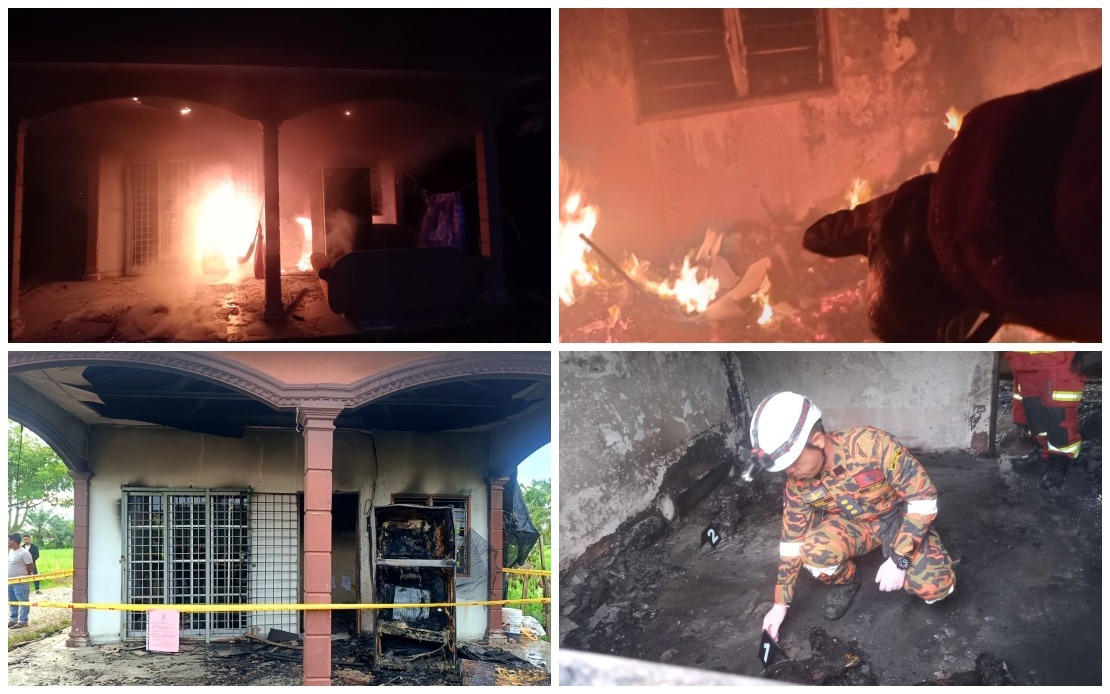
A tragedy struck the refugee community in Perak when a Myanmar family lost three members in a house fire that tore through their home in Taman Serai Maju, Bagan Serai, in the early hours of Thursday morning. The deceased included Mohd Yunus Nor Ali, 27, and his two young sons Muhammad Woheed Mohd Yunus, aged 6, and Mohamad Aheed Mohd Yunus, aged 3. His wife, Saniya Jahan Juma Abul Kasim, 24, survived the blaze but sustained burns to her hands and feet. The incident claimed three lives from a household of seven foreign nationals sharing the premises.
Emergency responders reached the scene swiftly after receiving a distress call at 5.17 am, with the first fire and rescue team arriving just thirteen minutes later at 5.30 am. Upon arrival, firefighters discovered the Class A residential structure—measuring 20 feet by 40 feet—already engulfed in flames with approximately 70 percent of the building consumed by the fire. The rapid advancement of the blaze underscored the dangers that informal housing arrangements can pose to vulnerable migrant populations in Malaysia, particularly those living in densely occupied dwellings with limited safety infrastructure.
According to Perak Fire and Rescue Department director Datuk Sayani Saidon, the mother of the deceased children was discovered outside the burning house when rescue personnel arrived. She immediately informed emergency workers that her husband and their two children remained trapped within the structure. This critical information prompted the rescue team to launch an immediate search and rescue operation employing the RECEO methodology, a systematic approach designed to maximize the chances of locating and extracting trapped occupants from burning buildings.
The rescue efforts, though executed with professional efficiency, yielded heartbreaking results. Firefighters located all three victims in the first room where the fire had originated. Medical personnel from the Ministry of Health who arrived at the scene confirmed that all three had succumbed to the flames before rescue could be completed. The rapid spread of the fire from its point of origin suggests the blaze may have intensified quickly, leaving little opportunity for the occupants to escape from the initial compartment.
The survivor received immediate medical attention at the scene from emergency medical teams before being transported to hospital via Emergency Medical Rescue Services vehicles. Her injuries, while serious, were assessed as survivable, though the physical and psychological trauma of losing her husband and two children in such circumstances will undoubtedly affect her recovery process. Medical authorities will need to monitor her progress closely given the severity of burn injuries and the emotional devastation accompanying such family losses.
Firefighters brought the blaze under control by 6.20 am, though complete extinguishment and scene clearance required additional time, with operations concluding at 7.35 am. The investigation into the fire's origins has become a priority for both fire and rescue authorities and police investigators who have assumed responsibility for the deceased. Preliminary findings from the Perak Fire and Rescue Department's forensic team indicate that the fire originated in the first room where the victims perished, though the precise cause remains under active investigation.
The incident raises critical questions about housing standards and safety provisions for refugee and migrant populations in Malaysia. Rohingya and other Myanmar nationals living in informal settlements or shared housing arrangements often occupy spaces that may lack adequate fire safety equipment, emergency exits, or early warning systems. The tragedy in Bagan Serai exemplifies how vulnerable populations can face compounded risks when forced to reside in substandard accommodations with limited recourse to improve their living conditions or demand better safety standards.
Myanmar refugees in Malaysia have faced increasing hardship as regional displacement crises continue and host countries grapple with limited resources and competing policy priorities. The Myanmar military coup in 2021 and subsequent civil conflict have driven waves of displacement across Southeast Asia, with Malaysia hosting one of the largest refugee populations in the region. However, access to safe housing, employment, education, and healthcare remains severely constrained for these vulnerable groups, forcing many into informal economies and precarious living situations.
The loss of a young family highlights broader humanitarian concerns surrounding refugee protection in Southeast Asia. International humanitarian organizations have repeatedly warned that inadequate housing and living conditions pose serious health and safety risks to displaced populations. The absence of proper oversight, enforcement of building codes, and safety standards in informal housing areas creates environments where preventable tragedies can occur with devastating consequences for entire families.
Authorities have indicated that comprehensive investigations will proceed to establish the exact cause of the fire and determine whether any factors such as electrical faults, cooking accidents, or other hazards contributed to the outbreak. Such investigations are essential not only for legal and insurance purposes but also for identifying systemic vulnerabilities that could be addressed to prevent similar incidents in other refugee communities throughout Malaysia. The findings may also inform recommendations for improved housing standards and safety provisions for migrant populations across the country.
The incident serves as a sobering reminder of the precarious circumstances facing Myanmar refugees and other displaced persons in Malaysia. While the country has demonstrated humanitarian commitment by hosting significant refugee populations, the gap between policy intentions and ground-level realities remains substantial. Access to secure, safe housing with proper fire safety infrastructure should be considered a fundamental protection measure for all vulnerable populations, yet remains elusive for many refugee families navigating Malaysia's complex social and regulatory landscape.

