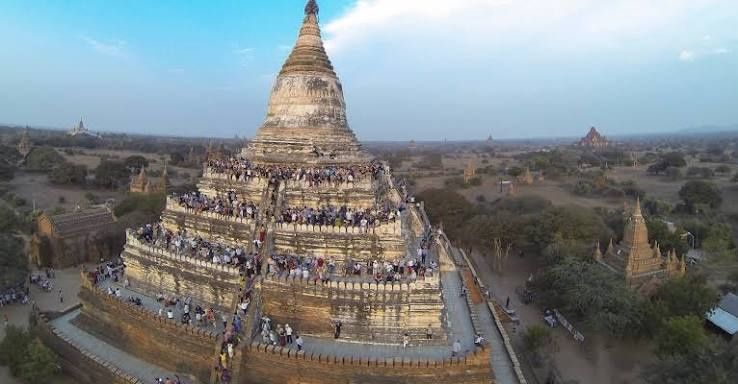
Myanmar's tourism infrastructure is experiencing tentative signs of revival as the country's military-led administration charts an ambitious course toward economic rehabilitation through visitor-driven growth. The push represents a calculated wager that reopening iconic destinations—from the ancient temples of Bagan to the spiritual significance of the Golden Rock Pagoda—will signal to the world that parts of the nation are stabilising after years of post-coup turmoil. This strategy carries profound implications for the broader Southeast Asian tourism ecosystem, where Myanmar's emergence as a frontier destination has long been overshadowed by political instability and international isolation stemming from the 2021 military coup.
The government has set an audacious target of attracting 1.8 million foreign visitors this year, representing a near-doubling from previous figures and reflecting confidence that economic rehabilitation can proceed alongside political normalisation. To achieve this, officials have deliberately streamlined visa procedures for nationals of key source markets, particularly China and Thailand, while maintaining visa-free entry for most Southeast Asian citizens. Maung Maung Kyaw, permanent secretary at the Ministry of Hotels, Tourism and Culture, characterised neighbouring markets as essential drivers, emphasising that Chinese and Thai travellers will form the backbone of growth. This geographic strategy acknowledges Myanmar's immediate commercial realities: regional proximity trumps distant Western markets in the near term, particularly given ongoing international travel warnings that persist from Western governments.
The actual trajectory, however, reveals a steeper climb than current momentum suggests. Through May this year, Myanmar had received 448,205 international arrivals, translating to a modest five per cent increase compared to the same period last year. The 2025 total of approximately 973,263 visitors established the baseline, yet achieving the 1.8 million target demands acceleration substantially exceeding recent trends. The country would need to welcome roughly 1.35 million visitors in the second half of the year—a quantum leap requiring sustained marketing momentum and continued regional confidence that Myanmar presents a viable, secure destination.
Chinese nationals remain the largest air-arrival cohort, with visitor numbers rising twelve per cent during the first five months of 2024, demonstrating responsiveness to improved bilateral relations under President Min Aung Hlaing's administration. Thai arrivals increased seven per cent over the same period, though both figures remain marginal compared to Thailand's outsized tourism infrastructure, which welcomed approximately 33 million visitors last year. This comparative context matters considerably for Malaysian readers: while Thailand has solidified itself as a regional tourism heavyweight commanding nearly twenty times Myanmar's visitor volume, Myanmar's recovery trajectory could eventually reshape competitive dynamics within Southeast Asian travel markets. The pre-coup benchmark of 4.7 million annual visitors in 2015—before Myanmar's subsequent international isolation—remains a distant target, yet symbolises the latent appeal inherent to the country's cultural and natural heritage.
The visa liberalisation framework now encompasses expanded visa-on-arrival provisions for Chinese, Indian, Japanese and South Korean nationals, accommodating the demographics most likely to generate meaningful volume growth. Officials indicate that further bilateral visa easing will proceed contingent upon demand signals from individual markets, suggesting a calibrated rather than wholesale opening. This measured approach reflects institutional caution, given Myanmar's complex security environment and the regional human trafficking crisis that has periodically intersected with tourism infrastructure. The official visitor statistics notably exclude undocumented arrivals, including those trafficked into compounds operating sophisticated online fraud schemes—a distinction that underscores the distinction between legitimate tourism recovery and the darker criminal enterprises that have occasionally leveraged Myanmar's porous borders.
Aung Aye Han, director general of the Directorate of Hotels and Tourism, framed the recovery agenda through a language of trust-building, identifying Yangon, Mandalay, Bagan, Inle Lake and the Golden Rock Pagoda as primary attractions. These destinations represent Myanmar's internationally recognised tourist circuit, each possessing genuine cultural and spiritual significance beyond superficial marketing appeal. The religious pilgrimage dimension assumes particular importance given Myanmar's predominantly Buddhist population and the country's position within a broader Asian pilgrimage network extending into Thailand, India and wider South Asia. For Malaysian operators and investors contemplating Southeast Asian tourism exposure, Myanmar's spiritual attractions present differentiated positioning relative to Thailand's beach-oriented model or Cambodia's temple heritage.
President Min Aung Hlaing's diplomatic initiatives since his April inauguration have meaningfully accelerated regional re-engagement, with state visits to China and India and deliberate normalisation efforts directed toward ASEAN neighbours. Thailand, historically Myanmar's closest economic partner, has begun substantive re-engagement; Thai Foreign Minister Sihasak Phuangketkeow's April visit symbolised renewed bilateral interest. More tellingly, popular Thai travel influencers including Farose and Bas of Go Went Go have recently produced content featuring Yangon, reintroducing the city to regional audiences after years during which it essentially vanished from travel media narratives. This grassroots influencer activity often precedes formal tourism marketing, suggesting organic regional interest preceding government-directed campaigns.
The hotel sector exhibits measurable recovery momentum, particularly among luxury establishments catering to high-value clientele. Chatrium Hotel Royal Lake's General Manager May Myat Mon Win, who serves simultaneously as an adviser to the Myanmar Tourism Federation, reported approximately ten per cent occupancy gains since the election, albeit with a notably altered demographic composition. Contemporary guests predominantly comprise business travellers exploring investment prospects, religious pilgrimage cohorts and individuals conducting due diligence on commercial opportunities rather than conventional leisure visitors. This composition matters strategically because business and investment tourism generates extended stays, higher expenditure and repeat visitation patterns—more valuable metrics than conventional tourist volume. May Myat Mon Win specifically anticipated Japanese arrivals driven primarily by commercial rather than leisure motivations, suggesting that tourism recovery may initially emphasise business travel before transitioning toward leisure-dominant patterns.
International scepticism persists despite measurable ground-level recovery. The United States State Department maintains an active "Do Not Travel" advisory citing armed conflict and civil unrest, a formal discouragement mirrored by similar warnings from other Western governments. Yet paradoxically, American arrivals increased seventeen per cent through May compared to the equivalent 2023 period, revealing the limited practical effect of official travel warnings on individual decision-making. Liam Martinez, a 34-year-old Texan visitor encountered in Yangon, exemplified this phenomenon: YouTube content featuring Myanmar had persuaded him to visit despite prominent international headlines, and he reported feeling completely secure during independent travel. This disconnect between official state guidance and individual traveller behaviour reflects broader patterns observed elsewhere in conflict-affected regions where media narratives sometimes exaggerate risks relative to ground realities.
For Malaysian observers, Myanmar's tourism recovery trajectory presents both opportunities and cautionary lessons. The country's renewed international visibility could generate spillover benefits for regional tourism, potentially establishing Myanmar as a complementary destination within broader Southeast Asian itineraries rather than a standalone attraction. Malaysian tour operators and hospitality investors might encounter nascent opportunities as Myanmar's tourism infrastructure modernises and regional connectivity improves. However, the political and security environment remains genuinely volatile despite surface-level normalisation; the 2021 coup and subsequent civil conflict fundamentally altered Myanmar's risk profile, and optimistic tourism projections must acknowledge enduring fragility. The government's betting that tourism visibility and foreign exchange generation will facilitate broader economic stabilisation and regional acceptance—a calculus that may eventually prove sound, but which currently depends upon maintaining security in volatile territories and sustaining international confidence that remains inherently conditional.

