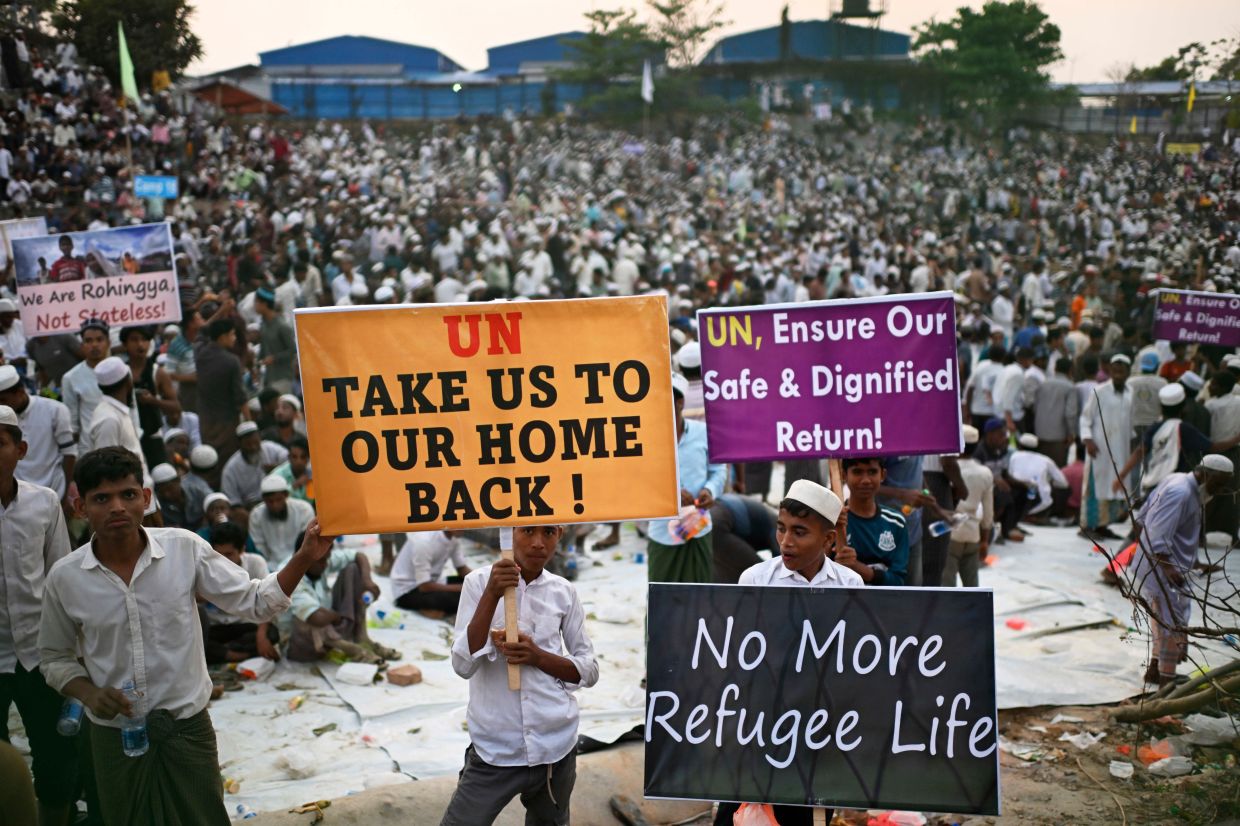
Myanmar's military-controlled government announced on Saturday that it has verified more than 300,000 Rohingya refugees sheltering in overcrowded camps across the Bangladesh border as legitimate former residents of Rakhine state, signalling potential acceptance of their return once conditions stabilize. The declaration from the Ministry of Foreign Affairs arrives at a grim milestone for the Rohingya crisis, which has now persisted for nine years with no meaningful resolution, leaving hundreds of thousands languishing in makeshift settlements across Bangladesh with diminishing prospects for either voluntary repatriation or resettlement elsewhere.
The verification announcement represents a partial acknowledgement from Naypyidaw that the refugees possess legitimate historical connections to Myanmar, a subtle but significant departure from the regime's longstanding denial of Rohingya citizenship or belonging. However, the conditional nature of the statement—acceptance contingent upon improved security—effectively postpones any near-term homecoming while Myanmar grapples with intensifying armed conflict within Rakhine itself. The government claims to have processed 426,545 of the 828,824 refugees listed by Bangladesh as of July's end, determining that 308,797 qualified as prior Rakhine residents, whilst flagging 113,507 as unverifiable and alleging 4,241 had links to insurgent activities.
The roots of this humanitarian catastrophe extend to August 2017, when Myanmar's military unleashed a devastating offensive in response to attacks by Rohingya militants on military installations. That crackdown displaced over 700,000 people across the Bangladesh border, compounding decades of previous displacement following earlier waves of state-sponsored persecution. The sheer scale and brutality of the operation drew international condemnation, with United Nations bodies and multiple nations accusing Myanmar of orchestrating ethnic cleansing and genocide—charges the junta categorically rejects whilst maintaining that Rohingya are Bengali migrants without legitimate claims to Myanmar citizenship.
Myanmar's official position remains that the Rohingya are not among the country's 135 recognized ethnic minorities, instead dismissing them as illegal settlers from Bangladesh to delegitimize their historical presence. This stance has proved central to explaining the government's resistance to meaningful repatriation efforts, even as it gradually acknowledges some verifiable connections between refugee populations and Rakhine. The military's narrative that no more than 540,000 entered Bangladesh following the violence and that over 200,000 remain in northern Rakhine further attempts to minimize the operation's scope and impact on international opinion.
Repatriation efforts have repeatedly collapsed despite Myanmar and Bangladesh signing a bilateral agreement in 2018 envisioning a two-year return process. The political situation deteriorated sharply when the military staged a coup in February 2021, ousting civilian leader Aung San Suu Kyi and triggering nationwide resistance and armed conflict. These conditions rendered voluntary returns impossible, as internal security across Myanmar—particularly Rakhine—evaporated beneath competing claims to territorial control and escalating violence between military forces and the Arakan Army, a potent ethnic armed organization that has seized much of the state from government hands.
The Arakan Army's territorial gains since 2023 have paradoxically worsened conditions for remaining Rohingya populations and triggered fresh displacement toward Bangladesh and beyond. Fighting between the insurgent group and military units has displaced additional civilians whilst destroying critical infrastructure and services, making return scenarios increasingly implausible regardless of official verification schemes. The international community has grown skeptical that Myanmar possesses either the will or capacity to genuinely facilitate safe, dignified return of Rohingya populations, given the regime's historical behaviour and present inability to control its own territory.
Conditions in Bangladesh's refugee camps have progressively deteriorated, contributing to mounting desperation among residents. Overcrowding, inadequate medical facilities, limited educational opportunities, and severe restrictions on movement characterize daily existence for over 900,000 Rohingya now living across sprawling settlements. Simultaneously, foreign aid flows have contracted markedly as international attention has shifted to competing crises, leaving humanitarian organizations struggling to maintain basic service provision. These compounding pressures have driven increasing numbers of Rohingya to undertake perilous maritime journeys toward Malaysia and Indonesia aboard unseaworthy vessels operated by smuggling networks, with dozens perishing annually in the process.
Malaysia has emerged as a primary destination for Rohingya maritime refugees, hosting significant populations outside formal camp settings. Prime Minister Anwar Ibrahim announced in late July that Myanmar had consented to accept 5,000 Rohingya currently residing in Malaysia through a repatriation framework. This statement, however, immediately triggered contradictory messaging from Myanmar's Foreign Ministry official Han Win Aung, who stated that any repatriation program would exclusively address verified Myanmar nationals held in detention facilities, pointedly rejecting characterization of the arrangement as accepting Rohingya refugees generally. Such internal contradictions reflect the genuine disarray surrounding Myanmar's actual repatriation policy and the regime's continued reluctance to legitimize Rohingya claims to citizenship.
The persistent gap between Myanmar's rhetoric about verification and its actions regarding meaningful repatriation suggests that official announcements may serve primarily as diplomatic positioning rather than harbingers of genuine implementation. Observers note that security conditions in Rakhine—the stated precondition for accepting returnees—show no signs of improvement and arguably continue deteriorating as competing military factions clash over territorial dominion. The junta's conditional language therefore appears designed to deflect international criticism whilst preserving flexibility to indefinitely delay any actual return of refugees, allowing Myanmar to avoid the operational burden and political complications of reintegrating a population it refuses to fully acknowledge as citizens.
For Malaysia and other Southeast Asian nations hosting Rohingya communities, Myanmar's ambiguous signals create difficult policy dilemmas. Accepting that repatriation remains impractical, these countries confront escalating domestic political pressures regarding refugee populations whilst lacking the resources or international burden-sharing mechanisms to provide permanent solutions. The region has increasingly gravitated toward securitized approaches treating Rohingya arrivals as migration challenges rather than humanitarian imperatives, particularly following incidents of maritime accidents attracting domestic attention. Myanmar's verification announcements, despite ostensibly offering hope, ultimately underscore the cruel reality that the Rohingya crisis will likely persist indefinitely absent fundamental political transformation in Myanmar or unprecedented international intervention to compel repatriation against Naypyidaw's preferences.

