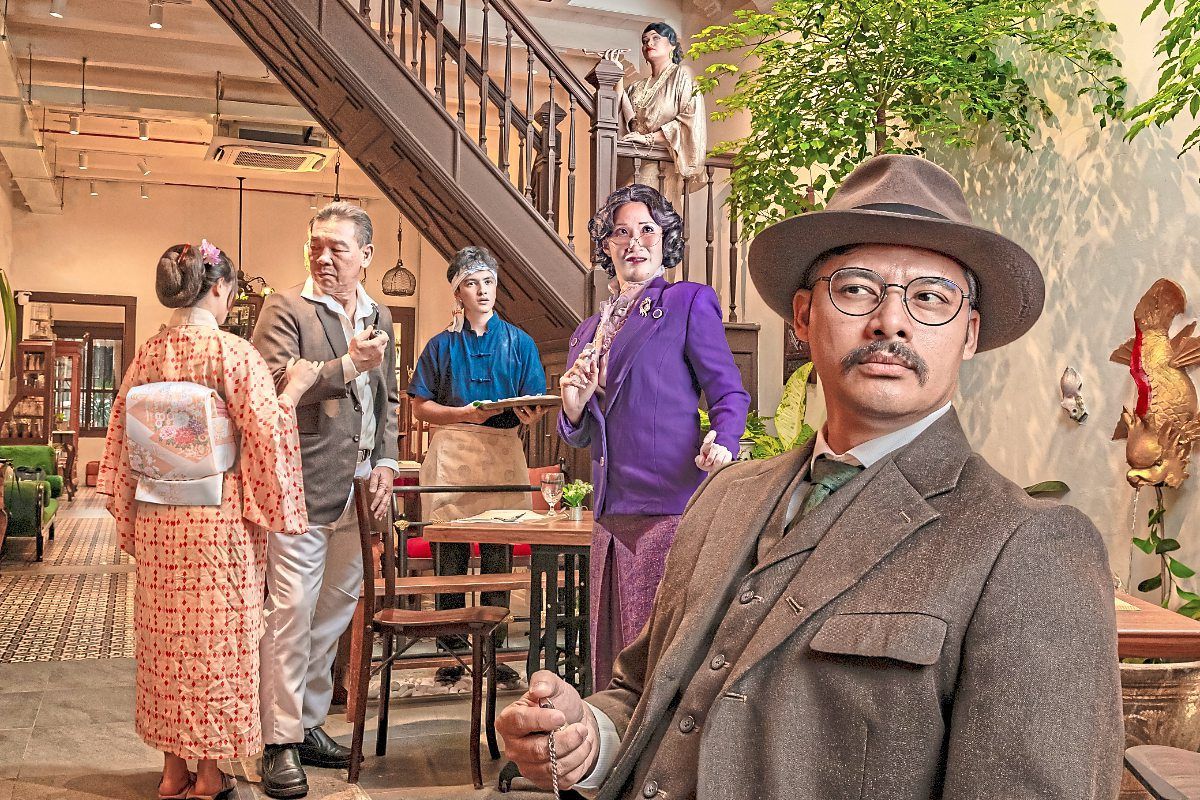
Melaka's thriving experimental theatre scene is taking an intriguing turn with the launch of an immersive murder mystery experience that merges the city's culinary traditions with participatory storytelling. Over four weekends spanning July and August, Krate Creative Space has partnered with The Garden@Heeren, a heritage Peranakan establishment located on Jalan Tun Tan Cheng Lock, to present an evening where guests simultaneously dine and investigate a staged crime unfolding around them.
The production represents a distinctive approach to cultural tourism in Malaysia's heritage heartland, moving beyond passive sightseeing toward experiences that engage multiple senses. Upon arrival, participants are invited to wear vintage or Peranakan-inspired formal wear, setting a deliberate aesthetic tone before they encounter the evening's central narrative. The experience unfolds across approximately two and a half hours, beginning with an elaborate multi-course Peranakan dinner featuring traditional dishes including pie tee, pongteh chicken, and cincalok omelette. Rather than treating the meal as merely supplementary to the performance, the food becomes integral to atmosphere-building, anchoring the experience in Melaka's celebrated gastronomic heritage.
The mystery itself is anchored in a specific scenario: guests have been invited to celebrate the grand reopening of a beautifully refurbished restaurant helmed by the celebrated Chef Fa. This celebratory premise quickly deteriorates when a shocking tragedy interrupts the festivities, prompting the arrival of Detective Raymond to investigate. From that moment, attendees transition from passive observers to active participants, moving throughout The Garden@Heeren's spaces to examine crime scenes, search for concealed evidence, interrogate suspects portrayed by professional actors, and construct their own theories about the perpetrator's identity.
What distinguishes this production from conventional murder mystery dinner theatre is the deliberate emphasis on audience agency. Rather than following a predetermined narrative arc, different groups of participants will uncover distinct clues based on their investigative choices, engage suspects through different conversational approaches, and ultimately arrive at potentially divergent conclusions. This variability means no two performances proceed identically, a feature that Krate has intentionally designed into the experience. Additionally, the production features two entirely separate endings, with the first two weekends presenting one resolution while the final two weekends reveal an alternative conclusion. This structure encourages return attendance among local audiences, as returning participants encounter fundamentally different narrative trajectories.
The cast comprises seasoned performers drawn from Krate's existing production roster, including Francis Augustine as Detective Raymond, Sonia Lee as Miss Irene, Lee You Meng as Baba Pang, Elijah Skye as Peter Pang, and Neena Shu as Mama Maria. The production is officially recommended for audiences aged fifteen and above, acknowledging that younger participants may find certain dramatic elements challenging. The creative direction stems from Wee, Melaka-based writer and developer of all Krate Creative Space productions, who has pursued this murder mystery concept for an extended period before identifying suitable collaborators and venue.
Wee emphasises that discovering The Garden@Heeren as a performance space proved transformative for the project's realisation. The heritage house's architectural qualities and historical resonance naturally support the mysterious, suspenseful atmosphere the production seeks to cultivate. More significantly, Wee recognised that Melaka's renowned food culture presented an opportunity to synthesise theatrical performance with experiential dining, transporting audiences to the 1930s through cumulative sensory engagement encompassing visual design, period costumes, traditional music, prepared dishes, and direct human interaction.
The fundamental innovation underlying this production concerns how audiences shape the experience through their investigative decisions. Participants will pose distinct questions to suspects, follow divergent investigative trails, and interpret ambiguous evidence differently depending on individual reasoning and group discussion. This participant-driven narrative structure ensures that audience engagement directly influences performance content, a distinction Wee identifies as her primary creative excitement regarding this production. The unpredictability this generates contrasts sharply with more conventional theatre formats where audience response remains largely predetermined.
Krate Creative Space itself merits attention as an institutional presence within Malaysia's independent theatre landscape. Established in 2016, the organisation represents Melaka's first dedicated independent creative community specialising in customised, interactive, and multidisciplinary live performance. Across its operational history, Krate has mounted over ten original productions while cultivating both local and regional audiences. Approximately half of Krate's attendees originate from Melaka itself, though substantial portions travel from the Klang Valley, Penang, Johor, and Singapore. The company has even attracted international tourists seeking cultural experiences that transcend conventional tourism offerings.
The operational sustainability of independent theatre remains precarious within Malaysia's cultural economy, a reality Krate has confronted directly. To maintain viability, the organisation has deliberately diversified beyond live performance alone. The company's creative hub, situated in Bukit Beruang and encompassing rehearsal facilities, studio space, and discussion areas, also functions as a cafe, generating supplementary revenue streams. This adaptive approach reflects broader challenges facing Malaysian independent performing arts organisations navigating limited public funding and inconsistent audience bases.
Wee's long-term vision positioning immersive theatre as a distinctive component of Malaysia's cultural tourism infrastructure deserves serious consideration. She argues persuasively that heritage-designated cities including Melaka possess natural advantages for presenting theatre that connects audiences to historical narratives and spatial memory. Rather than positioning theatre and heritage tourism as separate activities, Wee envisions integrated experiences where original Malaysian stories become available year-round within preserved historical environments. This perspective challenges conventional tourism models that often segregate cultural attractions into discrete, temporally bounded experiences.
Looking forward, Krate aspires to establish a permanent dedicated venue within Melaka where heritage-inspired immersive productions could operate regularly, accommodating both local residents and tourist visitors throughout the year. This ambition reflects broader institutional maturation for Melaka's independent creative sector. The company previously extended operations beyond Melaka by presenting its original production The Best Nyonya at Georgetown Mansion in Penang, demonstrating capacity for regional expansion. The murder mystery weekends represent continuation of this outward trajectory while simultaneously deepening engagement with Melaka's distinctive cultural identity.
The murder mystery production ultimately exemplifies how Malaysian performing arts practitioners are experimenting with audience participation, heritage interpretation, and experiential design to create cultural offerings that generate both artistic and commercial viability. By anchoring interactive theatre within specific historical periods, authentic culinary traditions, and preserved architectural spaces, Krate demonstrates how creative industries might function as meaningful economic engines for heritage cities while simultaneously offering residents and visitors substantive cultural engagement beyond conventional tourism paradigms. The success of these four weekends will likely influence how other Malaysian creative organisations conceptualise the relationship between performance, place, and audience participation.

