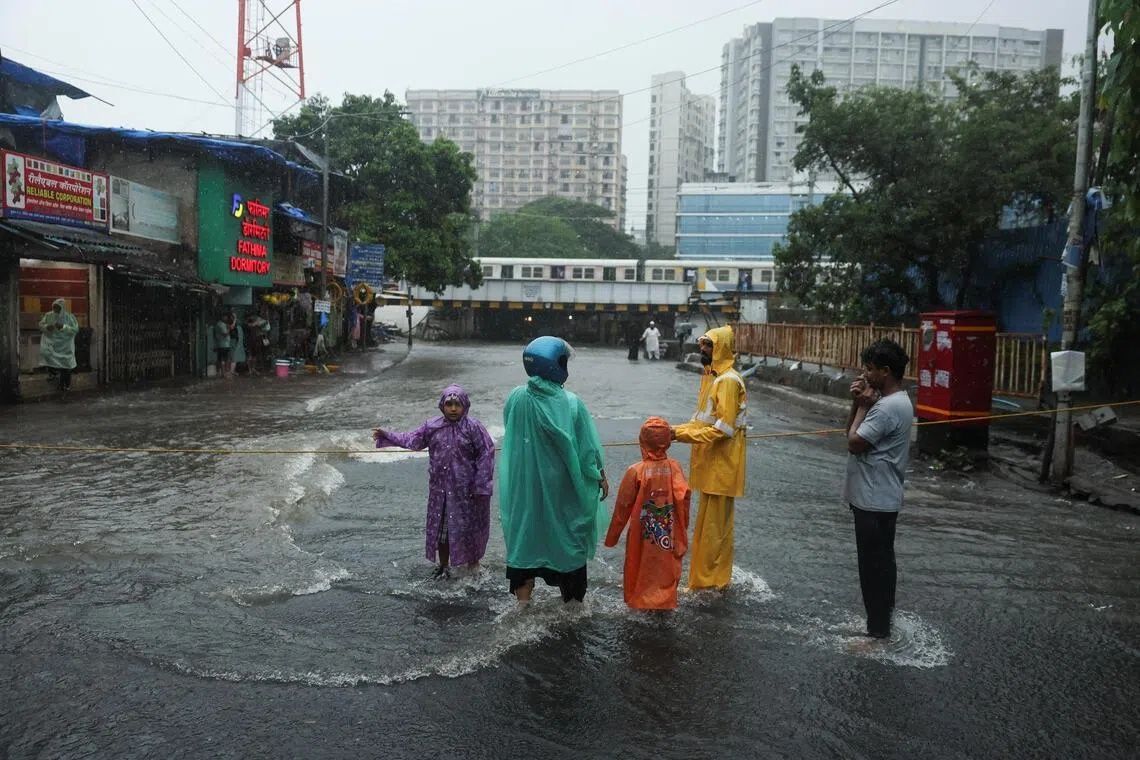
An intensifying monsoon spell has brought tragedy and chaos to Mumbai, claiming two lives and exposing serious gaps in civic preparedness as the India Meteorological Department issued an orange alert for the financial capital on July 3. The relentless downpour has paralysed large sections of the city, submerging key thoroughfares, disrupting public transport, and unleashing a fresh wave of criticism directed at both the state government and the Brihanmumbai Municipal Corporation (BMC) regarding their capacity to manage seasonal hazards that claim lives with predictable regularity each year.
The first fatal incident occurred when a massive tree, destabilised by strong winds accompanying the heavy rain on June 30, collapsed onto a school bus carrying students from Universal High School and Tilak Nagar School in the Chembur neighbourhood. The impact trapped several young passengers inside the vehicle, necessitating an extended rescue operation that deployed cutting equipment to extract them from the wreckage. Among those injured was eleven-year-old Vihan Shrivastav, whose condition deteriorated despite emergency medical intervention. He was rushed to Zen Hospital where he subsequently succumbed to his injuries, transforming the incident from a frightening accident into a tragedy that has intensified scrutiny of tree maintenance protocols across the city.
Political figures quickly responded to the school bus disaster, with Maharashtra minister Ashish Shelar acknowledging the gravity of the incident and pledging government action. However, his characterisation of the event as merely unfortunate drew criticism from opposition lawmakers who contended that bureaucratic failures warranted more severe consequences than his statement suggested. Maharashtra Legislative Assembly member Rohit Pawar, after meeting with the bereaved family, pressed for accountability extending beyond junior administrative staff, arguing that the incident represented a fundamental breakdown in civic responsibility rather than an isolated operational lapse. Pawar specifically questioned whether pre-monsoon inspections of critical infrastructure—roads, drainage systems, and municipal maintenance schedules—were being conducted with sufficient rigour, suggesting that repeated similar incidents pointed towards systematic negligence rather than unavoidable accidents.
The second fatality occurred in a different part of the city, further compounding concerns about monsoon preparedness. Sixty-year-old Aslam Isak Shaikh died on July 2 after falling into an uncovered manhole in Sakinaka while heavy rain was still falling. According to available information, civic workers had removed the drainage cover for routine maintenance but failed to implement adequate safety barriers or warning markers around the hazard. Shaikh, who was distracted by a mobile phone conversation, could not avoid the opening as he walked through the area. The force of rainwater flowing through the drainage system swept him into the underground passage, necessitating a three-hour search-and-rescue operation before his body was recovered, transforming what should have been a straightforward maintenance procedure into another preventable tragedy.
Muhammad Vijay Wadettiwar, an MLA member representing the affected ward, called for criminal investigation against officials responsible for the lapse, arguing that basic safety protocols had been wholly disregarded. The absence of temporary barriers, warning signs, or personnel posted to monitor the exposed opening during wet weather conditions represented, in Wadettiwar's assessment, gross negligence warranting formal criminal charges rather than administrative disciplinary action. He specifically questioned where accountability resided within the municipal bureaucracy and demanded that a First Information Report be registered, signalling his belief that the matter should be treated as a criminal act rather than a civil administrative failure. MLA Speaker Rahul Narwekar acknowledged the incident's severity during assembly discussions and confirmed that a detailed investigation report had been requested, characterising the event in measured terms that nonetheless indicated the gravity with which legislative leadership viewed the breakdown.
Mumbai Mayor Ritu Tawde framed the incident as an administrative error and announced compensation of 10 lakh rupees—approximately US$10,455—for Shaikh's bereaved family. While the financial gesture acknowledged the family's loss, many observers questioned whether compensation adequately addressed the underlying systemic failures that enabled two separate fatal incidents within a matter of days. The municipal authority's tendency to classify such incidents as individual administrative oversights rather than symptoms of broader infrastructural and supervisory deficiencies has long frustrated both civil society observers and elected representatives seeking meaningful institutional reform.
Beyond the fatal incidents themselves, the monsoon spell has created widespread disruption across Mumbai's transportation networks and commercial activity. Waterlogging has persisted in numerous residential and commercial areas, including Dadra East and Sion Gandhi Market, creating traffic gridlock that has left commuters stranded during extended delays. A truck overturned near the Kharghar Toll Plaza on the Sion-Panvel Highway, blocking multiple lanes and requiring emergency services to clear the damaged vehicle before traffic flow could resume. These incidents, while less immediately tragic than the deaths of Shrivastav and Shaikh, nonetheless underscore the broader inability of municipal systems to manage rainfall events that, while severe, fall well within historical patterns for the monsoon season.
The India Meteorological Department's orange alert—indicating heavy to very heavy rainfall expected over the succeeding 24 hours—prompted authorities to advise residents against unnecessary movement and suggested that disruptions would likely persist through the forecast period. This advisory, while prudent, underscores a troubling pattern wherein Mumbai essentially comes to a standstill during monsoon downpours despite the predictability of seasonal weather patterns. The financial hub of India, home to millions and responsible for generating substantial national economic output, repeatedly finds itself paralysed by monsoon conditions that engineers and planners have had decades to anticipate and accommodate.
For Malaysian and Southeast Asian observers, Mumbai's recurrent monsoon crises offer sobering lessons regarding the importance of proactive infrastructure resilience planning. Malaysia, similarly located within a monsoon climate zone, faces comparable seasonal weather challenges, yet the contrast between institutional capacity in some Malaysian cities and Mumbai's recurring struggles suggests that adequate budgeting, rigorous maintenance protocols, and genuine political will can substantially mitigate such disasters. The pattern of deaths resulting from preventable failures—fallen trees inadequately maintained, uncovered utility openings insufficiently protected—speaks to a broader governance gap that transcends weather and becomes a measure of administrative competence and public sector accountability.
The demand from opposition lawmakers for criminal prosecution of senior officials rather than junior staff represents a significant escalation in accountability rhetoric within Maharashtra politics. If implemented, such an approach would represent a departure from customary patterns wherein administrative failures have historically resulted in relatively minor disciplinary action affecting subordinate personnel. Whether this political pressure translates into actual changes in institutional practice, investment in preventive maintenance, or enhanced supervisory oversight remains uncertain, but the clarity of legislative demands suggests that Mumbai's citizenry may no longer tolerate the excuse that monsoon deaths are inevitable consequences of seasonal weather rather than failures of governance and planning.

