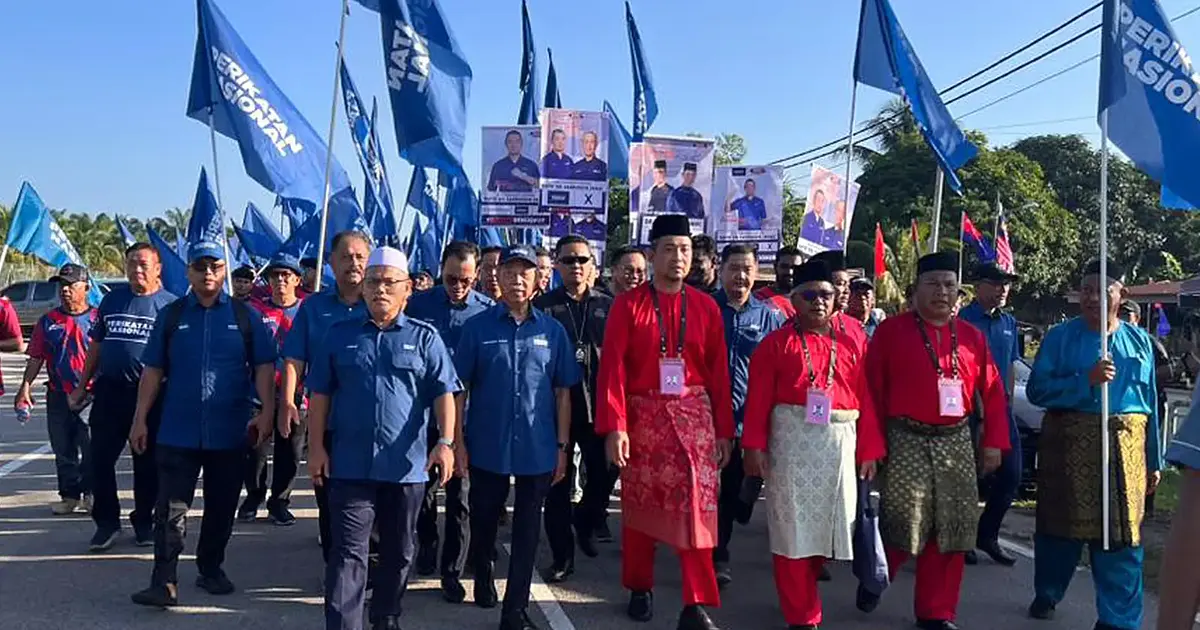
Perikatan Nasional chairman Muhyiddin Yassin threw his weight behind the coalition's campaign efforts in Bukit Kepong, joining hundreds of enthusiastic supporters in a show of unity designed to energise grassroots activism ahead of polling day. The veteran politician's direct involvement underscores the significance of the constituency to Perikatan's electoral calculus, while signalling the coalition's determination to consolidate support across crucial battleground constituencies.
At the heart of Perikatan's campaign push stands Dr Sahruddin Jamal, who seeks to retain the Bukit Kepong seat as Bersatu's standard-bearer. The two-term assemblyman brings accumulated experience from his tenure in the state legislature, where he has developed constituent connections and legislative acumen. His previous electoral success in the constituency provides Bersatu with an incumbent advantage, though incumbency alone rarely guarantees victory in Malaysia's increasingly competitive electoral landscape.
The deployment of Muhyiddin to lead this campaign activity reveals the strategic importance Perikatan places on the Bukit Kepong contest. Rather than relying solely on grassroots organising, the presence of top-tier coalition leadership galvanises supporters and generates media attention—resources that smaller or less-resourced campaigns cannot readily mobilise. Such leadership visibility also sends a signal to fence-sitters that Perikatan regards this particular seat as winnable and worthy of centralised party machinery backing.
Perikatan Nasional itself represents a coalition structure forged through the combination of Bersatu, PAS, and regional components, a formation that has significantly reshaped Malaysia's political topology since 2020. The coalition's varying performance across different constituencies and voter demographics means that targeted campaigns in contested seats become critical calibration points for the broader political narrative. Bukit Kepong evidently qualifies as such a constituency, justifying resource concentration.
The rallying of hundreds of supporters for Dr Sahruddin's campaign reflects the labour-intensive nature of modern Malaysian electoral politics. Despite advances in digital campaigning and social media outreach, traditional grassroots mobilisation—canvassing, town halls, public gatherings—remains indispensable for converting political preference into actual votes. Ground operations of this scale require coordination across party structures, volunteer networks, and community organisations, demanding the kind of institutional capacity that established coalitions like Perikatan can more readily supply than newer or smaller political entities.
For voters across Southeast Asia's largest economy, such campaign activities signal the intensity with which political coalitions compete for legislative representation. Malaysia's Westminster-derived system makes constituency-level contests the primary battleground where national political narratives ultimately resolve into legislative outcomes. A single seat's marginal contribution to a coalition's parliamentary strength may seem modest in abstract terms, yet accumulated across dozens of constituencies, these incremental gains determine whether governments command majorities or languish in opposition.
The timing and scale of Muhyiddin's campaign appearance also reflects calculations about momentum and narrative control. By maintaining visible presence in constituencies through leadership appearances, Perikatan attempts to sustain supporter enthusiasm and shape media framing around which coalition possesses forward momentum. In an electoral environment where swing voters and persuadable supporters comprise pivotal blocs, the psychological dimension of perceived momentum can meaningfully influence voting behaviour.
Dr Sahruddin's track record as a two-term assemblyman provides context for understanding why Perikatan selected him as the coalition's candidate. Electoral candidates in Malaysia's system typically require demonstrated capacity to connect with constituents, navigate local issues, and translate community concerns into legislative priorities. Incumbent assemblymen who successfully achieve re-election twice signal to party leadership that they possess these qualities, justifying selection as coalition standard-bearers for higher office or contested seats.
The Bukit Kepong campaign also encapsulates broader questions about competitive dynamics within Malaysia's federal and state politics. Different constituencies experience varying political alignments depending on demographic composition, economic interests, and historical voting patterns. A seat that Perikatan targets for consolidation might represent a territory from which rival coalitions seek to make inroads, creating the zero-sum competitive environment that generates need for intensive campaign mobilisation.
For Malaysian voters evaluating political alternatives, such campaign events offer opportunities to assess candidate competence, policy platforms, and coalition direction. The public spectacle of hundreds gathering behind Dr Sahruddin communicates something about perceived candidate viability and coalition organisation, though voters ultimately must weigh such displays against substantive policy records and political credibility. Muhyiddin's personal involvement extends beyond ceremonial endorsement to active campaign partnering, suggesting Perikatan genuinely prioritises success in this constituency.
The campaign activity in Bukit Kepong also reflects how Malaysian politics operates through networked relationships between leadership, party machinery, and grassroots supporters. These interconnections enable large-scale mobilisation when necessary, translating elite political decisions into coordinated ground activity. Understanding such organisational capacity matters for assessing which coalitions can effectively translate electoral prospects into legislative gains.

