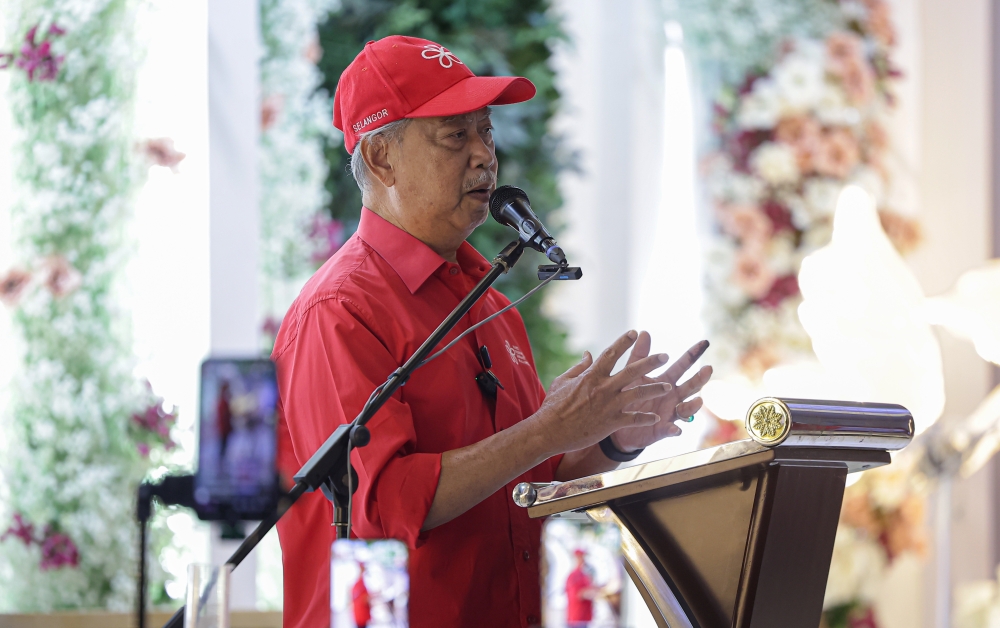
Tan Sri Muhyiddin Yassin has staked a significant claim that Parti Pribumi Bersatu Malaysia now represents the country's only genuine Opposition in Parliament, marking a bold assertion amid the fluid landscape of Malaysian political alliances. The former Prime Minister's characterisation reflects deepening fragmentation within opposition ranks and points to the strategic repositioning of Bersatu as Parliament's principal scrutineer of government policy.
Muhyiddin's declaration arrives at a critical juncture in Malaysian politics, where traditional Opposition coalitions have fractured and reformed repeatedly over recent years. His argument rests on the contention that other opposition-leaning entities have either aligned themselves with the government or entered arrangements that compromise their independence as watchdogs. This positioning effectively distinguishes Bersatu from competitors seeking opposition credentials, particularly as Pakatan Harapan navigates its own internal complexities and DAP and Amanah manage their respective political trajectories.
The assertion carries significant implications for how Parliament functions and debates are conducted. An Opposition defined as singular rather than plural suggests a concentration of scrutiny and amendment-proposing responsibility on one party rather than distributed across multiple entities. This concentration could theoretically enhance the clarity of opposition messaging but might equally limit parliamentary diversity of critical perspectives, depending on whether cross-party voting patterns emerge on contentious issues.
Bersatu's trajectory illustrates the paradoxes of Malaysian political realignment. The party, which was foundational to Pakatan Harapan's 2018 electoral triumph, subsequently withdrew from that coalition and forged alternative arrangements. Muhyiddin's leadership of Bersatu during these transitions established him as a key architect of the coalition mathematics that has defined recent Malaysian governance. His current assertion about sole opposition authenticity therefore reflects both Bersatu's current parliamentary positioning and his own evolution as a political actor.
The claim warrants scrutiny regarding what constitutes authenticity in an opposition role. Traditional measures include parliamentary voting patterns, consistency on policy positions, and independence from executive influence. Bersatu's own history of coalition participation and reconfiguration complicates any straightforward definition. However, if the party indeed maintains independent voting patterns on government legislation and consistently challenges executive decisions, the substance of Muhyiddin's argument may carry weight among voters seeking clarity about which MPs genuinely resist government policies.
For Malaysian voters and observers, this declaration signals continuing turbulence within opposition ranks. The notion that Parliament contains only one authentic Opposition suggests either extraordinary fragmentation among potential government critics or a strategic rebranding exercise by Bersatu designed to consolidate opposition-minded voters. Understanding which interpretation applies requires close attention to Bersatu's parliamentary conduct in coming months, particularly on legislation addressing economic, social, and constitutional matters.
The regional dimension also merits consideration. Southeast Asian democracies increasingly grapple with Opposition fragmentation, coalition fluidity, and the challenge of maintaining meaningful checks on executive power amid realigned party systems. Malaysia's experience with these dynamics, including Muhyiddin's navigation of them, offers instructive patterns for neighbouring democracies managing similar transitions. The effectiveness of any single-entity Opposition depends heavily on whether Parliament's procedural rules empower minority voices and whether media ecosystems amplify opposition scrutiny.
Bersatu's financial and organisational capacity to sustain an independent opposition role also warrants examination. Maintaining parliamentary presence, research capacity, and policy development requires resources that smaller parties sometimes struggle to secure. Muhyiddin's assertion about authentic opposition status implicitly claims Bersatu possesses or can mobilise such capacity. Government access to state resources and incumbent advantages in fundraising create inherent asymmetries that any opposition entity must navigate.
The tactical dimension of this declaration reflects Bersatu's need to differentiate itself within a crowded political marketplace. By claiming singular authenticity, the party positions itself as the decisive choice for voters dissatisfied with government performance but uncertain whether other entities represent genuine alternatives. This messaging strategy seeks to consolidate fragmented anti-government sentiment into coherent electoral support, particularly crucial in mixed electoral systems where concentration of votes can translate into seat gains.
Looking forward, the credibility of Muhyiddin's assertion will depend on observable parliamentary conduct and policy positions. If Bersatu consistently opposes government legislation, proposes substantive amendments, and advocates for positions distinct from the executive, the claim gains empirical grounding. Conversely, if the party maintains cordial relations with government figures, votes in alignment with administration priorities, or exhibits inconsistency in opposition positions, the declaration may be dismissed as strategic rhetoric rather than authentic description.
The broader implication concerns parliamentary democracy's quality in Malaysia. Meaningful opposition scrutiny, whether concentrated in one entity or distributed across multiple parties, remains essential for government accountability and democratic health. Muhyiddin's claim about Bersatu's singular authenticity ultimately matters less than whether Parliament contains sufficient independent voices genuinely holding executive power to account, regardless of partisan labels or coalition configurations.

