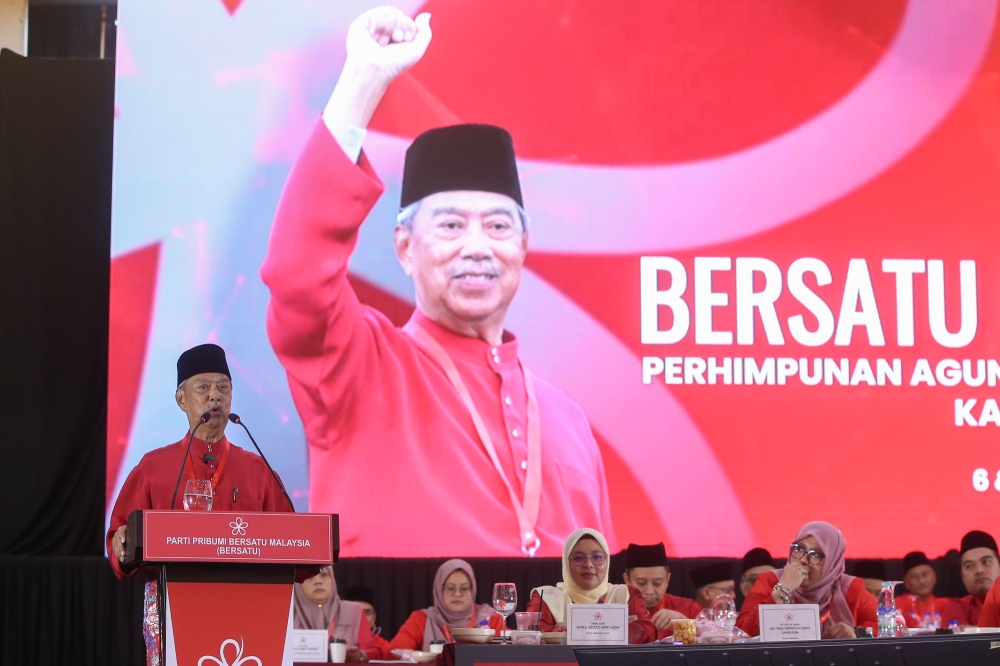
Bersatu president Tan Sri Muhyiddin Yassin escalated tensions within Malaysia's conservative political landscape on Wednesday, asserting that the Perikatan Nasional coalition has systematically sidelined his party while questioning whether the current Umno-centred alliance genuinely advances the interests of Malay-Muslim Malaysians. His remarks signal deepening fractures among parties that once positioned themselves as custodians of Malay-Muslim political interests, a traditionally powerful voting bloc that has shaped Malaysian electoral outcomes for decades.
Muhyiddin's critique comes at a critical juncture for Malaysian politics, where the balance of power between competing Malay-Muslim coalitions remains fluid. The statement underscores how the Bersatu leader views his party's treatment within Perikatan as symptomatic of broader strategic failures rather than mere internal disagreements. By framing the question in terms of authenticity—whether the Umno alliance truly serves Malay-Muslim unity—Muhyiddin is attempting to reposition Bersatu as the principled alternative to what he characterises as a compromised or merely transactional political arrangement.
The exclusion Muhyiddin references appears to relate to decision-making structures and seat allocations within the Perikatan framework, where Bersatu's influence has been constrained despite its historical role in coalition-building among Malay-Muslim parties. This marginalization carries implications for seat negotiations ahead of any future electoral contests, as the distribution of constituencies remains a fundamental currency in Malaysian coalition politics. For Bersatu members, particularly those holding parliamentary positions, limited influence within Perikatan translates directly into reduced negotiating power when determining electoral candidacies.
Muhyiddin's characterization of the Umno-led alliance as lacking genuine Malay unity reflects a philosophical disagreement about coalition composition. The implication appears to be that a truly authentic Malay-Muslim political movement would operate on fundamentally different principles—potentially suggesting that Bersatu envisions either a reconstituted coalition or an alternative arrangement more closely aligned with its ideological priorities. This framing allows Muhyiddin to present Bersatu's potential exit or reduced participation not as political weakness but as principled withdrawal from an arrangement he views as hollow.
The timing of these accusations matters significantly within Malaysian political cycles. With electoral pressure mounting and coalition stability increasingly fragile across the political spectrum, statements from senior figures like Muhyiddin can either accelerate defections or trigger defensive realignments. Other coalition members may feel compelled to either defend Perikatan's current structure or acknowledge the legitimacy of Muhyiddin's concerns, potentially prompting internal discussions about power redistribution within the coalition.
For Malaysian voters concerned with Malay-Muslim political representation, Muhyiddin's comments invite reconsideration of which coalition genuinely prioritizes their interests. This messaging strategy attempts to exploit any perception among the Malay-Muslim electorate that existing arrangements prioritize personal or factional ambitions over collective community welfare. Should such sentiments resonate broadly, they could fragment the Malay-Muslim vote further, with unpredictable consequences for seat distribution in parliament.
The substance of Muhyiddin's critique also suggests that behind-the-scenes negotiations within Perikatan have deteriorated beyond what public statements previously indicated. Coalition members typically maintain public facade of unity even amid serious disagreements, so explicit accusations of exclusion signal that internal tensions have reached thresholds where diplomatic niceties no longer constrain public communication. This development potentially indicates that Bersatu leadership has concluded that defending coalition solidarity yields fewer political benefits than staking out distinctive positions.
From a regional Southeast Asian perspective, Malaysian coalition instability reverberates across the broader democratic landscape. Other nations with similar multi-ethnic and multi-religious compositions observe how Malaysia's major political groupings manage internal diversity and competing claims to represent majority communities. The current tensions illustrate both the potential for inclusive coalition-building and the persistent risks of exclusionary politics when particular factions dominate decision-making structures.
Muhyiddin's position as Bersatu president gives his statements particular weight, as he remains a nationally recognized political figure with experience in high office. His criticism carries authority that grassroots party activists or lesser-known figures could not match, potentially influencing how both Bersatu supporters and undecided voters interpret the current political configuration. The credibility question becomes whether his assessment reflects genuine policy disagreements or primarily reflects personal and factional positioning within competitive party politics.
The path forward for Malaysian Malay-Muslim politics remains uncertain, with Muhyiddin's latest pronouncements likely to intensify rather than resolve underlying tensions. Whether Bersatu can convert rhetorical challenges into practical political gains depends substantially on whether disaffected coalition members or floating voters respond to the party's messaging about authenticity and genuine representation. The coming months will reveal whether Muhyiddin's criticisms catalyze significant political realignment or remain largely confined to elite-level maneuvering with limited grassroots impact.

