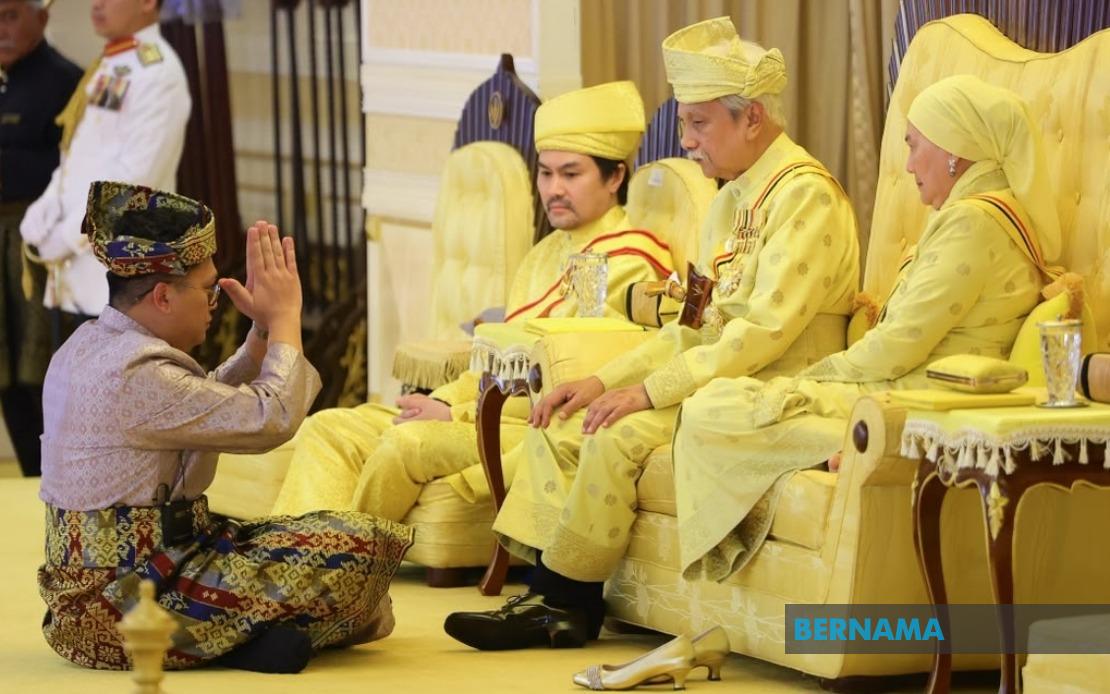
Muhammad Faris Johari has assumed his role as the 11th Undang of Luak Sungei Ujong following his formal installation by Tuanku Muhriz Tuanku Munawir, the Yang Dipertuan Besar of Negeri Sembilan. The ceremonial investiture took place at Istana Besar Seri Menanti on June 27, marking a significant moment in the state's traditional governance structure. As part of the installation, Muhammad Faris received the customary title Datuk Klana Petra, a distinction that underscores his new position within Negeri Sembilan's hierarchical system of Orang Kaya, or traditional chieftains.
The investiture followed an established protocol rooted in Negeri Sembilan's unique constitutional arrangements. The proceedings commenced when the Orang Empat Istana—the traditional council of four senior chieftains—sought the Yang Dipertuan Besar's permission to proceed with the installation. Muhammad Faris subsequently took an oath of allegiance to the ruler, a ceremonial act that formalises the relationship between the appointed leader and the state's constitutional monarchy. This ritual reinforces the symbiotic relationship between traditional leadership and the formal institution of royalty that characterises Negeri Sembilan's governance model, distinguishing it from other Malaysian states through its Minangkabau-influenced constitutional framework.
Tuanku Muhriz emphasised the gravity of the undertakings made during the ceremony, stressing that all pledges must be executed with unwavering sincerity, personal integrity, and a profound sense of responsibility. The ruler's remarks reflected broader concerns about maintaining institutional stability in an increasingly complex political environment. He pointedly reminded the Orang Kaya present that their continued allegiance to the Yang Dipertuan Besar institution remains paramount, and that they must cultivate respectful and harmonious relations with both the ruler and the Palace infrastructure. These directives suggest an effort to reinforce traditional hierarchies and institutional bonds during a period when customary authorities face evolving pressures from modern governance demands.
The ruler further articulated his vision for sustainable leadership within the state, arguing that relationships constructed on foundations of reciprocal respect, institutional trust, and consensus-building are vital for preserving constitutional monarchy frameworks. This philosophy extends beyond ceremonial matters to encompass the practical challenges facing Negeri Sembilan's governance. Tuanku Muhriz's emphasis on these principles speaks to a recognition that customary leadership must adapt to contemporary expectations while maintaining legitimacy rooted in historical tradition. His remarks underscore the delicate balancing act required of state institutions in preserving constitutional arrangements that have evolved over more than a century.
A particularly significant dimension of Tuanku Muhriz's address concerned the preservation of Adat Perpatih, the matrilineal customary law system unique to Negeri Sembilan. He called upon both the traditional leadership structure and the broader populace to work collaboratively in safeguarding these inherited cultural practices. The ruler's emphasis on intergenerational transmission of Adat Perpatih values reflects concerns within the state about potential erosion of distinctive legal and social traditions in the face of modernisation and centralising pressures. For Malaysian observers interested in constitutional pluralism and the maintenance of regional legal diversity, this advocacy for customary law preservation carries broader implications about how federal systems can accommodate localised governance traditions.
Muhammad Faris brings considerable professional credentials to his new role. The 28-year-old, born on October 30, 1997, holds a bachelor's degree in accountancy from Universiti Teknologi MARA, one of Malaysia's premier tertiary institutions. He subsequently obtained professional accreditation through the Association of Chartered Certified Accountants programme in 2022, demonstrating commitment to acquiring internationally recognised qualifications. These credentials suggest a profile attuned to bridging traditional governance roles with contemporary professional standards—a pattern increasingly evident among younger appointees to customary leadership positions throughout Malaysia. His appointment may reflect recognition that modern chieftaincy positions require individuals capable of navigating both ancestral governance frameworks and contemporary administrative demands.
The new Undang's personal circumstances also reflect patterns within Negeri Sembilan's elite circles. Muhammad Faris is married to Sharifah Amirah Syed Ismail Ash-Shahab, suggesting connections within established networks of traditional and political families. Such matrimonial alliances have historically served to consolidate influence among Negeri Sembilan's hereditary leadership structures and demonstrate how personal relationships intersect with formal governance roles in the state's unique constitutional arrangement.
The ceremonial proceedings attracted attendance from significant figures within the state's political and administrative establishment. Present were Tunku Ampuan Besar Tuanku Aishah Rohani Tengku Besar Mahmud, Tunku Besar Seri Menanti Tunku Ali Redhauddin Tuanku Muhriz, and Tunku Panglima Besar Tunku Zain Al-'Abidin, representing the broader royal and noble structure. Menteri Besar Datuk Seri Aminuddin Harun attended alongside heads of various state government departments, signalling the integration of customary leadership installation ceremonies within the formal apparatus of state governance. This convergence of traditional and bureaucratic authority underscores how Negeri Sembilan navigates its dual institutional framework.
The installation of Muhammad Faris represents merely one component of a broader ceremonial sequence scheduled for that day. Later on June 27, a separate royal audience was scheduled to formalise the installation of the 22nd Undang of Luak Rembau, indicating that the Yang Dipertuan Besar had multiple investiture ceremonies to oversee. This succession of traditional appointments highlights the ongoing significance placed on customary leadership transitions within Negeri Sembilan's governance structure despite the state's simultaneous operation within Malaysia's federal constitutional system.
Negeri Sembilan's distinctive political architecture, rooted in its 19th-century confederation of nine luaks, or traditional territories, remains largely intact despite postcolonial constitutional evolution. The preservation of the Undang system and their ceremonial installation through royal prerogative represents a conscious decision to maintain hierarchical structures predating British colonial administration. For comparative analysis of Malaysian constitutionalism, Negeri Sembilan exemplifies how federal arrangements can accommodate considerable regional variation in governance institutions while preserving monarchical institutions and customary law frameworks. Muhammad Faris's appointment as the 11th Undang of Sungei Ujong thus carries significance extending beyond the individual successor to encompass broader questions about institutional continuity and adaptation within Malaysia's pluralistic constitutional order.
The installation ceremony itself reflects how Malaysian states employ ceremonial occasions to reinforce institutional legitimacy. The public nature of the proceedings, attended by government officials and recorded through official channels, transforms what might otherwise remain a largely private dynastic succession into a moment of state affirmation. Through such ceremonies, Malaysia's traditional institutions demonstrate their continued relevance and claim to authority within the contemporary political system. For observers tracking the relationship between monarchy, customary leadership, and modern governance in Southeast Asia, these installations provide valuable insights into how hereditary institutions navigate legitimacy within democratic and federal frameworks.

