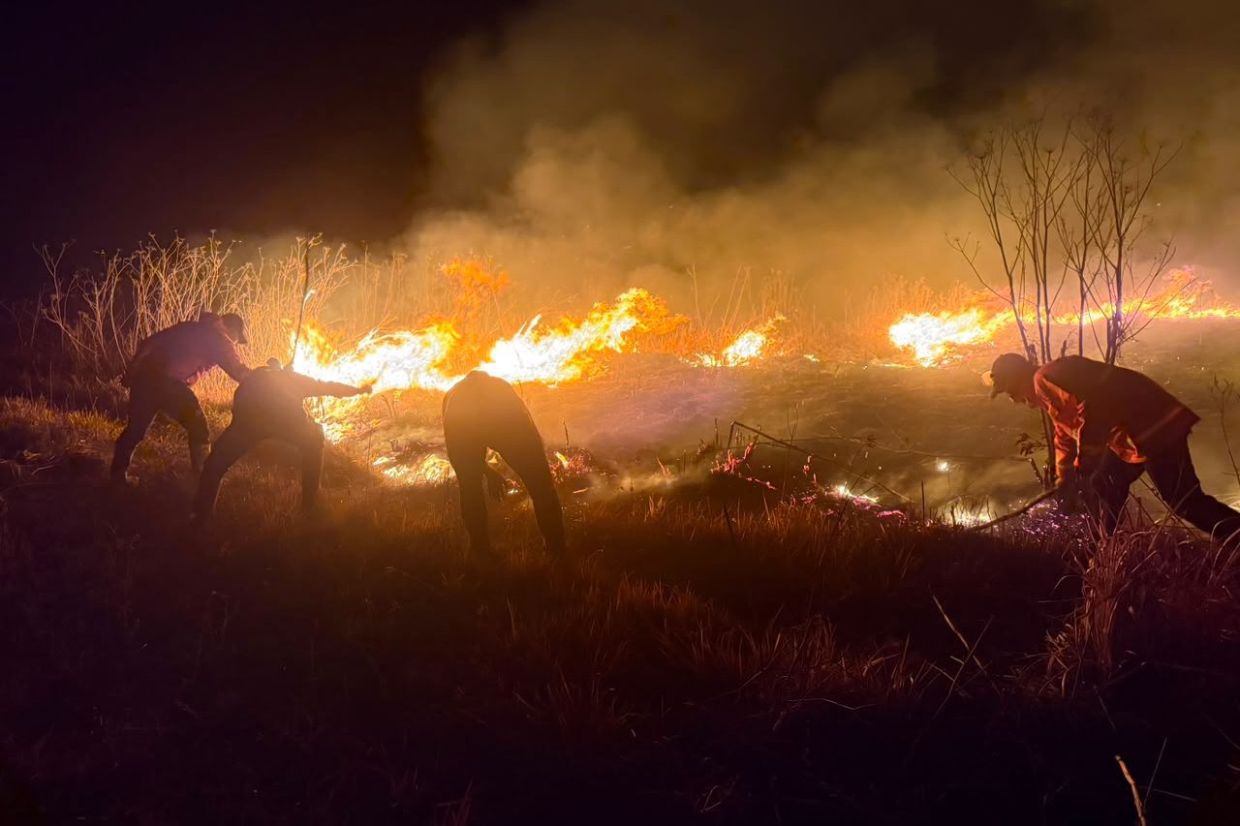
Indonesia's Mount Bromo is experiencing a rapidly deteriorating wildfire crisis, with flames consuming roughly 520 hectares across the slopes and savanna grasslands of East Java's iconic volcano. The Bromo Tengger Semeru National Park Authority announced the alarming expansion on Sunday, revealing that the situation has worsened considerably since the fire reignited with renewed intensity on Saturday evening. The blaze, which now threatens both the natural ecosystem and tourism infrastructure in one of the region's most visited destinations, represents a serious environmental and economic challenge for the provincial government.
Weather conditions have emerged as a critical factor accelerating the fire's spread beyond initial containment efforts. Strong winds that intensified from Saturday afternoon onwards have driven flames down the mountain's slopes and across the surrounding savanna with remarkable speed, overwhelming the ability of firefighters to establish firebreaks. Rudijanta Tjahja Nugraha, head of Bromo Tengger Semeru National Park Authority, attributed the rapid expansion directly to these atmospheric conditions, explaining that the combination of forceful gusts and the mountainous terrain created an ideal pathway for the fire to advance from elevated regions towards lower elevations. The directional nature of the winds has meant that flames have spread unpredictably, making strategic fire management exceptionally challenging for the response teams deployed to the area.
The vulnerability of the landscape itself has compounded the disaster, with vegetation across the park having reached critically dry conditions that make ignition and combustion far more likely. The savanna environment, characterized by dry grass and sparse vegetation typical of the dry season, provides an abundance of combustible material that feeds the flames with minimal resistance. Officials noted that the accumulated aridity created ideal burning conditions, effectively transforming the natural landscape into an enormous tinder box. This seasonal dryness is a recurring challenge in East Java during certain months, and the timing of the Mount Bromo fire demonstrates how environmental factors beyond human control can magnify the consequences of initial ignition sources.
The national park authorities took decisive action to protect public safety by implementing a comprehensive closure of Mount Bromo across all entry points beginning Saturday evening at 10pm. This blanket closure remains in effect indefinitely until fire suppression operations achieve successful containment and officials determine that conditions are safe for visitor access. The decision reflects the gravity of the situation and the unpredictable nature of wildfire behavior on mountainous terrain. For the tourism industry and visitors who had booked experiences at the volcano, the park has offered pragmatic alternatives including the option to reschedule visits at future dates or to receive full financial refunds, attempting to minimize economic damage to both tourism operators and travelers.
Investigations into the fire's origin have already produced preliminary findings suggesting human involvement in the initial ignition. The Bromo Tengger Semeru National Park Authority indicated on Friday that the evidence collected thus far points toward anthropogenic causes rather than natural phenomena such as lightning strikes or spontaneous combustion. However, the formal investigation into determining culpability and establishing specific circumstances remains under the jurisdiction of law enforcement authorities. This investigative division between environmental and law enforcement agencies reflects the Indonesian governance structure, where multiple agencies hold overlapping responsibilities in natural disaster response and environmental crime prosecution.
Forestry Minister Raja Juli Antoni issued stern warnings regarding potential penalties for those found responsible for forest and land burning. His public statement served both as a deterrent to future violations and as reassurance to the public that the government takes such incidents seriously. The threat of legal consequences underscores the national importance placed on forest conservation, particularly in protected areas such as national parks. However, enforcement challenges remain significant in Indonesia, where vast forest territories and limited monitoring capacity can make detecting and prosecuting perpetrators difficult, especially if fires originate in remote or less-accessible regions.
The Mount Bromo incident carries broader implications for Indonesia's environmental management during the dry season, a period when wildfire risk escalates dramatically across the archipelago. The vulnerability demonstrated at one of the nation's most prominent natural attractions raises questions about preparedness and resource allocation for fire management during high-risk months. East Java's experience with this uncontrolled fire provides lessons for other provinces managing similar ecosystems and tourism dependencies. The rapid expansion from initial outbreak to 520 hectares illustrates how quickly situations can deteriorate without adequate suppression resources and favorable weather conditions.
For Malaysian and Southeast Asian observers, the Mount Bromo crisis serves as a regional reminder of transnational environmental challenges. Large-scale wildfires in Indonesia have historically generated transboundary smoke and haze affecting neighboring nations including Malaysia and Singapore. While the current Mount Bromo fire remains localized to East Java, escalating wildfire frequency and severity across Indonesia increases the probability of future episodes producing regional air quality impacts. The economic costs associated with tourism disruption, firefighting operations, and potential environmental damage highlight the interconnected nature of the region's environmental challenges and shared interests in effective fire management.
The situation at Mount Bromo underscores the necessity for comprehensive approaches to wildfire prevention that address both human behavior and environmental preparedness. Beyond investigating current causes and pursuing legal accountability, authorities must implement long-term strategies including forest management practices, community education about fire dangers, and adequate funding for detection and suppression infrastructure. The closure of this major tourist destination, even temporarily, demonstrates the cascading consequences of environmental incidents on regional economies and demonstrates why prevention ultimately proves more cost-effective than response and recovery operations.

