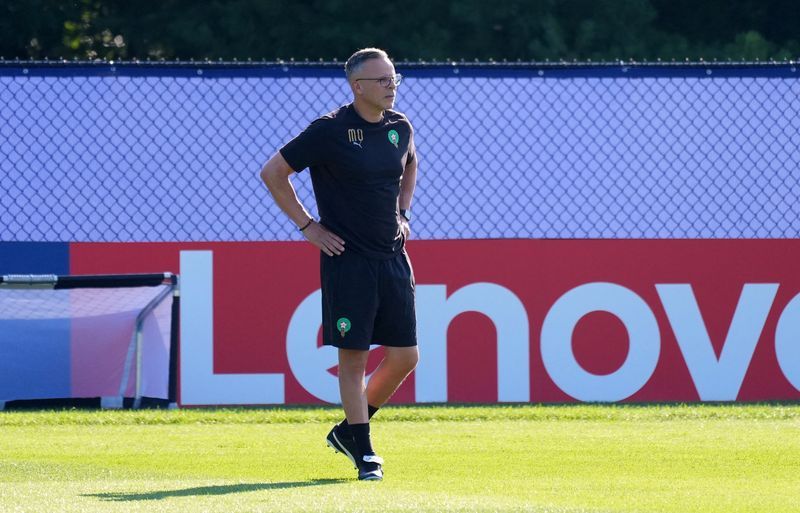
Morocco's coaching staff has made clear they will not indulge in self-congratulation over their impressive World Cup campaign so far, with technical director Mohamed Ouahbi declaring that any meaningful assessment of the team's performance must wait until the tournament's conclusion. Speaking at a press conference in Foxborough, Massachusetts, ahead of their quarter-final clash against France, Ouahbi projected a mindset focused entirely on the pursuit of the trophy rather than basking in the reflected glory of reaching this stage.
Thursday's encounter with the French represents a compelling narrative thread in international football, as the two nations will renew their rivalry just months after colliding in the semi-finals of the 2022 World Cup in Qatar. On that occasion, France proved to be the superior force, eliminating Morocco and halting what had been a historic campaign for the North African nation. However, the context has shifted considerably since that meeting. Morocco arrives this time not as an underdog defying expectations, but as a squad brimming with confidence and genuine aspirations to win the tournament outright.
Ouahbi's comments reflected a philosophical approach that rejects the notion of moral victories or the notion of competing merely to exceed baseline expectations. He articulated a vision wherein the team's only acceptable outcome is ultimate success on the global stage. The coach emphasized that accepting progress without pursuing the crown would constitute a fundamental misunderstanding of why his players have worked so diligently to reach this point. In his view, settling for a respectable exit would betray the ambition that has driven the squad's development throughout the competition and beyond.
The competitive landscape favors France, who hold the distinction of being both the defending world champions from 2018 and finalists in the previous tournament. Les Bleus dispatched Paraguay in their round-of-16 encounter with a measured, if uninspiring, performance that produced a solitary goal, a penalty conversion by talismanic forward Kylian Mbappé. The PSG star has emerged as one of the tournament's most prolific goal scorers, having struck seven times in the campaign. This output places him second on the golden boot standings, trailing only Argentina's Lionel Messi, who has notched eight goals.
France's attacking prowess extends well beyond Mbappé's individual contributions. The squad boasts several supporting forwards of exceptional quality, including Ousmane Dembélé, whose pace and technical ability pose constant threats to opposing defenses. Michael Olise and Bradley Barcola complete an offensive arsenal that numerous football analysts have characterized as among the most dangerous and well-stocked forward lines ever assembled at a World Cup. This depth provides France with tactical flexibility and the capacity to rotate fresh legs into attacking positions throughout a grueling tournament.
Morocco's path through the tournament has demonstrated impressive efficiency and tactical discipline. The team navigated their group phase without undue difficulty, establishing themselves as one of the stronger collective units in the competition's early stages. Subsequent knockout victories against the Netherlands and Canada, the tournament's co-hosts, substantiated claims that Morocco represented a serious threat to the traditional powerhouses. These victories erased any lingering perception of the North Africans as a one-tournament phenomenon, instead positioning them as developing heavyweights capable of sustained competition at the highest level.
Ouahbi moved to counter any suggestion that Morocco's squad lacks the individual quality to compete with France's array of attacking talent. Rather than engaging in a comparison of player assets, he framed the matchup as an encounter between two evolving teams whose relative strengths would be determined on the pitch through execution and intensity rather than on paper through statistical comparison. The coach insisted that his players would enter the contest without regrets, determined to leave nothing in reserve and commit themselves to performing at an extraordinary level of physical and mental engagement.
The tone of Ouahbi's remarks underscored a determined resistance to the narrative of contentment with progress. He explicitly rejected the notion that Morocco should approach the quarter-final with a mindset of treating any further advancement as a bonus or windfall gain. Such a framework would fundamentally limit the team's performance ceiling, he argued, as it psychologically permits players to settle for respectable outcomes rather than demanding absolute maximum effort toward victory. By contrast, the coach's philosophy positions the World Cup itself as the true bonus—the fruit of sustained excellence over time and the ultimate measure of success.
The psychological dimension of this contest extends beyond tactical preparation. Morocco must contend not only with France's superior pedigree and firepower but also with the weight of historical precedent from their recent semi-final encounter. Reversing that result would constitute a significant psychological breakthrough for a squad that has labored to establish itself as a permanent fixture among world football's elite. For French supporters and analysts, the match represents an opportunity to reassert dominance over a rising competitor and validate France's status as the tournament favorites.
Ouahbi's insistence on deferring celebration until the tournament concludes reflects the maturity and professional focus that has characterized Morocco's recent progression in international football. The team has moved beyond the stage where reaching a quarter-final merits extravagant praise or serves as a natural resting point for ambition. Instead, Morocco's leadership has established a cultural expectation wherein the squad will judge itself by the ultimate criterion: whether it lifts the trophy at the tournament's conclusion. This mentality, if sustained through the pressure of knockout football against elite opposition, could prove decisive in determining whether Morocco's World Cup campaign becomes a memorable semi-final run or an achievement that culminates in silverware.

