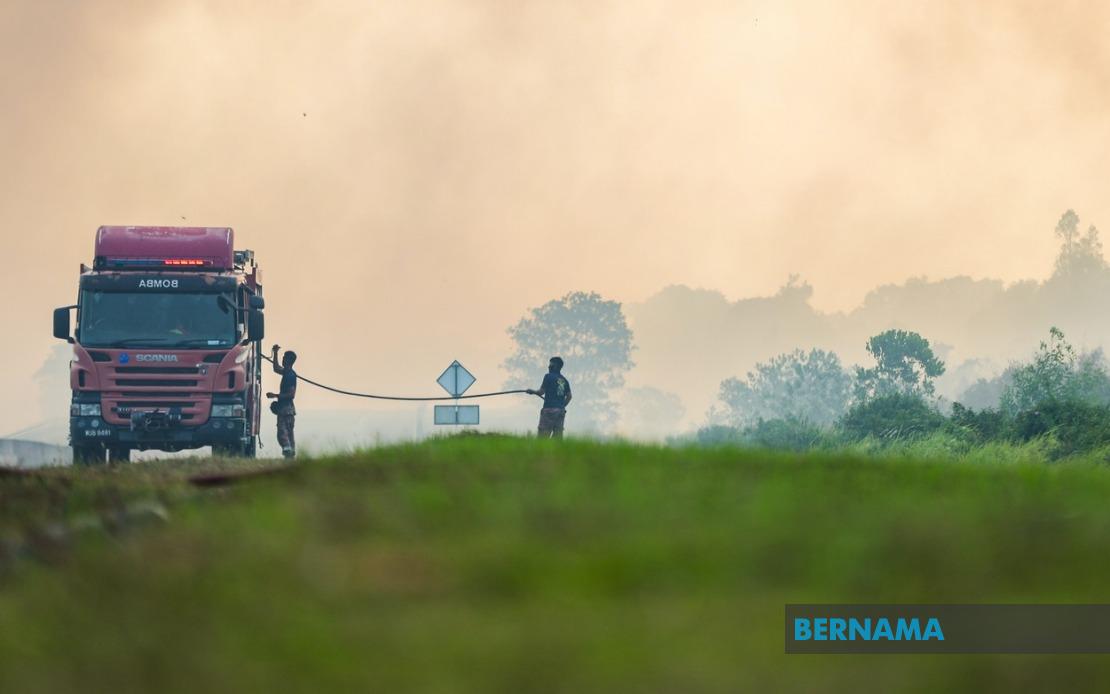
A significant peatland fire burning across more than 50 hectares in Pengerang near Kota Tinggi has seen substantial progress as authorities brought more than 29 hectares under control by late afternoon on August 26. The blaze, which ignited on Jalan Bypass Punggai-Sebana Cove on Monday, has mobilised a substantial emergency response involving personnel from multiple government and private agencies working in coordinated firefighting operations across two distinct sectors.
Fire Superintendent II Baharuddin Idris, commanding operations at Sungai Rengit Fire and Rescue Station, outlined the scope of the ongoing containment effort. The firefighting teams have maintained round-the-clock operations since the fire's outbreak, systematically working to extinguish active flames, establish firebreaks to prevent further spread, and monitor the affected terrain to prevent reignition. This sustained approach reflects the challenges posed by peatland fires, which can prove particularly difficult to fully suppress due to the combustible nature of peat and underground smouldering that may persist long after surface flames are controlled.
The affected area encompasses 51.4 hectares of peatland, with the battle split between two operational zones. Sector A presented the more demanding challenge, with more than 21 hectares still requiring active firefighting and firebreak work as operations continued. In contrast, Sector B had been brought to near-complete suppression, demonstrating the varying intensity across the fire's spread. The progress achieved by late afternoon represented substantial headway, though authorities recognised that the remaining work would demand continued vigilance and resources.
Aircraft support became a crucial addition to ground-based efforts when a plane took to the air at 2:30 pm following approval from the Air Operations Control Centre (PGOU). This aerial capability provides capabilities beyond what ground teams alone can deliver, particularly in accessing difficult terrain and applying water or fire-retardant agents across wider areas more efficiently than traditional ground-based methods. The integration of aviation resources demonstrates how modern fire suppression in Malaysia draws on diverse technological assets to combat large-scale incidents.
The personnel mobilised for this operation reflect the complexity of coordinating emergency response across multiple institutions. A total of 36 firefighters formed the core response team, supplemented by nine personnel from the Malaysian Civil Defence Force (APM), whose role extends beyond traditional firefighting to encompassing broader disaster management and emergency coordination. Additionally, 14 staff members from Ranhill SAJ brought specialist expertise, likely related to water management or environmental remediation given the company's involvement in utility services. The Department of Environment contributed two representatives, underscoring the environmental dimensions of controlling fires that release significant particulate matter and potentially hazardous emissions into the atmosphere.
The involvement of Pengerang Municipal Council with three personnel highlights how local government bodies play vital supporting roles in emergency response, providing coordination with residents, access to local infrastructure, and ground-level knowledge of the affected area's geography and vulnerabilities. This multi-agency approach, though complex to coordinate, ensures that firefighting operations benefit from specialised knowledge and resources that individual agencies could not independently provide.
Peatland fires in Malaysia carry particular significance given the country's extensive peat reserves, particularly in Peninsular Malaysia and Sabah. When peat ignites, it burns with characteristics that differ markedly from conventional vegetation fires—the fuel burns more slowly but generates intense heat and smoke, and subsurface burning can persist for weeks even after visible flames are suppressed. This slow-burn quality means that firefighting teams must remain vigilant long after declaring surface fires extinguished, as underground peat may continue smouldering beneath the surface.
The Johor incident occurs against a broader backdrop of Southeast Asian peatland fire management. The region has experienced severe peatland fire episodes historically, most notably in 1997-1998 and 2015, when extensive peat fires across Indonesia, Malaysia, and Singapore blanketed the region with transboundary haze affecting air quality across multiple nations. Incidents like the Punggai-Sebana Cove fire, though smaller in scale, require robust response systems to prevent escalation to the scale of those historical events.
From a Malaysian perspective, the effectiveness of the response to this Johor fire demonstrates the capacity of local emergency services and coordinating agencies to mobilise substantial resources and deploy modern firefighting techniques. The 24-hour operations tempo reflects commitment to minimising the fire's environmental and air quality impacts, particularly important given that Pengerang lies in Johor's industrial corridor with nearby residential and commercial development. Uncontrolled peatland fires would pose air quality risks extending beyond the immediate fire zone, potentially affecting breathing conditions across the wider Johor region and neighbouring areas.
The incident also underscores ongoing challenges in peatland fire prevention and management across Southeast Asia. While firefighting response capability has improved substantially in recent decades, the most cost-effective and environmentally preferable approach involves preventing peatland fires through better land management, drainage control, and enforcement of regulations governing peatland use. Peatlands in their natural state remain waterlogged and fire-resistant; degradation of these water tables through agricultural development, forestry operations, and other land uses creates conditions where fires can ignite and spread readily.
As operations continued into subsequent days, the focus shifted toward ensuring complete extinguishment of Sector A's remaining hotspots while maintaining vigilance across Sector B to prevent any flare-ups. The integration of air support with sustained ground operations positioned authorities to achieve full containment while minimising environmental damage and protecting air quality for residents across the region.

