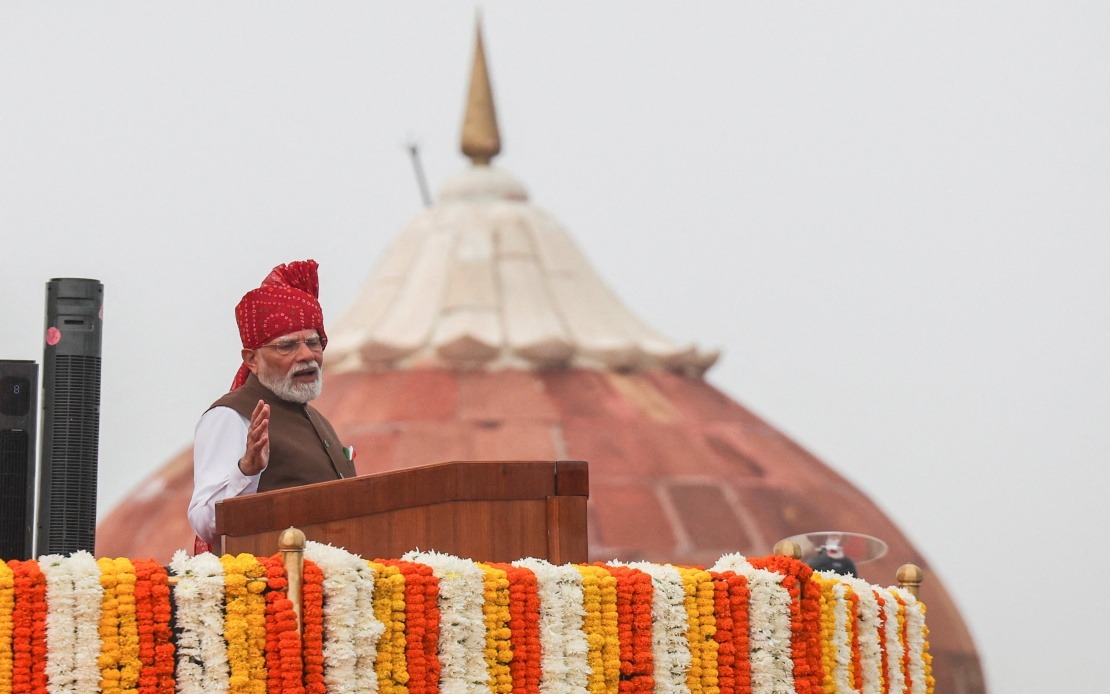
Indian Prime Minister Narendra Modi delivered a sweeping vision for national transformation on Independence Day, casting self-reliance across critical industries as the foundation for India to become a developed economy by 2047. Speaking from the Red Fort in Delhi on Saturday, Modi articulated a comprehensive strategy that extends beyond traditional manufacturing into cutting-edge technology sectors, reflecting New Delhi's determination to reduce dependence on foreign supply chains and build indigenous capabilities.
The semiconductor industry emerged as a cornerstone of Modi's self-sufficiency agenda. India has already commissioned three semiconductor fabrication plants, with expectations that another five to eight facilities will become operational within the next seven to eight years. This expansion represents a significant strategic pivot for India, which has historically relied heavily on imported chips. The semiconductor push carries particular resonance for Southeast Asian nations, as regional supply chain dynamics could shift substantially if India succeeds in establishing itself as a viable alternative semiconductor hub to existing players in Taiwan, South Korea, and the Philippines.
Energy security constitutes another pillar of India's self-reliance programme, with Modi emphasizing nuclear power as essential infrastructure for meeting future demand. The government has set an ambitious target of achieving 100 gigawatts of nuclear generating capacity by 2047, requiring the commissioning of five new reactors within the current decade. More significantly, Modi highlighted India's recent achievement in mastering fast-breeder nuclear technology, a development he characterized as critical progress toward fuel self-sufficiency. This technological breakthrough could reshape India's energy independence calculations and reduce vulnerabilities to international uranium market fluctuations.
Renewable energy showcases measurable progress toward the broader self-reliance objective. Solar capacity has expanded dramatically from just 2 gigawatts twelve years ago to 160 gigawatts currently, demonstrating sustained momentum in the clean energy transition. This trajectory positions India as a renewable energy leader within Asia and signals serious commitment to decoupling from fossil fuel imports, particularly crude oil. Such developments carry implications for regional energy markets and geopolitical positioning, as nations reducing energy import dependency gain greater strategic autonomy.
Oil and gas exploration represents a newer frontier in Modi's self-reliance framework. India has allocated 850 billion rupees, approximately US$8.9 billion, toward exploring offshore petroleum reserves in areas previously classified as economically unviable or inaccessible. This substantial investment reflects confidence that technological advances now make previously marginal deposits commercially feasible. Success in this endeavour would materially reduce India's substantial oil import bill and provide greater insulation from global energy price shocks that frequently impact developing economies throughout the region.
Defence manufacturing constitutes perhaps the most strategically significant component of Modi's vision. The Prime Minister specifically highlighted the importance of developing domestic capabilities in advanced military technologies, particularly drones, counter-drone systems, and hypersonic defence technologies. This emphasis on military self-sufficiency reflects India's regional security concerns and its desire to reduce dependence on Russian, American, and Israeli defence imports. For Southeast Asian nations managing their own defence modernization requirements, India's development of indigenous military capabilities could eventually create alternative procurement options and reduce reliance on traditional Western suppliers.
The ideological dimension of Modi's self-reliance campaign emphasizes consumer choice and national identity alongside pure economic calculation. He explicitly encouraged Indian citizens to purchase domestically manufactured products, framing consumption decisions as expressions of patriotism and capability-building. The Prime Minister acknowledged that foreign products might occasionally be cheaper or more readily available, but argued such convenience comes at the cost of forgoing opportunities to test and strengthen indigenous capabilities. This messaging attempts to reshape consumer behaviour patterns and build domestic industries through nationalist sentiment.
Modi's comprehensive approach reflects a deliberate strategy to reduce vulnerability to external supply disruptions, as India experienced during pandemic-related logistical breakdowns. By developing integrated self-sufficiency across semiconductors, energy, defence, and critical resources, India aims to insulate itself from geopolitical pressures or embargo threats. The 2047 timeline aligns symbolically with India's centennial independence commemoration, transforming economic planning into a nation-building narrative that resonates across domestic constituencies.
For Malaysia and other Southeast Asian economies, India's self-reliance trajectory carries mixed implications. On one hand, successful Indian development of semiconductor, renewable energy, and defence capabilities could create alternative supply sources and reduce regional dependence on established powers. On the other hand, India's inward focus and emphasis on domestic procurement may reduce opportunities for regional trade and investment partnerships. Malaysian companies operating in technology and energy sectors should monitor Indian capacity-building initiatives closely, as competitive dynamics in these industries will shift substantially if Modi's ambitions are realized.
The 2047 vision also reflects India's broader positioning as a counterweight to Chinese economic dominance in Asia. By building self-sufficiency across strategic sectors rather than integrating deeply into Chinese-dominated supply chains, India attempts to preserve autonomous decision-making and reduce economic coercion vulnerabilities. This approach echoes similar strategies adopted by other Asian democracies seeking to balance economic interdependence with strategic autonomy in an increasingly multipolar regional environment.
Implementing such an expansive self-reliance agenda presents formidable execution challenges. Building world-class semiconductor capabilities, scaling nuclear capacity, and developing advanced military technologies simultaneously requires sustained capital investment, technical expertise, and industrial coordination across multiple years. India's historical track record on mega-projects shows variable outcomes, suggesting realistic timelines may extend beyond initial projections. Nonetheless, the strategic intent and resource allocation demonstrate New Delhi's seriousness in reducing external dependencies across critical sectors.
Modernizing India's economic structure toward greater self-reliance represents a fundamental reorientation of development strategy. Rather than seeking integration into global supply chains on terms dictated by established powers, Modi positions India as building comprehensive domestic capabilities across multiple technology frontiers simultaneously. If successful, this approach could establish India as a genuine alternative centre of technological and industrial power within Asia, fundamentally altering regional economic hierarchies and strategic relationships.

