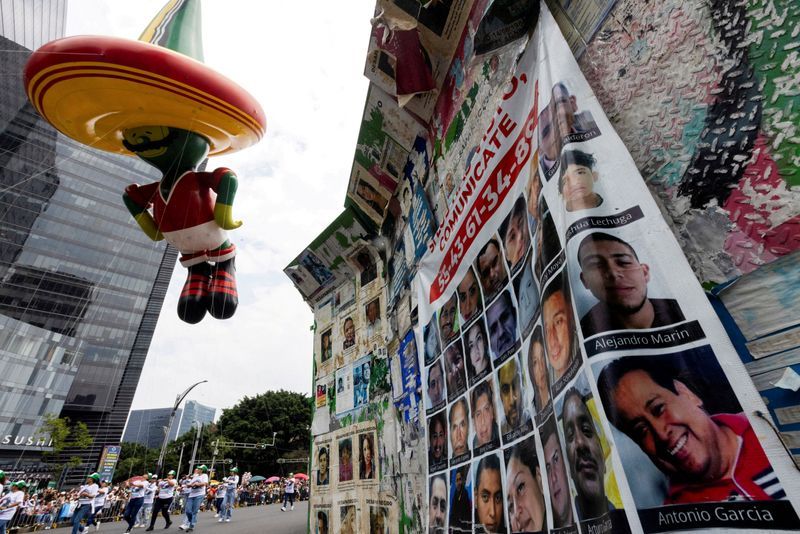
Mexico City's main boulevard has transformed into a festival ground ahead of the country's last-16 World Cup encounter with England, yet the celebratory billboards share space with posters bearing the faces of more than 135,000 missing people—a grim reminder of crises that refuse to fade even as national attention focuses on the football pitch. The scale of disappearances has ballooned dramatically since 2006, when then-President Felipe Calderon initiated an aggressive military campaign against the country's powerful drug cartels, an intervention that destabilized much of Mexico and scattered countless families searching for lost relatives.
The sporting tournament, which Mexico co-hosts alongside the United States and Canada, offers a brief respite from the anxieties that normally dominate public discourse. The national team's undefeated group-stage performance, capped by a knockout victory over Ecuador that marked Mexico's first success in such a competition since the 1980s, has generated genuine patriotic momentum. Yet this sporting accomplishment exists in uncomfortable proximity to the routine sight of Paseo de Reforma being cordoned off—sometimes for celebrations, but just as often for organized protests against government policies and living conditions.
Podcaster and journalist Carlos Mendoza articulated the psychological tension many Mexicans experience: the World Cup provides what he describes as a "national dopamine rush" that permits society to defer reckoning with systemic failures, including persistent accusations that members of the ruling Morena party have collaborated with organized crime syndicates. This convenient distraction, however temporary, dissolves once the tournament concludes and citizens return to confronting the structural problems that the football spectacle merely obscures. The phenomenon raises uncomfortable questions about how national governments leverage major sporting events to manage public attention during periods of crisis.
Economic pressures compound the psychological discomfort. Although inflation moderated somewhat in early June, Mexico's core inflation rate persists above the Bank of Mexico's target of 3%, eroding household purchasing power and deepening anxieties among working families. The World Cup itself has become an inadvertent symbol of economic inequality: ticket prices for matches have soared into the thousands of dollars, effectively barring ordinary Mexican supporters from attending games featuring their national team. Mendoza argues this represents "one of the biggest offences of this tournament," transforming what was once a matter of securing advance booking into a question of financial capacity that excludes poorer citizens from shared cultural experiences.
The celebration of Mexico's knockout victory was darkened by the death of four people during festivities around Reforma, a tragic reminder that collective enthusiasm can overwhelm individual safety. Across the city and surrounding the iconic Azteca Stadium, anti-World Cup graffiti continues to mark walls, testaments to organized opposition that emerged during the tournament's opening days. Members of the CNTE teachers' union established protest encampments in central Mexico City, blocking entire streets to demand that the government honour its campaign commitment to repeal a 2007 pension reform law and provide salary increases for public-sector educators. These competing claims on public space and political attention reveal a society attempting to simultaneously celebrate and resist.
The government's narrative emphasizes stability and progress. President Claudia Sheinbaum's approval rating has recovered to 69% according to polling by El Financiero, reversing a slide that began in March. Officials have publicly identified the location of missing persons as a national priority, though families and human rights advocates remain skeptical about concrete progress. The administration attempts to project competence while managing multiple crises, leveraging the World Cup's positive publicity to maintain political standing.
Local politician Rodrigo Cordera captured the complex emotional terrain many citizens navigate on social media, noting that supporting the football team and simultaneously worrying about national governance are not mutually exclusive positions. "You can get excited about 90 minutes of football," he reflected. "You can worry about the country, get angry at FIFA, and detest the politics and organisation of the Mexico City government. Life isn't black and white." This acknowledgment that citizens hold multiple, sometimes contradictory emotional truths simultaneously reflects a more sophisticated understanding of how people actually process national events than conventional political messaging typically permits.
Resident Alejandra Gonzalez offered perhaps the most penetrating observation about the World Cup's genuine function in Mexican public life. Rather than resolving underlying tensions, the tournament simply relocates them temporarily down the priority hierarchy, she suggested, permitting government and industry to delay consequential decisions while the population remains distracted by sporting outcomes. Gonzalez emphasized that while collective optimism holds value, such moments must be accompanied by critical examination of systemic failures and inequality—a balance requiring active citizenship rather than passive consumption of nationalist symbolism.
The coming weeks will test whether Mexico can advance deeper into the tournament while sustaining focus on domestic accountability. The football competition provides a genuine moment of shared pride and collective identity for a nation fractured by violence and inequality. Yet the challenge facing Mexican society extends beyond the final whistle: harnessing whatever positive momentum emerges from sporting success to address the missing, support struggling households, and hold political leadership accountable to substantive reform. The World Cup offers neither solution nor distraction, but rather a compressed timeframe in which citizens and leaders must decide whether patriotic sentiment can be transformed into pressure for meaningful change.

