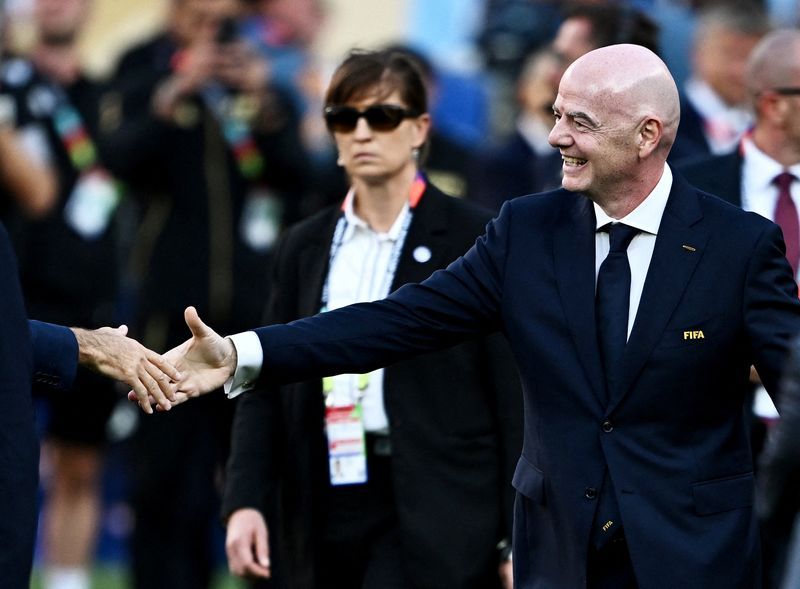
FIFA President Gianni Infantino's grip on power remains contested despite backing from two of world football's heavyweights, Mexico and Argentina, following international uproar over his now-shelved attempt to monetise portions of the World Cup's commercial future. The competing declarations of support and opposition from continental confederations reveal a fractured global football administration grappling with fundamental questions about institutional governance and presidential authority.
Mexico's football federation broke ranks with its own regional body, CONCACAF, by publicly endorsing Infantino's continued leadership. This divergence is significant because it demonstrates how the commercial rights controversy has created unusual political fissures within established regional structures. The Mexican Football Federation issued a statement declaring it would not recognise any process to remove Infantino that bypassed a full vote of all 211 FIFA member associations, effectively framing the dispute as one of procedural legitimacy rather than substantive policy disagreement.
Argentina's football association followed with its own letter of support, acknowledging that while errors occurred in how the commercial rights proposal was communicated and processed, the appropriate path forward lay in maintaining institutional continuity under Infantino's direction. The AFA's carefully worded statement recognised the proposal had generated substantial uncertainty yet stopped short of condemning the FIFA president himself. This nuanced stance suggests that even nations backing Infantino recognise significant governance failures occurred, though they prioritise procedural regularity over demanding leadership change.
The continental confederations have become the battleground for competing visions of FIFA's future. Africa's confederation, CAF, threw its unified weight behind Infantino on Thursday, while South America's CONMEBOL similarly rejected any removal process that circumvented democratic procedures. These positions align with Infantino's argument that challenges to his authority must follow established constitutional channels. However, Europe's UEFA and Asia's confederation have maintained their opposition, with UEFA explicitly committing to boycott FIFA competitions unless governance standards improve.
For Southeast Asian readers, these developments carry particular importance. The AFC's alignment with UEFA and CONCACAF signals that Asian football bodies view this governance crisis as threatening the sport's institutional integrity across multiple regions. Malaysia, as an AFC member, is indirectly positioned within this coalition concerned about FIFA's executive overreach. The rejection of Infantino's commercial rights proposal—which would have shifted significant revenue control toward the presidency—represents a broader pushback against executive power accumulation in international sports governance.
Infantino's proposed monetisation scheme, which would have allowed FIFA to sell portions of the World Cup's commercial rights portfolio, crossed a fundamental line for many football administrators. The proposal was not merely a technical adjustment but an unprecedented transfer of control over a competition's financial future from member associations to the executive office. FIFPRO, the global players' union, characterised the initiative as a profound abuse of presidential power, adding the voices of professional footballers to the growing chorus of criticism.
The timing of this crisis threatens to overshadow Infantino's expected reelection bid at the FIFA Congress scheduled for Morocco in March. Two months prior to this controversy, his fourth-term reelection appeared virtually assured. However, the bungled commercial rights proposal and subsequent handling of criticism have created political space for potential challengers, even if none have yet formally emerged. The absence of a clear opposition candidate does not diminish the reputational damage Infantino has sustained.
Croatia's withdrawal of support provides telling context for how individual associations are responding to the governance failures. The Croatian Football Federation explicitly cited recent developments surrounding the World Cup 2026 and internal governing body discussions as reasons for reconsidering its position. This suggests that beyond the immediate commercial rights controversy, several national federations harbour deeper concerns about FIFA's administrative direction and decision-making processes under Infantino's tenure.
FIFA's apology to member associations, delivered following a Rabat meeting, represents a partial acknowledgment of institutional failure. The organisation committed to reviewing processes that generated the crisis, though it maintained that actions complied with existing FIFA regulations. This distinction—between procedural compliance and substantive governance standards—captures the core tension animating the dispute. Critics argue that FIFA's regulations themselves may have become insufficiently protective of member association interests and democratic participation.
For Malaysia and other Southeast Asian nations, this controversy illuminates how concentrated executive power in international sports bodies can operate without adequate checks and balances. The AFC's stance alongside UEFA and CONCACAF suggests a emerging consensus that FIFA's governance architecture requires substantive reform, not merely procedural clarification. These regional confederations appear determined to ensure that any future FIFA initiatives affecting World Cup commercial structures receive transparent member consultation and approval.
The split among South American confederations deserves closer examination. While CONMEBOL rejected any unconstitutional removal process, its statement emphasised concerns about repeated unilateral presidential actions lacking proper dialogue. Argentina's letter of continued support therefore represents endorsement of institutional procedure rather than unconditional backing for Infantino's leadership style. This distinction matters because it suggests even supporter nations want visible changes in executive governance practices.
Infantino's survival through this crisis appears likely given procedural protections, but the political costs have mounted considerably. The convergence of opposition from UEFA, AFC, and CONCACAF—representing Europe, Asia, and North America—indicates that geographic centres of football power have serious reservations about his direction. For Malaysian football stakeholders and Southeast Asian observers, this governance dispute underscores the importance of regional confederations vigorously protecting member interests within international sports structures where executive authority continues to expand without proportional institutional restraints.

