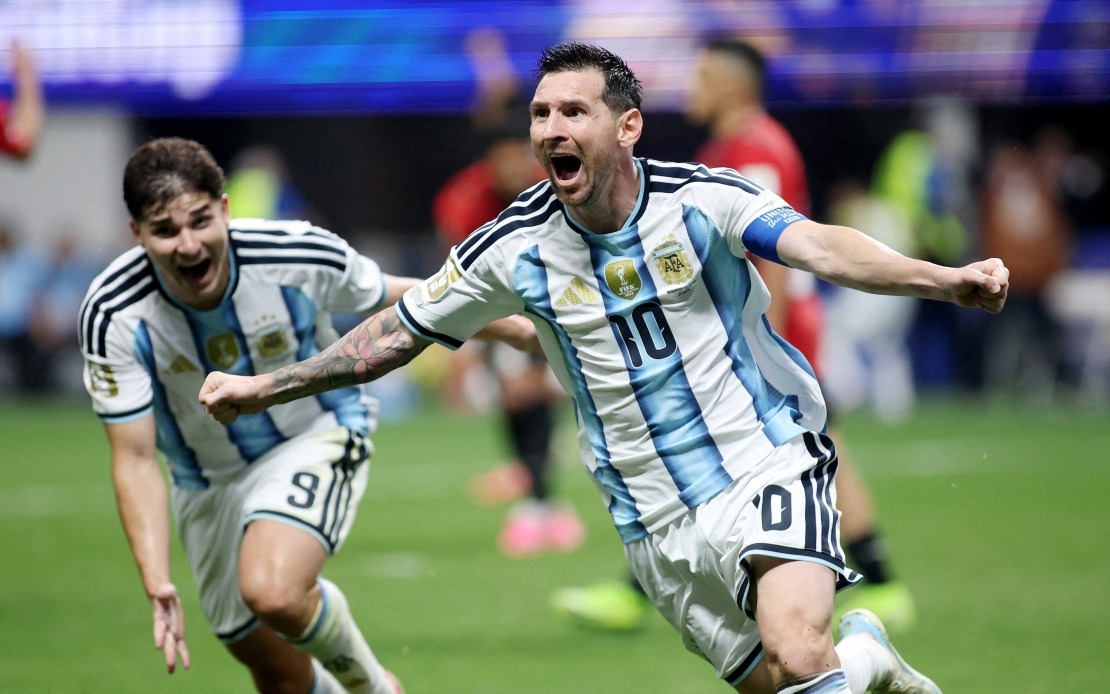
Lionel Messi steps into another defining moment of his World Cup journey as Argentina prepares to face England in Atlanta on Wednesday, a reminder that the 39-year-old Argentine remains one of global football's most magnetic forces. The stakes are particularly high for the Inter Miami forward, who enters this fixture level with France's Kylian Mbappé on eight goals—a position that places him at the sharp end of this summer's tournament's scoring race and within reach of several records that have long evaded his grasp.
Messi's resurgence comes nearly two years after he orchestrated Argentina's triumph in Qatar, where his seven-goal haul and two-goal final performance against France secured a maiden World Cup title for his nation. That 2022 campaign carried an air of finality to it, with the Argentine squad seemingly galvanised by a collective desire to gift their ageing talisman a world championship before he departed the international stage. Yet here he stands in North America, defying expectations of a graceful exit and once again demonstrating the competitive hunger that has defined his career across six World Cup appearances—a historic feat he now shares only with Cristiano Ronaldo.
The pursuit of the Golden Boot represents unfinished business for Messi. In Qatar, Mbappé snatched the honour with a tournament-leading six goals, capped by a hat-trick in the final despite his side's defeat, leaving Messi with one of football's rarer absences from his honours list. This time, both forwards have surged ahead of the field, with England's Harry Kane and rising star Jude Bellingham trailing on six goals each. Germany's Erling Haaland, another serious contender at the tournament's outset, has been eliminated from contention, narrowing the competition to Europe's elite talents.
Beyond the immediate tournament scoreline, Messi and Mbappé have redefined World Cup history itself. The pair's combined onslaught has obliterated Miroslav Klose's longstanding benchmark of 16 goals, with Messi now owning 21 career World Cup goals—a tally that appears certain to be surpassed by Mbappé before the tournament concludes. Kane too has climbed the historical register with impressive speed, now possessing 14 World Cup goals. For all Messi's accomplishments, the unspoken narrative is one of legacy passing: younger competitors are not merely matching his achievements but threatening to relegate his career statistics to secondary status.
The twin milestone achieved by Messi and Ronaldo—becoming the first men to participate in six World Cup tournaments—stands as a testament to their sustained excellence across two decades of international football. Messi has now accrued 32 World Cup appearances, preparing to extend that to 33 against England, a margin that places him six appearances ahead of his Portuguese rival. This longevity alone sets both players apart from the broader football pantheon, yet the difference in their tournament trajectories offers instructive contrasts. Messi's debut in 2006 yielded merely a single goal, while 2010 saw him unable to register at all.
The turning point arrived with the 2014 tournament in Brazil, where Messi scored four goals—a performance that proved prophetic of his later dominance. A solitary strike followed in 2018, yet his 2022 campaign represented a statistical rewriting of his World Cup narrative. At 35 years old, he scored more goals in that single tournament than he had accumulated across his previous four World Cup campaigns combined—a fact that underscores both his durability and his capacity for explosive performances when motivation peaks. The 2022 tally benefited substantially from four penalty conversions, though this strength has become vulnerable in the current competition.
Penalty conversion presents a curious chink in Messi's World Cup armour. While he has succeeded in all three of his World Cup penalty shootouts—against the Netherlands in 2014 and 2022, and France in the 2022 final—his general spot-kick record tells a less flattering story. In this tournament alone, he sent a penalty wide against Austria during the group stage and had another saved by Egypt's Mostafa Shobeir in the round-of-16 encounter. Across World Cup history, he has converted only four of eight penalties, excluding shootout scenarios. This imperfection, while minor in the broader context of his brilliance, nonetheless represents a measurable vulnerability that opponents may seek to exploit in high-pressure knockout scenarios.
Messi's two previous Golden Ball awards—honouring the tournament's best player—position him among football's elite performers, yet this summer has added two monumental records to his already overflowing collection. His 33rd World Cup appearance will draw him further clear of Ronaldo's participation tally, extending a lead that appears likely to remain unmatched given the physical demands of international football at the highest level. The psychological weight of chasing records while simultaneously leading a title challenge creates a unique pressure that few athletes have navigated at an advanced career stage.
The contest against England on Wednesday carries dimensions beyond a simple quarterfinal clash. For Messi, it represents an opportunity to advance his quest for a second World Cup crown whilst simultaneously positioning himself to win the tournament's individual scoring accolade—a redemptive arc that would complete a career narrative few would have predicted when he began his World Cup journey nearly two decades ago. England, meanwhile, presents a formidable obstacle featuring Kane's clinical finishing and Bellingham's emerging brilliance, making victory anything but assured despite Argentina's demonstrable superiority in recent tournament play.
The broader context of this matchup speaks to football's evolving landscape. Messi's continued excellence at 39 challenges contemporary assumptions about athletic decline and the feasibility of sustained performance at the sport's highest level. His eight goals represent not merely statistical achievement but a statement of competitive relevance in a tournament increasingly dominated by younger, physically dominant performers. Whether he can convert this momentum into a second world title, and whether he can claim the Golden Boot that remains absent from his résumé, will largely define how football remembers this unexpected final chapter of his World Cup story.

