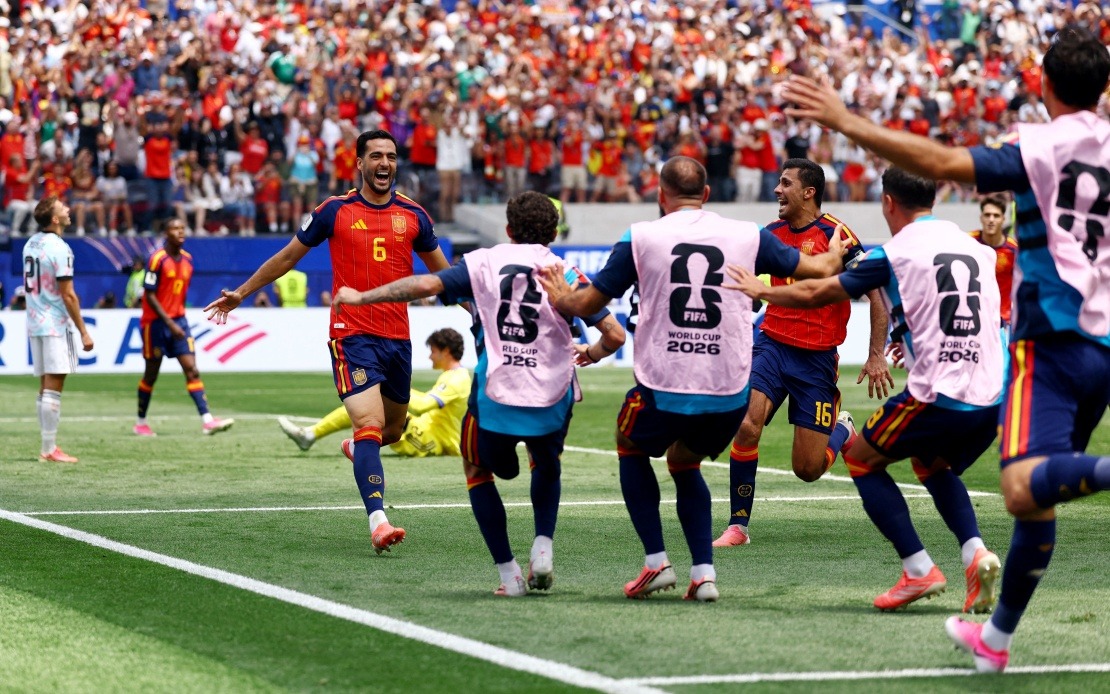
Spain has secured a place in the World Cup semi-final after dispatching a depleted Belgium side 2-1 in Inglewood, California, setting up a tantalizing encounter with France near Dallas on Tuesday. The European champions demonstrated their quality despite facing an opponent severely weakened by injuries, with substitute Mikel Merino delivering the crucial strike in the 88th minute to seal the victory. The performance reinforces Spain's credentials as genuine contenders for a second world title, having previously won the competition in 2010.
Fabián Ruiz gave Spain the advantage midway through the first half with a goal in the 30th minute, establishing the foundation for what would prove a commanding display. The opening goal came as Spain controlled possession and dictated the rhythm of play throughout the opening period, creating a platform from which their attack could flourish. This early breakthrough placed immediate pressure on Belgium and forced them into a reactive posture for much of the contest. Ruiz's contribution reflected Spain's midfield dominance, a hallmark of their tournament performance that continues to distinguish them from other contenders.
Belgium's hopes of mounting a comeback were handed a lifeline when Charles De Ketelaere found the equalizer, drawing the match level and momentarily suggesting an upset might be possible. This goal was particularly notable for the circumstances surrounding it, as it represented the first time Spain's goalkeeper Unai Simón had conceded in a remarkable 649 World Cup minutes accumulated across two tournaments. The streak, which had defined Spain's defensive solidity throughout their campaign, was broken at a critical juncture. Despite the equalizer, Spain's superiority never truly wavered, and they maintained sufficient control to ensure they would not be denied advancement.
The turning point came when substitute Mikel Merino capitalized on a crucial error from Belgium's replacement goalkeeper Senne Lammens in the 88th minute. Merino, who had also scored the decisive goal in Spain's round-of-16 victory over Portugal, demonstrated composure and clinical finishing to convert into the roof of the net. His role as an impact substitute has become increasingly important to Spain's cause throughout the tournament, providing fresh legs and attacking impetus when opposition defenses tire. The Arsenal midfielder's ability to influence matches from the bench has provided Spain's coach with valuable tactical flexibility and has transformed him into a tournament revelation.
Belgium's campaign was undermined by a cascade of injuries that proved insurmountable. Captain Youri Tielemans was forced to withdraw during warm-up preparations due to what appeared to be a hamstring injury, depriving Belgium of crucial midfield experience and leadership. This setback compounded the absence of Amadou Onana, whose knee ligament tear had already compromised Belgium's ability to control the center of the pitch. These losses meant Belgium entered the match without two key pillars of their midfield architecture, making it nearly impossible to match Spain's technical superiority and territorial dominance.
The situation deteriorated further when Thibaut Courtois, Belgium's primary goalkeeper, suffered an injury in the 71st minute that forced him to leave the field in visible distress. The deployment of Manchester United's Senne Lammens as replacement marked the beginning of Belgium's final act of desperation. Although Lammens performed admirably given the circumstances, his inexperience at this stage of tournament football proved costly when he spilled a long-range attempt from Pau Cubarsi that Merino converted with ruthless efficiency. This moment crystallized Belgium's afternoon of misfortune and effectively decided the contest.
Spain's upcoming semi-final meeting with France represents a fascinating clash of continental chess masters. The fixture will be a rematch of the Euro 2024 semi-final, which La Roja won decisively, establishing psychological dominance heading into this encounter. France, despite being favorites entering the tournament as two-time world champions and runners-up to Argentina four years ago, will face their most formidable opponent to date. The French have navigated their pathway to the semi-finals relatively smoothly, but they understand that Spain represents a qualitatively different proposition, a team that has demonstrated exceptional technical ability and strategic discipline throughout their World Cup campaign.
The competitive history between these nations adds another layer to the narrative. France's World Cup pedigree is undeniable, having won the tournament in 1998 and 2018, establishing themselves as one of football's elite powers. However, Spain's dominance in recent European competitions and their performance in this World Cup suggests they possess the tactical sophistication and individual talent to trouble even the most experienced opponents. The semi-final will likely be decided by fine margins and moments of individual brilliance rather than any fundamental imbalance between the teams.
For Malaysian and Southeast Asian readers, this match represents a significant moment in world football's calendar. Spain's progression demonstrates the enduring quality of their football philosophy, one that emphasizes possession, technical excellence, and positional play. This approach has influenced football globally and remains relevant despite evolving tactical trends. The upcoming semi-final between Spain and France will showcase two different interpretations of elite football, with Spain favoring control and France capable of devastating transitions and individual heroics. The winner will advance to face either Argentina or Germany in the final, setting the stage for what promises to be a compelling climax to the tournament.

