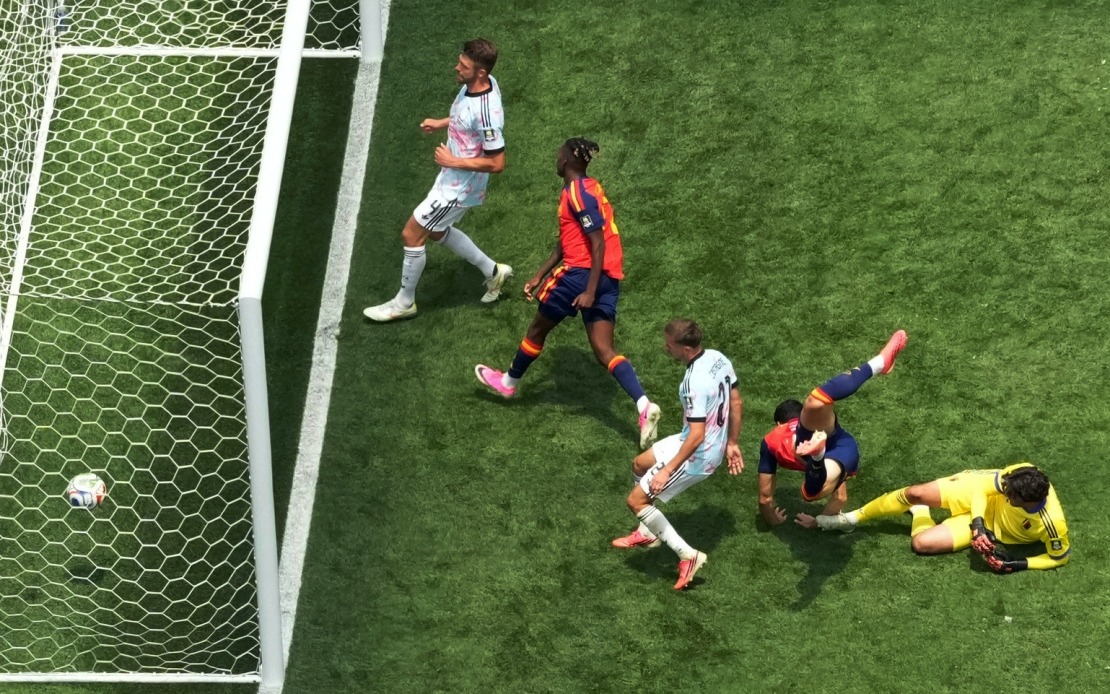
Mikel Merino has become Spain's unlikely hero at the FIFA World Cup 2026, striking again from the bench to propel La Roja into the semi-finals with a 2-1 victory over Belgium at Los Angeles Stadium on Friday. The midfielder's dramatic 88th-minute finish sends the two-time champions through to the last four for the first time in 16 years, continuing a remarkable pattern of crucial substitution appearances that has defined Spain's tournament run.
Merino's impact from the bench follows an identical script to his match-winning performance against Portugal in the round-of-16, where he emerged as a change-maker when Luis de la Fuente's tactical adjustments needed precision execution. This consistency in delivering under pressure reveals an often-overlooked dimension of modern football strategy: the value of a well-timed substitute with composure and positioning. For Malaysian fans following the tournament, Merino's ability to capitalise on goalkeeper errors and deflected play demonstrates how tournament football rewards teams with tactical flexibility and depth in their squad.
Spain dominated large stretches of the opening period, controlling possession and creating dangerous opportunities. The breakthrough arrived in the 30th minute when midfielder Fabian Ruiz capitalised on a rebound, converting after Belgian goalkeeper Thibaut Courtois produced an outstanding save to deny winger Dani Olmo's attempt. The 34-year-old Courtois, still operating at an elite level despite his age, continued to frustrate Spain's attacking intent minutes later, diving low to his right to keep out an 18-year-old wonderkid Lamine Yamal's free-kick that appeared destined for the bottom corner.
Belgium, under French coach Rudi Garcia, weathered the Spanish onslaught and stunned La Roja with an equaliser in the 41st minute. Full back Timothy Castagne whipped a precise cross from the right flank, and forward Charles De Ketelaere powered a downward header past goalkeeper Unai Simon, marking the first goal Spain had conceded throughout the entire tournament. The leveller fundamentally shifted the tactical balance, forcing both teams into a more competitive midfield battle where individual moments of quality would ultimately prove decisive.
The second half saw Belgium emerge with renewed intent, nearly taking the lead just ten minutes after the restart when full-back Maxim De Cuyper's effort struck the side netting. Courtois continued his masterclass, producing back-to-back saves within 60 seconds to deny both Yamal and forward Mikel Oyarzabal, showcasing the goalkeeper's experience and reading of the game. However, an apparent leg injury forced Courtois's substitution in the 71st minute, with Manchester United goalkeeper Senne Lammens entering the field as his replacement—a change that would prove decisive in the tournament's trajectory.
Lammens's inexperience in this competition became apparent immediately. When centre-back Pau Cubarsi unleashed a long-range effort in the 88th minute, the goalkeeper spilled the ball directly in front of goal. Merino, positioned perfectly as a replacement striker, reacted with the speed and instinct of a natural poacher, firing home the loose ball to send Spain through to the semi-finals. The moment encapsulated both Belgium's misfortune and Spain's ruthlessness in converting half-chances into tournament progression.
Spain will now face France in Dallas Stadium on July 15 in a blockbuster semi-final meeting. France secured their own last-four berth by dispatching Morocco 2-0 on Thursday, setting up a contest between two of international football's most successful nations. For Southeast Asian observers, this matchup represents a clash between differing football philosophies—Spain's possession-based, technical approach against France's athleticism and experience in knockout tournament football.
The FIFA World Cup 2026 represents a watershed moment for global football, expanding to 48 teams across three co-hosting nations: Canada, Mexico, and the United States. This represents the largest tournament structure since the competition's inception in Uruguay in 1930, fundamentally altering qualification pathways and group dynamics. The expanded format has already produced compelling knockout stage drama, with Spain's progression exemplifying how even traditionally strong nations must navigate a more competitive and unpredictable tournament structure.
The tournament, which commenced on June 11, continues through July 19, with the remaining fixtures determining which nations will contest the final. Spain's semi-final appearance vindicated their possession-dominant football philosophy and squad depth, particularly their strategic use of substitutes. Merino's two decisive goals demonstrate how modern tournament football increasingly rewards teams capable of maintaining intensity and clinical finishing regardless of when players enter the match, a tactical evolution that resonates across all levels of professional competition.

