Tens of thousands of Malaysians from diverse backgrounds assembled at Dataran Putrajaya on August 31 to commemorate the nation's 69th year of independence, transforming the federal administrative capital into a vibrant showcase of national pride and communal celebration. The convergence of families, young professionals, and elderly citizens along the parade route demonstrated the enduring resonance of the independence narrative across Malaysia's multicultural fabric, with participants waving the Jalur Gemilang and embracing the year's commemorative theme of "Malaysia MADANI: Kesejahteraan Dinikmati"—a vision centred on shared prosperity and inclusive well-being.
Putrajaya's selection as the venue reinforced its symbolic importance as Malaysia's administrative heartland, a distinction the city has earned through repeated hosting of the national-level celebrations. The pattern of previous deployments—in 2003, 2005, 2018, 2019, 2023, 2024, and 2025—underscores how Putrajaya has become the established setting for orchestrating the nation's premier patriotic gathering, offering the logistical infrastructure and ceremonial gravitas befitting such landmark observances.
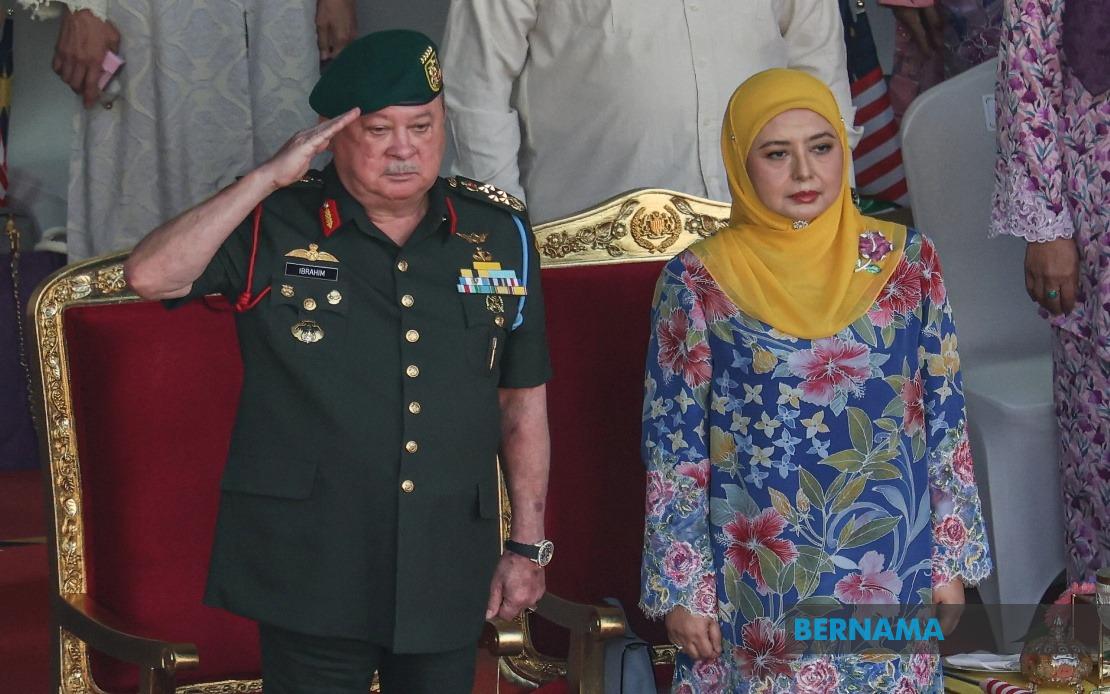
The morning's ceremonial unfolded with deliberate pageantry designed to underscore the hierarchies and traditions of Malaysian state governance. Prime Minister Datuk Seri Anwar Ibrahim and his spouse, Datuk Seri Dr Wan Azizah Wan Ismail, arrived at the royal stage at 7.53 am, their reception marked by the instrumental strains of "Hormat Perdana." This opening act served as prelude to the principal moment—the arrival of Their Majesties Sultan Ibrahim and Raja Zarith Sofiah at 8 am, an event marked by the thunderous passage of five military helicopters trailing the national flag across Putrajaya's skyline whilst "Negaraku" and "Hormat Diraja" resonated through amplified speakers.
The ceremonial apparatus assembled for the occasion reflected the gravity with which the government treats this annual affirmation of national identity. Deputy Prime Minister Datuk Seri Dr Ahmad Zahid Hamidi shared the platform with cabinet-level figures, notably Communications Minister Datuk Seri Fahmi Fadzil, whose portfolio extends to chairing the main committee coordinating both the National Day and Malaysia Day festivities. The diplomatic corps and foreign representatives in attendance signalled that these celebrations serve simultaneously as international messaging about Malaysia's stability and cohesion.
The formal proceedings commenced with the national anthem, followed by the raising of the Jalur Gemilang accompanied by a fourteen-gun salute—each percussion report corresponding to one of Malaysia's fourteen constituent states, a symbolic affirmation of federalism embedded within military protocol. The 41st Battery of the Royal Artillery Regiment, commanded by Major Hafizan Mat Ghani, executed this ceremonial obligation with precision, embedding constitutional geography within auditory spectacle.
A particularly resonant moment emerged through the collective recitation of the Rukun Negara, Malaysia's five founding principles, led by Datuk Abdul Razak Muda of the Malaysian Fire and Rescue Department. Significantly, sixty-nine members of the JBPM—the department's 'Red Heroes'—participated alongside a sign language interpreter, Nur Alyanatasha, ensuring that the nation's foundational values reached audiences regardless of hearing ability. This inclusive approach to state ceremony reflects evolving understandings of how national rituals might extend their resonance beyond traditional frameworks.
The crescendo arrived with the seven-fold proclamation of "Merdeka" that followed the Rukun Negara recitation, a moment designed to activate collective emotion and assert the permanence of independence from British colonial rule. The visual accompaniment—tens of thousands of Malaysians simultaneously elevating miniature flags—created an undeniable tableau of unified national sentiment, transforming individual patriotic expression into a choreographed mass phenomenon.
For Malaysian viewers and the regional audience, these celebrations carry particular significance in an era marked by questions about social cohesion, political polarisation, and economic inequality. The Malaysia MADANI thematic framework, emphasising shared prosperity rather than partisan division, suggests official efforts to reposition National Day beyond ceremonial repetition toward substantive engagement with contemporary concerns. Whether such aspirations translate into tangible policy outcomes or remain rhetorical exercises remains a question for ongoing scrutiny.
The choice to emphasise inclusive participation—through diverse representation, accessibility measures, and multi-generational attendance—implicitly acknowledges anxieties about national unity that periodically surface in Malaysian public discourse. By orchestrating these celebrations with visible attention to representation and accessibility, the government signals awareness that the social compact undergirding the nation requires continuous renewal and affirmation rather than passive acceptance. The spectacle at Putrajaya thus functions simultaneously as historical commemoration and contemporary political statement, anchoring national identity in ceremony whilst navigating the complexities of twenty-first century Malaysian society.

