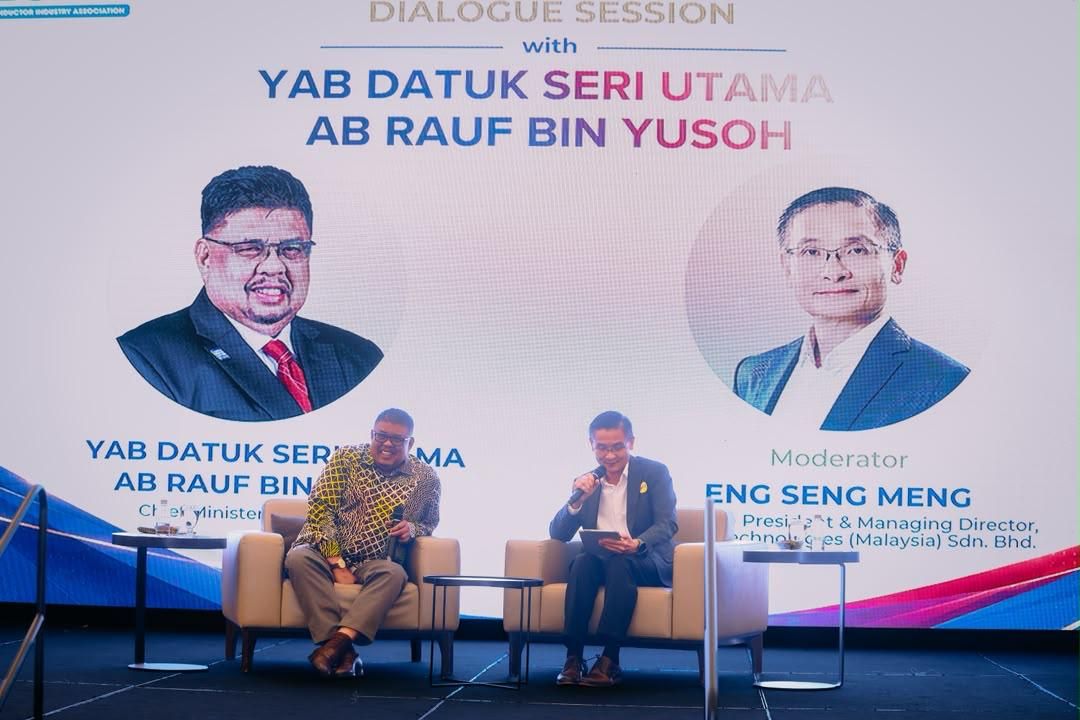
Melaka's semiconductor industry has matured into a RM17.6 billion economic engine, driven by decades of sustained investment and industrial development that traces its origins to a pivotal decision by an international manufacturer in the early 1970s. This remarkable transformation, according to Chief Minister Datuk Seri Ab Rauf Yusoh, exemplifies how strategic positioning and consistent policy support can nurture a world-class manufacturing sector from modest beginnings. Speaking during an industry dialogue at a Melaka hotel on Thursday, July 16, Ab Rauf reflected on how the sector evolved from a handful of workers at an Umno building on Jalan Hang Tuah into a global technology hub that now anchors the state's economic future.
The semiconductor sector's foundation was laid when an international company took the entrepreneurial gamble to establish operations in Melaka, initially working from unconventional premises before relocating to Batu Berendam following the creation of Melaka's first Free Industrial Zone in 1976. This early investment proved transformative, attracting subsequent multinational corporations and establishing Melaka's reputation as a serious contender in global semiconductor manufacturing. The initial workforce, though small, demonstrated the technical capabilities and work ethic that would characterise the sector's development over five subsequent decades. What began as an experiment in industrial relocation thus blossomed into a comprehensive ecosystem supporting not just manufacturers but an intricate network of suppliers, service providers and ancillary businesses.
Today, Melaka's manufacturing sector contributes 36.1 percent to the state's gross domestic product, with more than 400 companies operating across 18 industrial sectors. The semiconductor and electrical and electronics subsector remains the jewel in this crown, leveraging over 50 years of accumulated expertise and institutional knowledge. The ripple effects of this concentration extend far beyond factory floors—thousands of families depend on direct and indirect employment within the semiconductor ecosystem, while local suppliers and small and medium enterprises have built sustainable businesses servicing multinational operations. This economic diversification within the manufacturing space provides resilience, as different sectors can compensate when cyclical downturns affect particular segments of the industry.
Ab Rauf attributed the state's sustained competitive advantage to three interconnected factors that continue to draw global investors. Melaka's geographical positioning between Kuala Lumpur, Johor and Singapore offers unparalleled logistical convenience, with direct access to major seaports, airports, suppliers and a consolidated talent pool spanning three major economic zones. Operating costs remain competitive relative to rival locations, while the state maintains over 2,600 hectares of industrial land available for future expansion, providing manufacturers with the spatial flexibility necessary for growth. This combination of location economics and land availability proves critical in an industry where facility expansion often determines whether companies remain competitive or relocate production.
The state's emergence as a Technical and Vocational Education and Training hub strengthens its human capital proposition. Across 61 institutions, Melaka now produces industry-ready graduates through programmes increasingly calibrated to semiconductor manufacturers' evolving technical requirements. This alignment between educational output and industry demand creates a virtuous cycle—manufacturers remain confident that they can source skilled workers locally, reducing recruitment uncertainty and enabling long-term workforce planning. The emphasis on vocational pathways also democratises access to well-remunerated employment, particularly for students who might not pursue university education but who possess aptitude for technical work.
International manufacturers from the United States, Germany, China, Japan and beyond have demonstrated sustained confidence in Melaka through continuous operations and repeated expansion. This durability reflects the stability, regulatory predictability and business-friendly environment that accumulated institutional experience has enabled state authorities to provide. A concrete manifestation of this confidence emerged in 2025, when Melaka attracted RM14.68 billion in investments across 312 projects—the highest investment value in 22 years. This exceptional performance underscores that despite global manufacturing uncertainties, Melaka remains attractive to capital-intensive sectors seeking reliable operating environments.
However, Ab Rauf articulated a sobering reality confronting the state: the semiconductor industry stands at an inflection point where decisions taken today will reverberate through global technology supply chains for the next 10 to 20 years. Companies evaluating expansion locations must assess whether jurisdictions can deliver faster permitting timelines, robust capabilities and predictable regulatory frameworks. Melaka risks losing not merely new manufacturing investments but also the expansion projects and auxiliary industries that generate high-value employment if it fails to maintain competitive dynamism. The Chief Minister's warning extends beyond immediate competitiveness—local SMEs integrated into semiconductor supply chains face potential exclusion if Melaka's manufacturing ecosystem stalls or loses investor confidence to rival locations in Vietnam, Thailand or Indonesia.
To navigate this critical juncture, Melaka has articulated the Semiconductor Strategy 2035, a long-term policy framework targeting higher-value manufacturing investments while strengthening indigenous industrial capabilities. The strategy recognises that merely preserving existing operations proves insufficient; the state must actively position itself as the preferred location for next-generation semiconductor production and related advanced manufacturing. This forward-looking approach acknowledges that technological trajectories—from advanced packaging to semiconductor design capabilities—continuously reshape which locations attract premium investments and create highest-value employment.
Beyond infrastructure provisions and financial incentives, the state government has committed to operational partnership with investors, expediting regulatory approvals and troubleshooting implementation challenges that could otherwise impose friction costs on manufacturing operations. This administrative responsiveness transforms theoretical advantages into practical benefits, allowing investors to move from planning to production with minimal bureaucratic delay. The comprehensive value proposition—combining strategic connectivity, cost competitiveness, skilled labour availability, proven industrial ecosystems and supportive governance—positions Melaka to sustain its semiconductor sector leadership, provided state authorities maintain the policy agility and investor-centric approach that have characterised its five decades of industrial development.

