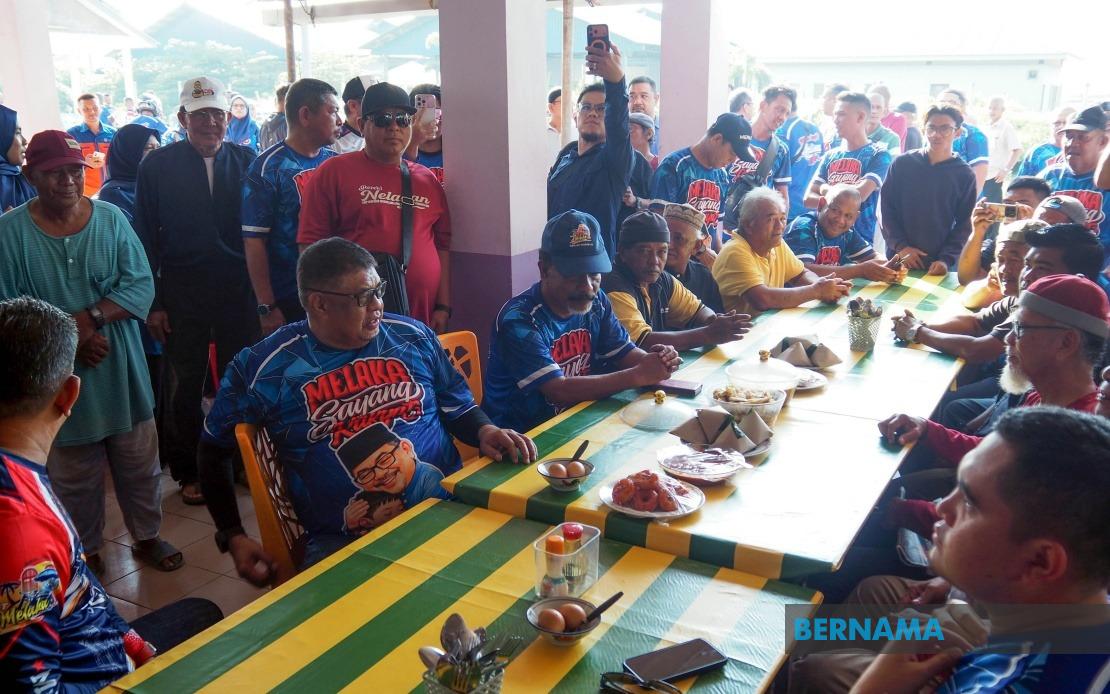
Melaka is stepping up direct engagement with its fishing communities through a combination of social safety nets and technological upgrades designed to modernise one of the state's traditional economic sectors. Chief Minister Datuk Seri Ab Rauf Yusoh unveiled the package during the fifth instalment of his grassroots outreach programme, the 'Jelajah Ketua Menteri Sayang Rakyat' tour, held at Kuala Sempang Jetty in Jasin. The two-pronged initiative pairs mandatory Social Security Organisation (PERKESO) enrolment for all registered fishermen with the provision of fish finder equipment, marking a strategic shift toward blending social protection with productive capacity.
The Chief Minister emphasised that these decisions emerged directly from on-the-ground consultations rather than bureaucratic decree, framing the initiative as evidence of a governing style rooted in accessibility. Speaking at the event, he articulated a philosophy of active engagement, contrasting his administration's approach with conventional office-bound governance. The announcement reflects broader policy aims to address vulnerabilities within a sector where workers face occupational hazards and income instability. By coupling welfare provisions with productivity enhancements, Melaka's approach attempts to tackle both immediate security concerns and longer-term earning potential for fishing households.
The material support distributed during the visit demonstrated immediate relief measures alongside longer-term capacity building. One hundred and seven registered fishermen each received RM200 under the 'Bantuan Jaring Nelayan' scheme, totalling RM21,400 in direct cash assistance. Simultaneously, three hundred and sixty kilogrammes of fish—valued at RM3,600—were distributed to members of the public, with each recipient obtaining approximately 1.5 kilogrammes. These concurrent distributions served both to support fishing livelihoods through cash transfers and to increase fish supply accessibility among ordinary households, addressing food security dimensions of the initiative.
The introduction of fish finder technology represents a significant modernisation intervention within Malaysia's traditional fishing sector, where knowledge transmission and experiential learning have historically dominated operational practices. Fish finders utilise sonar technology to identify underwater fish populations, enabling fishermen to locate concentrations with precision that would otherwise require decades of accumulated experience to match. The devices typically retail between RM1,000 and RM2,000 when purchased individually, placing them beyond routine capital expenditure for smallholder fishing operations. By removing this financial barrier, Melaka's provision democratises access to productivity-enhancing technology across the fishing community, potentially narrowing gaps between better-resourced and marginal operators.
Amirul Shah Fuad Shah, a thirty-five-year-old fisherman from Kuala Merlimau with over two decades in the profession, articulated how fish finders would transform operational efficiency and decision-making. He explained that conventional fishing relied predominantly on experiential knowledge—understanding seasonal patterns, reading water conditions, and interpreting environmental cues accumulated through years of practice. Fish finders compress this knowledge into real-time data, allowing even relatively inexperienced operators to identify productive fishing grounds rapidly. The technology promises to reduce fishing time, lower fuel consumption relative to catch volumes, and enable more strategic deployment of nets and equipment. For ageing fishermen like those represented in the community associations, the technology potentially extends productive working life by reducing physical exertion and improving targeting accuracy.
The PERKESO coverage component addresses occupational security gaps that have long characterised Malaysia's fishing sector. Unlike workers in formalised employment, self-employed fishermen typically lack structured social insurance against workplace injury, illness, or premature death. Fishing remains one of the nation's higher-risk occupations, with workers exposed to drowning hazards, equipment-related injuries, and harsh weather conditions. PERKESO enrollment provides contributory coverage for temporary and permanent disability, as well as death benefits for dependants. For ageing fishing communities where many workers have limited alternative income sources and few accumulated retirement savings, this coverage represents meaningful economic protection during vulnerable life stages.
Md Khalil Md Jadi, chairman of the Kampung Sempang Fishermen's Association at sixty-seven years old, situated the initiative within broader recognition of fishing communities' contributions and vulnerabilities. He emphasised that many association members are elderly individuals whose entire livelihoods depend on maritime work, with few alternative economic pathways available at advanced ages. The combination of PERKESO coverage and fish finder provision signals state acknowledgement of these realities. The technology component specifically reflects understanding that traditional fishing, while culturally significant and economically important, requires modernisation to remain viable in contemporary markets where operational costs and competitive pressures have intensified. By supporting technological adoption, the state signals commitment to preserving the sector rather than allowing it to gradually contract.
The modernisation element embedded in fish finder distribution carries implications for broader Malaysian economic policy toward traditional sectors. Rather than treating traditional fishing as a declining activity destined for obsolescence, Melaka's approach frames technological integration as a path toward sector vitality. This contrasts with alternative policies that might emphasise economic diversification away from fishing or subsidy-based income support without productivity enhancements. The initiative suggests that deliberate technology transfer, when paired with supportive infrastructure and social protection, can enable traditional sectors to compete in contemporary contexts. This model has relevance beyond fishing—to smallholder agriculture, traditional crafts, and other heritage-based economic activities where Malaysian communities maintain comparative advantages but face modernisation challenges.
The political dimensions of the announcement warrant consideration within Melaka's broader governance context. The 'Jelajah Ketua Menteri Sayang Rakyat' programme appears designed to demonstrate direct responsiveness to grassroots concerns, building political capital through visible engagement and tangible support. The timing and framing emphasise the Chief Minister's personal involvement in problem-solving, positioning him as accessible to ordinary citizens. This grassroots engagement strategy, particularly when combined with material benefit distribution, strengthens local political constituencies and demonstrates active governance. The fishing communities are relatively concentrated populations whose concerns can generate visible policy responses, making them strategically significant for political communication and constituency management.
Financial sustainability questions underpin the longer-term viability of these initiatives. While immediate outlays for PERKESO enrollment and fish finder distribution are specified, ongoing funding mechanisms for PERKESO contributions and technology maintenance or replacement require clarity. The state budget must absorb either direct subsidy costs or establish revenue sources through fishing-related levies or state enterprise contributions. For fish finders specifically, operational sustainability depends on ensuring device maintenance, repair facilities, and technical training availability across fishing communities. Without supporting infrastructure, expensive equipment can become non-functional liabilities rather than productive assets.
The implications for Southeast Asian fisheries policy extend beyond Melaka's borders. Regional fishing communities across Thailand, Indonesia, Philippines, and Vietnam face similar vulnerabilities regarding occupational protection and technological adoption. Malaysia's approach—combining targeted social security, technology provisioning, and direct political engagement—presents a model that other regional governments might consider or adapt. As Southeast Asian nations grapple with climate change impacts on fish stocks, international fishing regulations, and pressure to professionalise artisanal fishing sectors, integrated approaches addressing both welfare and productivity become increasingly relevant to regional economic development discussions.
The fishing community's reception of these initiatives signals appreciation for both the tangible benefits and the implicit recognition embedded in state action. When established leaders like Md Khalil express gratitude not merely for assistance but for being heard and valued, they indicate that community engagement processes themselves carry significance beyond material outcomes. For fishing communities historically marginalised in development policy discussions, direct Chief Ministerial engagement and rapid policy response represent changes in political attention that reinforce economic support. This combination of material benefit and recognition may generate political loyalty and community buy-in for additional initiatives, creating momentum for sector-level transformation.
Looking forward, Melaka's fishing sector faces challenges that these initial interventions address partially but not comprehensively. Climate variability, marine resource depletion, competing international fishing pressures, and generational transitions within fishing families create headwinds that technology and social protection can mitigate but not eliminate. However, by establishing that fishing communities merit state investment and that traditional sectors can absorb productive modernisation, Melaka establishes foundation conditions for more ambitious longer-term sector development. Future initiatives might extend technology provision to processing and marketing, develop skills training for value-added production, or establish market linkages that improve fishermen's access to higher-value distribution channels. The current announcement thus represents not a final solution but an opening chapter in potential sector transformation.

